


Using Wastewater Surveillance to Monitor Gastrointestinal Pathogen Infections in the State of Oklahoma
- PMID: 37764037
- PMCID: PMC10536226
- DOI: 10.3390/microorganisms11092193
Using Wastewater Surveillance to Monitor Gastrointestinal Pathogen Infections in the State of Oklahoma
Abstract
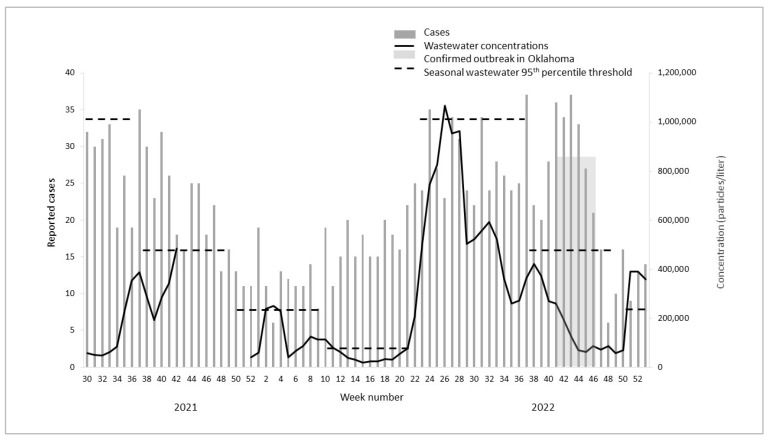
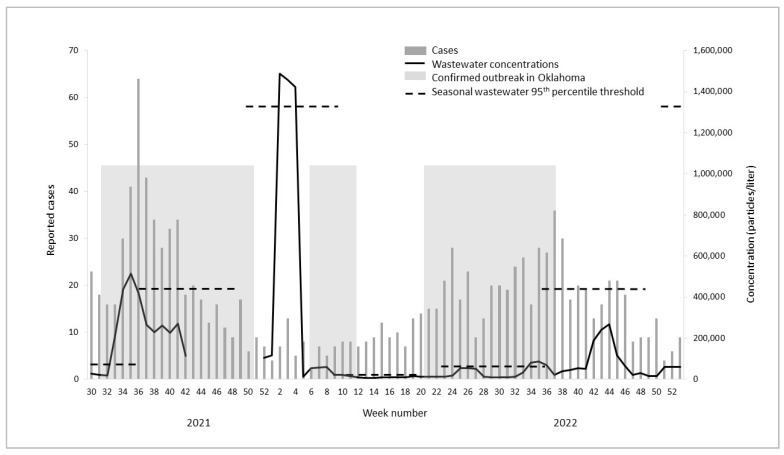
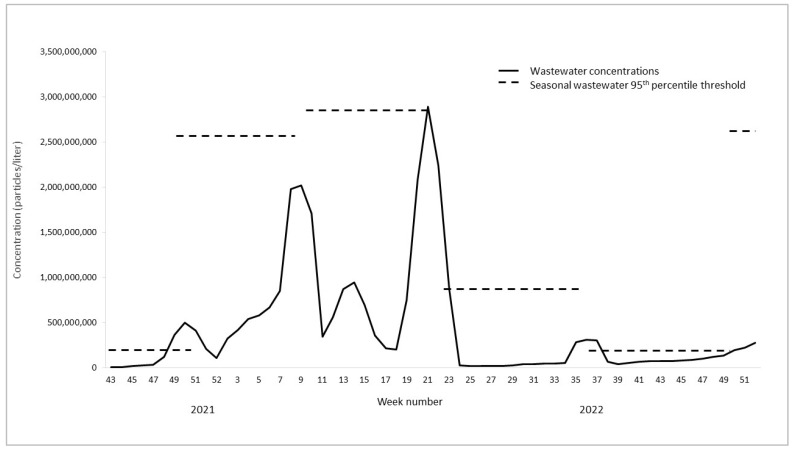
During the COVID-19 pandemic, wastewater surveillance was widely used to monitor temporal and geographical infection trends. Using this as a foundation, a statewide program for routine wastewater monitoring of gastrointestinal pathogens was established in Oklahoma. The results from 18 months of surveillance showed that wastewater concentrations of Salmonella, Campylobacter, and norovirus exhibit similar seasonal patterns to those observed in reported human cases (F = 4-29, p < 0.05) and that wastewater can serve as an early warning tool for increases in cases, offering between one- and two-weeks lead time. Approximately one third of outbreak alerts in wastewater correlated in time with confirmed outbreaks of Salmonella or Campylobacter and our results further indicated that several outbreaks are likely to go undetected through the traditional surveillance approach currently in place. Better understanding of the true distribution and burden of gastrointestinal infections ultimately facilitates better disease prevention and control and reduces the overall socioeconomic and healthcare related impact of these pathogens. In this respect, wastewater represents a unique opportunity for monitoring infections in real-time, without the need for individual human testing. With increasing demands for sustainable and low-cost disease surveillance, the usefulness of wastewater as a long-term method for tracking infectious disease transmission is likely to become even more pronounced.
Keywords: foodborne infections; gastrointestinal pathogens; monitoring; outbreaks; seasonality; surveillance; wastewater surveillance.
Conflict of interest statement
The authors declare that we have no conflict of interest.
Figures
References
-
- Gibbons C.L., Mangen M.-J.J., Plass D., Havelaar A.H., Brooke R.J., Kramarz P., Peterson K.L., Stuurman A.L., Cassini A., Fèvre E.M., et al. Measuring Underreporting and Under-Ascertainment in Infectious Disease Datasets: A Comparison of Methods. BMC Public Health. 2014;14:147. doi: 10.1186/1471-2458-14-147. - DOI - PMC - PubMed
-
- Haagsma J.A., Geenen P.L., Ethelberg S., Fetsch A., Hansdotter F., Jansen A., Korsgaard H., O’Brien S.J., Scavia G., Spitznagel H., et al. Community Incidence of Pathogen-Specific Gastroenteritis: Reconstructing the Surveillance Pyramid for Seven Pathogens in Seven European Union Member States. Epidemiol. Infect. 2013;141:1625–1639. doi: 10.1017/S0950268812002166. - DOI - PMC - PubMed
-
- McClary-Gutierrez J.S., Mattioli M.C., Marcenac P., Silverman A.I., Boehm A.B., Bibby K., Balliet M., de los Reyes F.L., Gerrity D., Griffith J.F., et al. SARS-CoV-2 Wastewater Surveillance for Public Health Action. Emerg. Infect. Dis. 2021;27:e210753. doi: 10.3201/eid2709.210753. - DOI - PMC - PubMed
-
- Kuhn K.G., Jarshaw J., Jeffries E., Adesigbin K., Maytubby P., Dundas N., Miller A.C., Rhodes E., Stevenson B., Vogel J., et al. Predicting COVID-19 Cases in Diverse Population Groups Using SARS-CoV-2 Wastewater Monitoring across Oklahoma City. Sci. Total Environ. 2022;812:151431. doi: 10.1016/j.scitotenv.2021.151431. - DOI - PMC - PubMed
Grants and funding
LinkOut - more resources
Full Text Sources
