Review
. 2023 Sep 8;16(9):1272.
doi: 10.3390/ph16091272.

Pharmacological Therapy in Inflammatory Bowel Diseases: A Narrative Review of the Past 90 Years

Affiliations
Review

Pharmacological Therapy in Inflammatory Bowel Diseases: A Narrative Review of the Past 90 Years

Marcello Imbrizi et al. Pharmaceuticals (Basel). .

Abstract

Inflammatory Bowel Diseases had their first peak in incidence in countries in North America, Europe, and Oceania and are currently experiencing a new acceleration in incidence, especially in Latin America and Asia. Despite technological advances, 90 years after the development of the first molecule for the treatment of IBD, we still do not have drugs that promote disease remission in a generalized way. We carried out a narrative review on therapeutic advances in the treatment of IBD, the mechanisms of action, and the challenges facing the therapeutic goals in the treatment of IBD. Salicylates are still used in the treatment of Ulcerative Colitis. Corticosteroids have an indication restricted to the period of therapeutic induction due to frequent adverse events, while technologies with less systemic action have been developed. Most immunomodulators showed a late onset of action, requiring a differentiated initial strategy to control the disease. New therapeutic perspectives emerged with biological therapy, initially with anti-TNF, followed by anti-integrins and anti-interleukins. Despite the different mechanisms of action, there are similarities between the general rates of effectiveness. These similar results were also evidenced in JAK inhibitors and S1p modulators, the last therapeutic classes approved for the treatment of IBD.

Keywords: 5-ASA; Crohn’s disease; JAK; biological therapy; corticosteroid; immunomodulator; s1P; ulcerative colitis.


Conflict of interest statement

MI reports personal fees from AbbVie, Ferring, Nestle, Janssen, Takeda and Pfizer. F Magro severd as speaker for: Abbvie, Arena, Biogen, Bristol-Myers Squibb, Falk, Ferring, Hospira, Janssen, Laboratórios Vitoria, Pfizer, Lilly, Merck Sharp & Dohme, Sandoz, Takeda, UCB, Vifor.

Figures
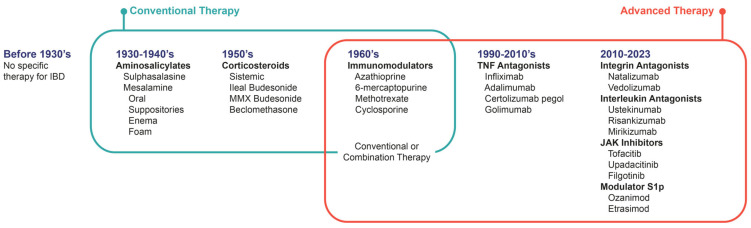
Figure 1
Figure 1
Timeline: development of IBD therapies by decade. IBD: Inflammatory Bowel Disease. MMX: Multi-matrix system. TNF: tumor necrosis factor. JAK: Janus Kinase. S1p: Sphingosine-1-phosphate.
Figure 2
Figure 2
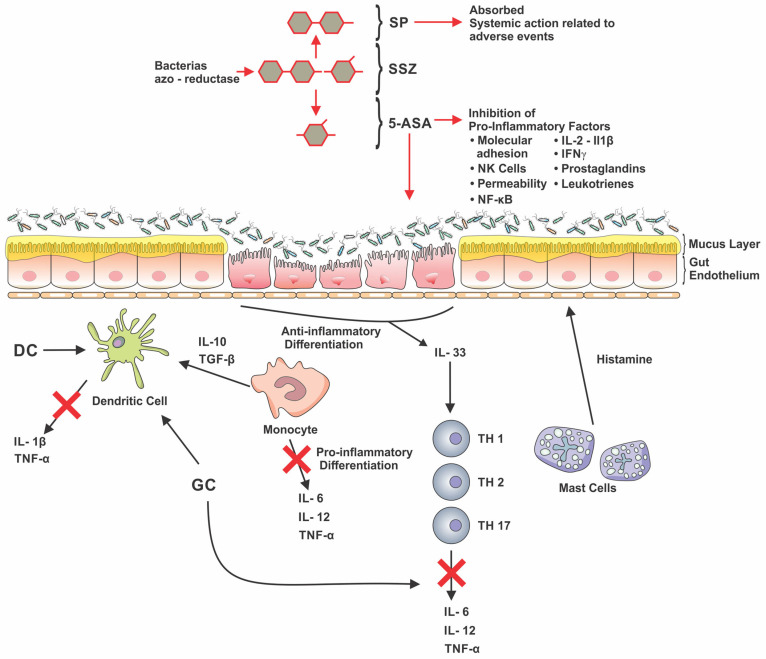
Action of salicylates and glucocorticoids in IBD. 5-ASA acts on pro-inflammatory factors such as molecular adhesion, Natural Killer cell activation, intestinal permeability, nuclear factor kappa B activation, IL-1β, IL-2, Interferon gamma, prostaglandins, and leukotrienes. Sulfasalazine is converted by bacterial azo-reductases into 5-ASA, the UC-acting moiety, and into Sulphapyridine, which is absorbed and is generally associated with adverse events. Glucocorticoids downregulate the inflammatory cascade by reducing cytokines (represented by the red crosses) such as IL-1 beta, IL-6, IL-12, TNF-alpha, in addition to allowing the release of regulatory cytokines such as IL-10. DC: Dendritic cell. GC: glucocorticoids. IL: interleukin. IFN: interferon. NF-κB: nuclear factor kappa B. NK: Natural Killer cells. SP: sulfapyridine. SSZ: sulfasalazine. TGF-β: transforming growth factor beta. TH: T helper. TNF: tumor necrosis factor. 5-ASA: 5-aminosalicylate.
Figure 3
Figure 3
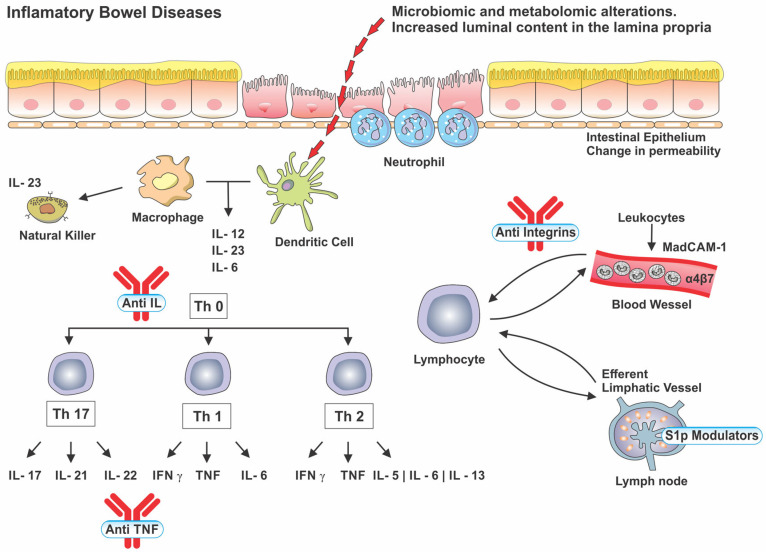
Inflammatory pathways in IBD and areas of action of biological therapies and S1p modulators. IL: Interleukin. Th: T helper. INF: Interferon. TNF: Tumor Necrosis Factor. MadCAM-1: Mucosal vascular addressin cell adhesion molecule 1. S1p: Sphingosine-1-phosphate.
Figure 4
Figure 4
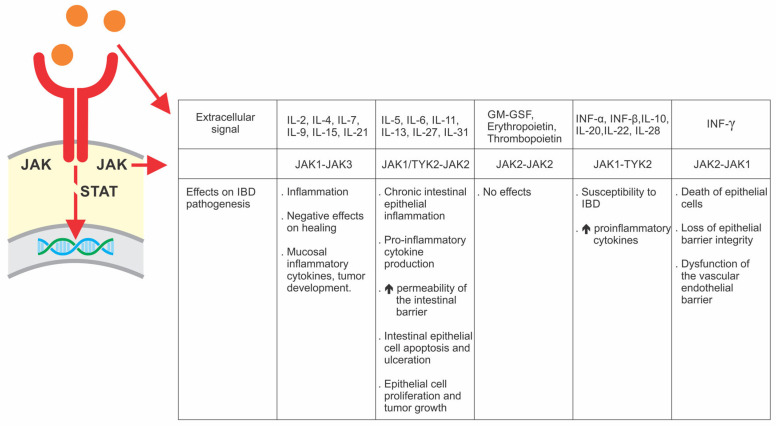
Mechanism of action of JAK inhibitors in IBD [95]. JAK blockade occurs in pairs involving five different inhibition scenarios interrupting STAT-mediated extracellular-nuclear communication. IL: Interleukin; JAK: Janus Kinase; GM-GSF: Granulocyte-macrophage colony-stimulating factor; INF: STAT: Signal transducer and activator of transcription proteins; INF: Interferon. Adapted with permission from Pippis, Elleni J; Yacyshyn, Bruce R, Inflammatory Bowel Diseases; published by Oxford University Press, 2020.
Figure 5
Figure 5
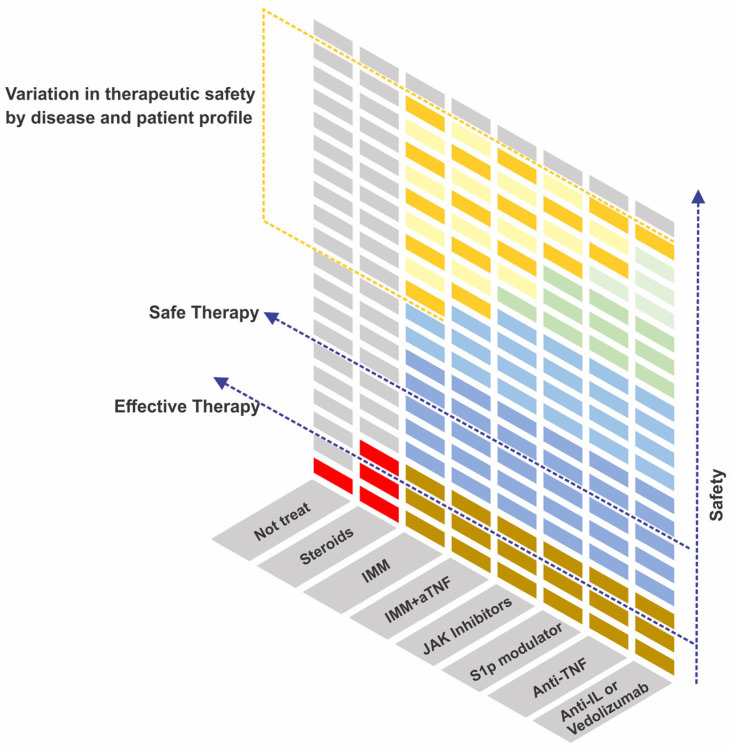
Immunosuppressive therapies for the treatment of inflammatory bowel diseases. The therapies currently proposed for treatment are safe and effective, except for corticosteroids, which in the long term have benefits that are outweighed by the risks. The graph demonstrates a lower to higher safety profile, considering the authors’ opinion. We consider newly approved therapies to be at a disadvantage in this review due to fewer studies addressing long-term safety. Safety between therapies varies by therapeutic class or combination. More importantly, safety varies by subgroup of patient (characteristics such as age and comorbidities) and disease (characteristics such as phenotypes and systemic manifestations) (variation represented by the yellow blocks). The use of safe therapies that are not ideal for the characteristics of the patient’s disease is also a therapeutic risk factor. S1p: Sphingosine 1-Phosphate; JAK: Janus Kinases; IMM: immunomodulators; aTNF: anti-Tumor Necrosis Factor; IL: Interleukins.

References

    1. Celebi Sozener Z., Ozdel Ozturk B., Cerci P., Turk M., Gorgulu Akin B., Akdis M., Altiner S., Ozbey U., Ogulur I., Mitamura Y., et al. Epithelial Barrier Hypothesis: Effect of the External Exposome on the Microbiome and Epithelial Barriers in Allergic Disease. Allergy. 2022;77:1418–1449. doi: 10.1111/all.15240. - DOI - PMC - PubMed
    1. Barrett B., Charles J.W., Temte J.L. Climate Change, Human Health, and Epidemiological Transition. Prev. Med. 2015;70:69–75. doi: 10.1016/j.ypmed.2014.11.013. - DOI - PMC - PubMed
    1. Colella M., Charitos I.A., Ballini A., Cafiero C., Topi S., Palmirotta R., Santacroce L. Microbiota Revolution: How Gut Microbes Regulate Our Lives. World J. Gastroenterol. 2023;29:4368–4383. doi: 10.3748/wjg.v29.i28.4368. - DOI - PMC - PubMed
    1. Ananthakrishnan A.N. Epidemiology and Risk Factors for IBD. Nat. Rev. Gastroenterol. Hepatol. 2015;12:205–217. doi: 10.1038/nrgastro.2015.34. - DOI - PubMed
    1. Gearry R.B. IBD and Environment: Are There Differences between East and West. Dig. Dis. 2016;34:84–89. doi: 10.1159/000442933. - DOI - PubMed

LinkOut - more resources