


Using Deep Learning Models to Predict Prosthetic Ankle Torque
- PMID: 37765769
- PMCID: PMC10535406
- DOI: 10.3390/s23187712
Using Deep Learning Models to Predict Prosthetic Ankle Torque
Abstract
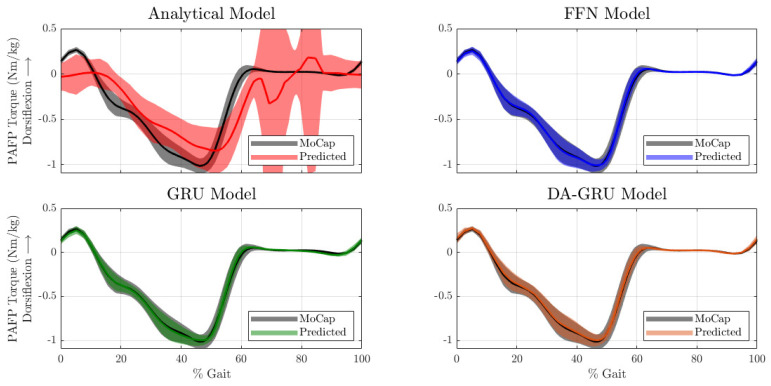
Inverse dynamics from motion capture is the most common technique for acquiring biomechanical kinetic data. However, this method is time-intensive, limited to a gait laboratory setting, and requires a large array of reflective markers to be attached to the body. A practical alternative must be developed to provide biomechanical information to high-bandwidth prosthesis control systems to enable predictive controllers. In this study, we applied deep learning to build dynamical system models capable of accurately estimating and predicting prosthetic ankle torque from inverse dynamics using only six input signals. We performed a hyperparameter optimization protocol that automatically selected the model architectures and learning parameters that resulted in the most accurate predictions. We show that the trained deep neural networks predict ankle torques one sample into the future with an average RMSE of 0.04 ± 0.02 Nm/kg, corresponding to 2.9 ± 1.6% of the ankle torque's dynamic range. Comparatively, a manually derived analytical regression model predicted ankle torques with a RMSE of 0.35 ± 0.53 Nm/kg, corresponding to 26.6 ± 40.9% of the ankle torque's dynamic range. In addition, the deep neural networks predicted ankle torque values half a gait cycle into the future with an average decrease in performance of 1.7% of the ankle torque's dynamic range when compared to the one-sample-ahead prediction. This application of deep learning provides an avenue towards the development of predictive control systems for powered limbs aimed at optimizing prosthetic ankle torque.
Keywords: biomechanics; deep neural networks; machine learning; robotic ankle prosthesis.
Conflict of interest statement
The authors declare no conflict of interest. The funders had no role in the design of the study; in the collection, analyses, or interpretation of data; in the writing of the manuscript; or in the decision to publish the results.
Figures



References
-
- Teramae T., Noda T., Morimoto J. EMG-Based Model Predictive Control for Physical Human–Robot Interaction: Application for Assist-As-Needed Control. IEEE Robot. Autom. Lett. 2018;3:210–217. doi: 10.1109/LRA.2017.2737478. - DOI
-
- Özen O., Traversa F., Gadi S., Buetler K.A., Nef T., Marchal-Crespo L. Multi-purpose Robotic Training Strategies for Neurorehabilitation with Model Predictive Controllers; Proceedings of the 2019 IEEE 16th International Conference on Rehabilitation Robotics (ICORR); Toroto, ON, Canada. 24–28 June 2019; pp. 754–759. - DOI - PubMed
-
- Winter D.A. Kinematic and kinetic patterns in human gait: Variability and compensating effects. Hum. Mov. Sci. 1984;3:51–76. doi: 10.1016/0167-9457(84)90005-8. - DOI
