


Validating a Consumer Smartwatch for Nocturnal Respiratory Rate Measurements in Sleep Monitoring
- PMID: 37766031
- PMCID: PMC10536355
- DOI: 10.3390/s23187976
Validating a Consumer Smartwatch for Nocturnal Respiratory Rate Measurements in Sleep Monitoring
Abstract
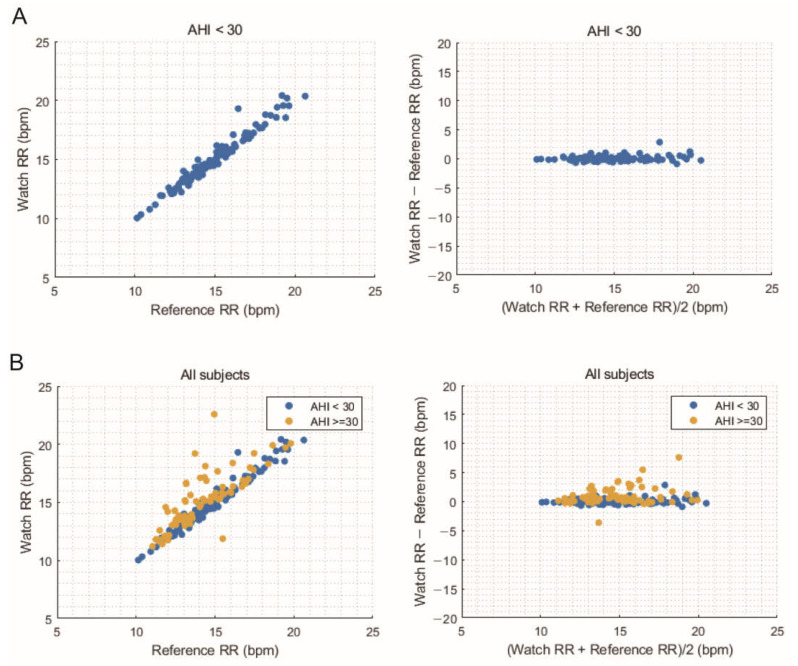
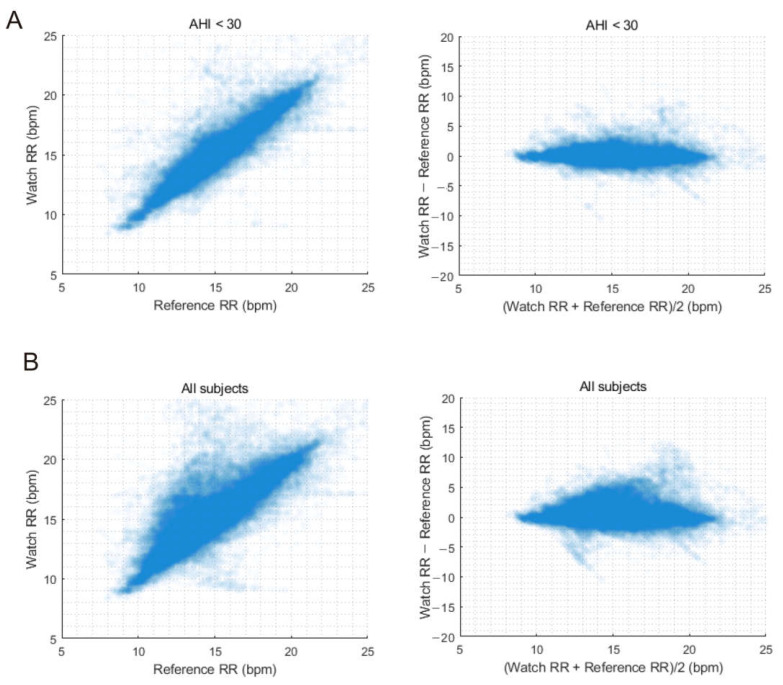
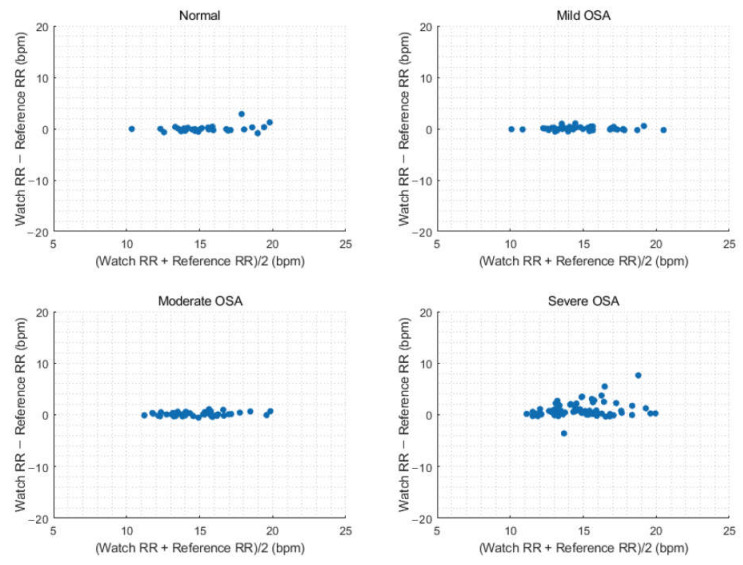
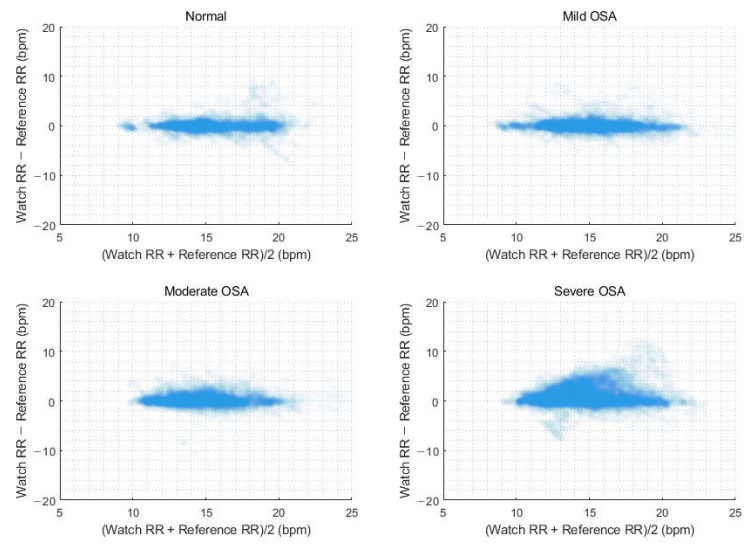
Wrist-based respiratory rate (RR) measurement during sleep faces accuracy limitations. This study aimed to assess the accuracy of the RR estimation function during sleep based on the severity of obstructive sleep apnea (OSA) using the Samsung Galaxy Watch (GW) series. These watches are equipped with accelerometers and photoplethysmography sensors for RR estimation. A total of 195 participants visiting our sleep clinic underwent overnight polysomnography while wearing the GW, and the RR estimated by the GW was compared with the reference RR obtained from the nasal thermocouple. For all participants, the root mean squared error (RMSE) of the average overnight RR and continuous RR measurements were 1.13 bpm and 1.62 bpm, respectively, showing a small bias of 0.39 bpm and 0.37 bpm, respectively. The Bland-Altman plots indicated good agreement in the RR measurements for the normal, mild, and moderate OSA groups. In participants with normal-to-moderate OSA, both average overnight RR and continuous RR measurements achieved accuracy rates exceeding 90%. However, for patients with severe OSA, these accuracy rates decreased to 79.45% and 75.8%, respectively. The study demonstrates the GW's ability to accurately estimate RR during sleep, even though accuracy may be compromised in patients with severe OSA.
Keywords: accelerometer; obstructive sleep apnea; photoplethysmography; respiratory rate; sleep monitoring; wearable device.
Conflict of interest statement
The authors of this paper (H.J., J.C.) are affiliated with Samsung Electronics, the company that manufactures the device used in the study. This study was funded by Samsung Electronics. To maintain transparency and uphold the integrity of the research process, the authors declare their associations and acknowledge the possible influence of these relationships on the outcomes of the study. The authors have undertaken their best efforts to conduct the study impartially and objectively, adhering to rigorous scientific standards.
Figures
References
-
- Ballal T., Heneghan C., Zaffaroni A., Boyle P., De Chazal P., Shouldice R., McNicholas W.T., Donnelly S.C. A pilot study of the nocturnal respiration rates in COPD patients in the home environment using a non-contact biomotion sensor. Physiol. Meas. 2014;35:2513–2527. doi: 10.1088/0967-3334/35/12/2513. - DOI - PubMed
Grants and funding
LinkOut - more resources
Full Text Sources
