. 2023 Sep 5;15(9):1877.
doi: 10.3390/v15091877.

B-Cell Epitopes-Based Chimeric Protein from SARS-CoV-2 N and S Proteins Is Recognized by Specific Antibodies in Serum and Urine Samples from Patients

Affiliations

B-Cell Epitopes-Based Chimeric Protein from SARS-CoV-2 N and S Proteins Is Recognized by Specific Antibodies in Serum and Urine Samples from Patients

Fernanda F Ramos et al. Viruses. .

Abstract

The impact of the COVID-19 pandemic caused by the SARS-CoV-2 virus underscored the crucial role of laboratorial tests as a strategy to control the disease, mainly to indicate the presence of specific antibodies in human samples from infected patients. Therefore, suitable recombinant antigens are relevant for the development of reliable tests, and so far, single recombinant proteins have been used. In this context, B-cell epitopes-based chimeric proteins can be an alternative to obtain tests with high accuracy through easier and cheaper production. The present study used bioinformatics tools to select specific B-cell epitopes from the spike (S) and the nucleocapsid (N) proteins from the SARS-CoV-2 virus, aiming to produce a novel recombinant chimeric antigen (N4S11-SC2). Eleven S and four N-derived B-cell epitopes were predicted and used to construct the N4S11-SC2 protein, which was analyzed in a recombinant format against serum and urine samples, by means of an in house-ELISA. Specific antibodies were detected in the serum and urine samples of COVID-19 patients, which were previously confirmed by qRT-PCR. Results showed that N4S11-SC2 presented 83.7% sensitivity and 100% specificity when using sera samples, and 91.1% sensitivity and 100% specificity using urine samples. Comparable findings were achieved with paired urine samples when compared to N and S recombinant proteins expressed in prokaryotic systems. However, better results were reached for N4S11-SC2 in comparison to the S recombinant protein when using paired serum samples. Anti-N4S11-SC2 antibodies were not clearly identified in Janssen Ad26.COV2.S COVID-19-vaccinated subjects, using serum or paired urine samples. In conclusion, this study presents a new chimeric recombinant antigen expressed in a prokaryotic system that could be considered as an alternative diagnostic marker for the SARS-CoV-2 infection, with the potential benefits to be used on serum or urine from infected patients.

Keywords: B-cell epitopes; SARS-CoV-2; chimeric protein; diagnosis; serum; urine.


Conflict of interest statement

A patent application at the Brazilian National Institute of Industrial Property was issued under case number BR 10 2021 014066 6. The authors declare that they have no other competing interests.

Figures
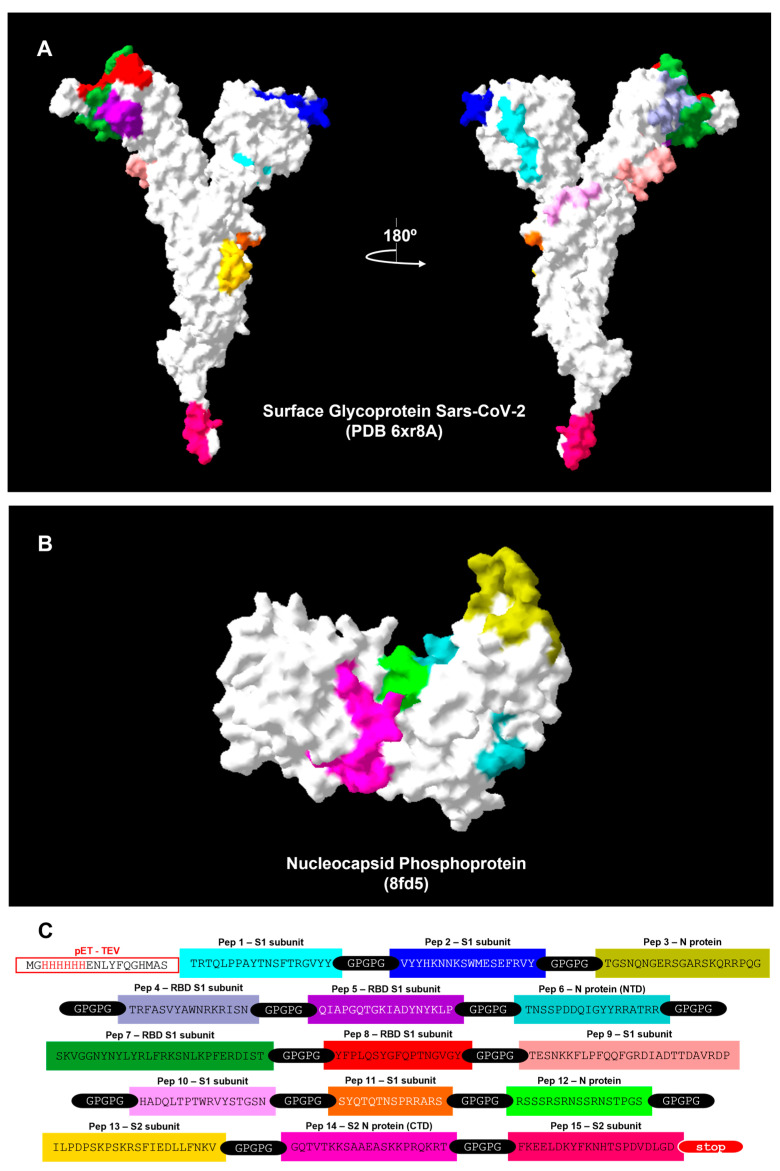
Figure 1
Figure 1
Construction of the N4S11-SC2 chimeric protein. (A,B): Identification of the B-cell epitopes chosen to build the chimeric protein represented on the 3D structure of (A) surface glycoprotein (YP_009724390.1) (PDB: 6xr8A) and (B) the nucleocapsid phosphoprotein (YP_009724397.2) (PDB: 8FD5). Structures were obtained from PDB and epitopes were selected and identified using SwissPDB-viewer. (C): The selected B-cell epitopes were grouped in a linear sequence with the inclusion of –GPGPG- linker residues between each epitope, and the chimeric protein sequence is shown. N4S11-SC2 gene was inserted into pET-TEV expression vector using NheI and NotI restriction enzymes. pET-TEV N-terminal tag containing the initial M and 6X-HIS was maintained into the constructed and a STOP codon was added. Each sequence is represented by color on the 3D structure (A,B). Peptides 3 and 12 are not represented as the amino acids are not available on the 3D structure.
Figure 2
Figure 2
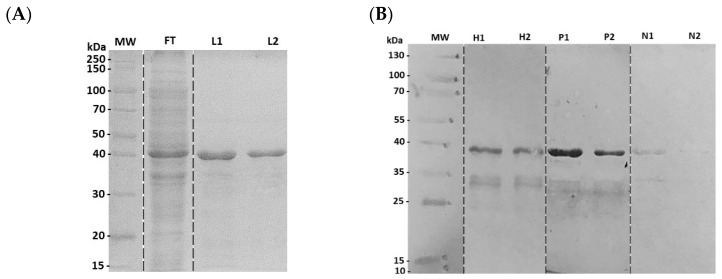
SDS-polyacrylamide gel electrophoresis showing the purification of N4S11-SC2 and immunoblotting of N4S11-SC2 protein against anti-HIS antibody and pooled serum samples from COVID-19 patients and negative control individuals. (A) SDS-polyacrylamide gel electrophoresis showing the purification of N4S11-SC2. FT = Flow-Through; L1 = First N4S11-SC2 Elution; L2 = Second N4S11-SC2 Elution; MW = PageRuler™ Unstained Broad Range Protein Ladder. (B) H1 and H2: First and second elutions of anti-HIS antibody; P1 and P2: First and second elutions of COVID-19 positive patient’s serum pools; N1 and N2: First and second elutions of negative pre-pandemic individuals’ serum pools; MW = Page Ruler™ Pre-stained Protein Ladder.
Figure 3
Figure 3
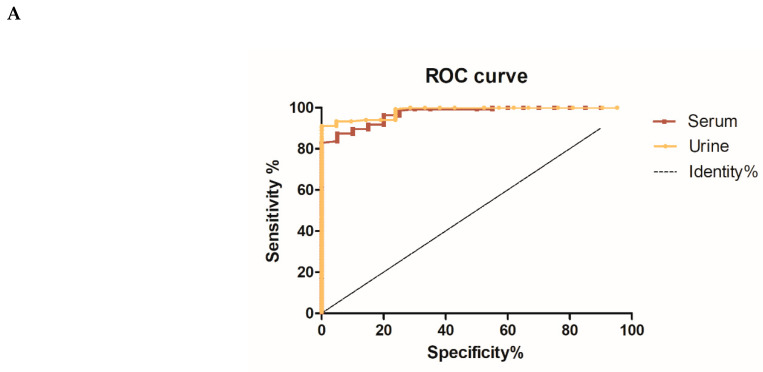
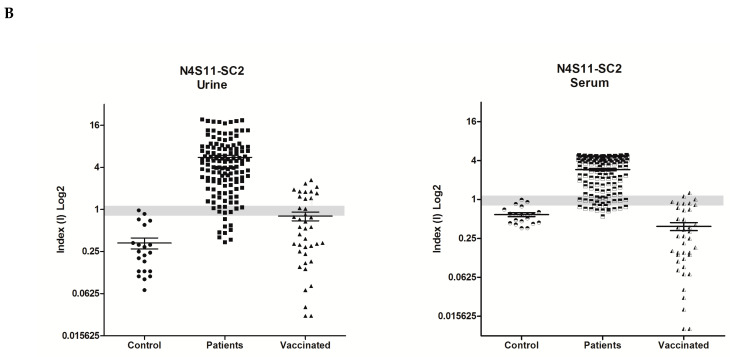
Comparative diagnostic performance of N4S11-SC2 protein with urine and serum samples. (A) Receiver Operating Characteristic (ROC) curves were constructed using the individual index (I) value for each sample to obtain sensitivity, specificity and area under the curve values. (B) ELISA assays were done using urine and paired serum samples (n = 135) from COVID-19 patients with previously positive qRT-PCR. Urine and paired serum samples (n = 40) were analyzed from previously vaccinated subjects. Urine and unpaired serum samples from healthy control subjects (n = 21 and n = 20, respectively) were also used. The mean of each group is shown and the gray band indicates indeterminate values for each sample, while index values below the range (<0.8) are negative and values above (>1.1) are considered positive.
Figure 3
Figure 3
Comparative diagnostic performance of N4S11-SC2 protein with urine and serum samples. (A) Receiver Operating Characteristic (ROC) curves were constructed using the individual index (I) value for each sample to obtain sensitivity, specificity and area under the curve values. (B) ELISA assays were done using urine and paired serum samples (n = 135) from COVID-19 patients with previously positive qRT-PCR. Urine and paired serum samples (n = 40) were analyzed from previously vaccinated subjects. Urine and unpaired serum samples from healthy control subjects (n = 21 and n = 20, respectively) were also used. The mean of each group is shown and the gray band indicates indeterminate values for each sample, while index values below the range (<0.8) are negative and values above (>1.1) are considered positive.
Figure 4
Figure 4
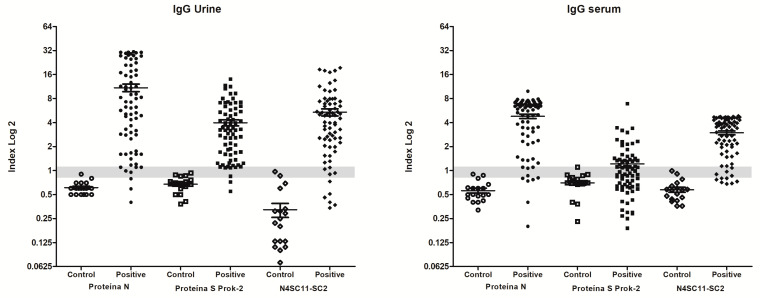
Comparative diagnostic performance among the recombinant N, S and N4S11-SC2 proteins. ELISA assays with the N, S and N4S11-SC2 were conducted using the same urine and serum samples from COVID-19 patients with previously positive qRT-PCR above 8 days PSO (n = 72) and from healthy control subjects (n = 18). The mean of each group is shown and the gray band indicates indeterminate values for each sample, while index values below the range (<0.8) are negative and values above (>1.1) are considered positive.

References

    1. FDA EUA Authorized Serology Test Performance. Food and Drug Administration. [(accessed on 22 August 2022)]; Available online: https://www.fda.gov/medical-devices/coronavirus-disease-2019-covid-19-em....
    1. CDC COVID-19 Testing: What You Need to Know. [(accessed on 16 August 2023)]; Available online: https://www.cdc.gov/coronavirus/2019-ncov/symptoms-testing/testing.html.
    1. Matta J., Wiernik E., Robineau O., Carrat F., Touvier M., Severi G., de Lamballerie X., Blanché H., Deleuze J.-F., Gouraud C., et al. Association of Self-reported COVID-19 Infection and SARS-CoV-2 Serology Test Results with Persistent Physical Symptoms among French Adults during the COVID-19 Pandemic. JAMA Intern. Med. 2022;182:19–25. doi: 10.1001/jamainternmed.2021.6454. - DOI - PMC - PubMed
    1. Ong D.S., Fragkou P.C., Schweitzer V.A., Chemaly R.F., Moschopoulos C.D., Skevaki C. How to interpret and use COVID-19 serology and immunology tests. Clin. Microbiol. Infect. 2021;27:981–986. doi: 10.1016/j.cmi.2021.05.001. - DOI - PMC - PubMed
    1. FDA SARS-CoV-2 Viral Mutations: Impact on COVID-19 Tests. Food and Drug Administration. [(accessed on 16 August 2023)]; Available online: https://www.fda.gov/medical-devices/coronavirus-covid-19-and-medical-dev....

Publication types