


The association between body mass index and live birth and maternal and perinatal outcomes after in-vitro fertilization: a national cohort study
- PMID: 37766680
- PMCID: PMC10520462
- DOI: 10.3389/fendo.2023.1239702
The association between body mass index and live birth and maternal and perinatal outcomes after in-vitro fertilization: a national cohort study
Abstract
Objective: To investigate the association between female body mass index (BMI) and live birth rates and maternal and perinatal outcomes after in-vitro fertilization (IVF).
Methods: We performed a national, population-based cohort study including women undergoing IVF between 2002 and 2020. The cohort included 126,620 fresh cycles and subsequent frozen embryo transfers between 2007 and 2019 (subpopulation 1) and 58,187 singleton deliveries between 2002 and 2020 (subpopulation 2). Exposure was female BMI (kg/m2) categorized according to the World Health Organization as underweight (<18.5), normal weight (18.5-24.9, reference), overweight (25.0-29.9), class I obesity (30.0-34.9), class II obesity (35.0-39.9), and class III obesity (≥40.0). The primary outcome in subpopulation 1 was cumulative live birth per started fresh IVF cycle, including fresh and subsequent frozen embryo transfers. Primary outcomes in subpopulation 2 were hypertensive disorders of pregnancy and preterm birth at less than 37 weeks. Risk ratios (RRs) with 95% confidence intervals (CIs) for the association between BMI class and outcomes were calculated using generalized linear models after adjustment for relevant confounders.
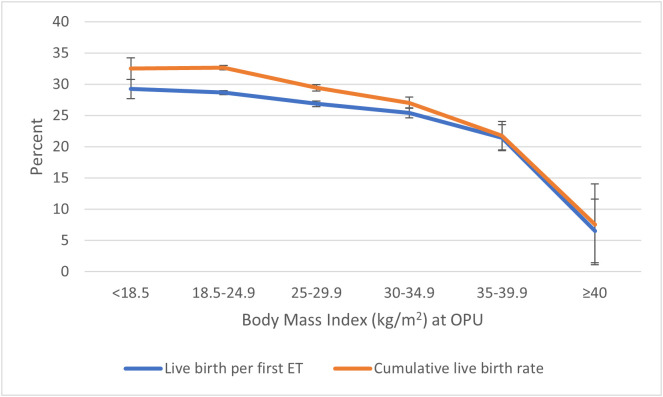
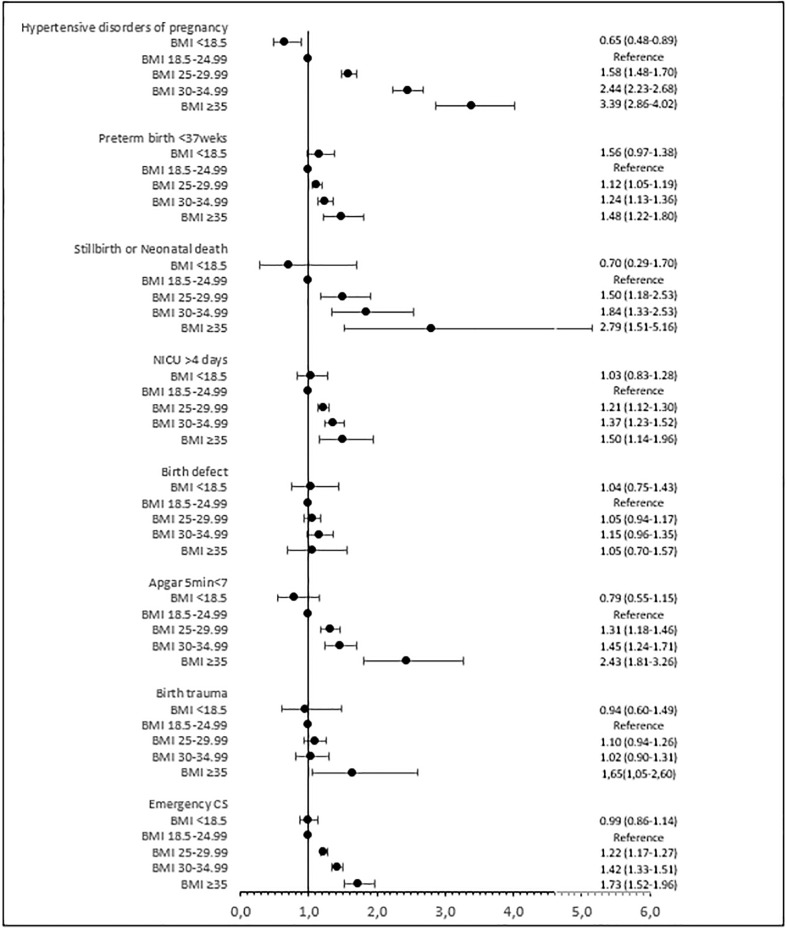
Results: The cumulative live birth rate decreased significantly with increasing BMI from 32.6% in normal-weight women to 29.4% in overweight women, 27.0% in women in obesity class I, 21.8% in women in obesity class II, and 7.6% in women in obesity class III. The risk of hypertensive disorders of pregnancy increased significantly and progressively with increasing BMI, from 4.6% in normal-weight women to 7.8% in overweight women and 12.5%, 17.9%, and 20.3% in women in obesity classes I, II, and III. The risk of preterm birth followed a similar pattern, from 6.3% in normal-weight women to 7.5% in overweight women and 8.9%, 9.9%, and 15.3% in women in obesity classes I, II, and III. The risks of other perinatal complications, such as perinatal death, showed an even more pronounced increase.
Conclusion: Using a large and complete national cohort of women undergoing IVF, we demonstrate a dose-dependent decrease in live birth rate and a substantial increase in maternal and perinatal complications with increasing BMI. Strategies to improve this situation are warranted.
Keywords: in vitro fertilization; live birth; maternal and perinatal outcomes; obesity; population registers.
Copyright © 2023 Kluge, Källén, Thurin-Kjellberg, Wennerholm and Bergh.
Conflict of interest statement
LK has received a scholarship from Ferring Pharmaceuticals and completed the ICMJE disclosure form. The remaining authors declare that the research was conducted in the absence of any commercial or financial relationships that could be construed as a potential conflict of interest.
Figures
References
-
- World Health Organization . Obesity and owerweight (2021). Available at: https://www.who.int/news-room/fact-sheets/detail/obesity-and-overweight.
-
- Petersson K, Skogsdal Y, Conner P, Sengpiel V, Storck Lindholm E, Kloow M. på uppdrag av Graviditetsregistret, Sweden. Graviditetsregistrets Årsrapport 2021. (2022). Available at: https://www.medscinet.com/gr/arsrapporter.aspx
-
- Driscoll AK, Gregory ECW. National Vital Statistics Reports 2020. Prepregnancy Body Mass Index and Infant Outcomes by Race and Hispanic Origin. United States: Centers for Disease Control and Prevention; (2020). Available at: https://www.cdc.gov/nchs/data/nvsr/nvsr70/nvsr70-16.pdf. - PubMed
Publication types
MeSH terms
LinkOut - more resources
Full Text Sources
Medical
