


The impact of long haul travel on the sleep of elite athletes
- PMID: 37766939
- PMCID: PMC10520441
- DOI: 10.1016/j.nbscr.2023.100102
The impact of long haul travel on the sleep of elite athletes
Abstract
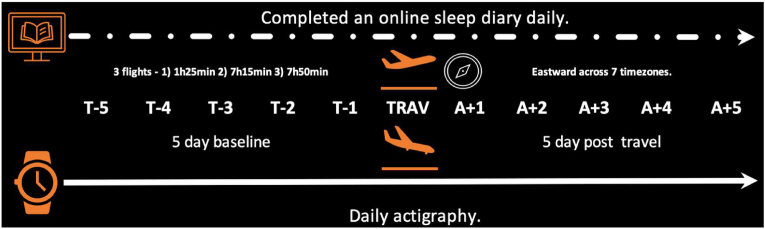
In order to manage and implement strategies to alleviate the symptoms of jet lag it is essential to assess the impact of jet lag in athletes. The aim of this study was to assess the impact of long haul eastward travel on elite athletes' (n = 7 elite national track cyclists; male n = 3, and female n = 4) sleep. The athletes' sleep was monitored before, during and after travel using both actigraphy and self-report measures. Participants wore an activity monitor for 5 days prior to travel, during the long haul travel and 5 days upon arrival at their destination and completed a daily online sleep diary Actigraphy highlighted significant reductions in time in bed, total sleep time and sleep efficiency (%) due to long haul eastward travel, particularly in the 48 h after travel. Sleep diary data exhibited significant reductions in time in bed, total sleep time, sleep efficiency, sleep quality and a significant increase in fatigue going to bed as a result of long haul eastward travel. In order to facilitate the development of interventions to reduce the symptoms and severity of jet lag objective and subjective assessments of sleep should be coupled with assessments of chronotype and perceived sleep need.
Keywords: Eastward travel; Elite athletes; Jet lag; Sleep.
© 2023 The Authors.
Conflict of interest statement
The authors declare that they have no known competing financial interests or personal relationships that could have appeared to influence the work reported in this paper.
Figures

References
-
- Arendt J. Managing jet lag: some of the problems and possible new solutions. Sleep Med. Rev. 2009;13(4):249–256. - PubMed
-
- Atkinson G., Drust B., Reilly T., Waterhouse J. The relevance of melatonin to sports medicine and science. Sports Med. 2003;33(11):809–831. - PubMed
-
- Baehr E.K., Revelle W., Eastman C.I. Individual differences in the phase and amplitude of the human circadian temperature rhythm: with an emphasis on morningness–eveningness. J. Sleep Res. 2000;9(2):117–127. - PubMed
-
- Beaumont M., Batejat D., Pierard C., Van Beers P., Denis J.B., Coste O., Doireau P., Chauffard F., French J., Lagarde D. Caffeine or melatonin effects on sleep and sleepiness after rapid eastward transmeridian travel. J. Appl. Physiol. 2004;96(1):50–58. - PubMed
LinkOut - more resources
Full Text Sources
