


Usage of unguided, guided, and blended care for depression offered in routine clinical care: Lessons learned
- PMID: 37767005
- PMCID: PMC10520335
- DOI: 10.1016/j.invent.2023.100670
Usage of unguided, guided, and blended care for depression offered in routine clinical care: Lessons learned
Abstract
Introduction: Internet-delivered psychotherapy is often considered to be a promising way to extend mental healthcare services around the world. Research findings that have emerged over the past two decades have strengthened this claim. However, very little is known about the usage of internet-delivered psychotherapy in real-life circumstances.
Methods: The current study explored the real-life usage of depressiehulp.be, a publicly available online platform for depression that offers pure self-help, online guided self-help, and blended treatment for depression in Flanders, Belgium, using data collected from 2656 participants between May 2018 and May 2022.
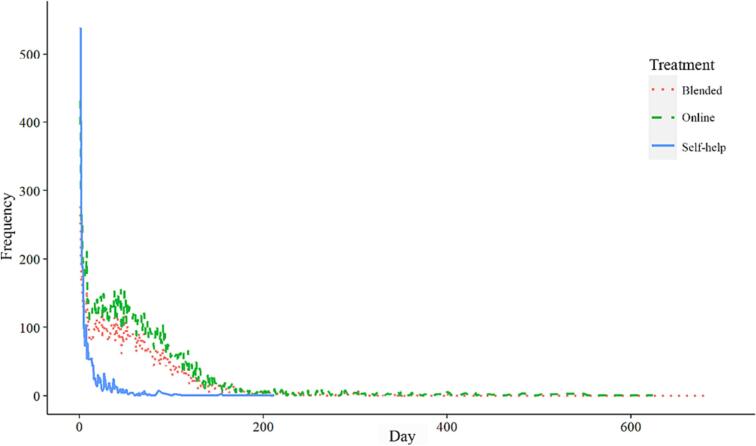
Results: Both duration of engagement with the online platform and number of exercises completed increased with increasing levels of therapist guidance. Findings also showed a particular pattern of engagement for each of the online treatments. Overall, participants completed most exercises during the first days of treatment. However, participants using pure online self-help showed the fastest decrease of engagement over time, with most dropping out after completing a few exercises, and more than half of all participants who enrolled in the self-help programme did not even begin the programme. In both guided and blended treatment, participants tended to show higher levels of engagement with the online platform. In each treatment modality, a relatively small but notable group of participants showed high levels of engagement. There was no relationship between severity of depression and duration of engagement.
Conclusions: The current study demonstrates the importance of therapist support in online interventions and offers additional insights into how, and to what extent, online platforms are used. Future research should explore clinical impact and policy implications.
Keywords: Blended treatment; Depressive symptoms; Dropout; Guidance; Online intervention; Self-help.
© 2023 The Authors.
Conflict of interest statement
PL and HC are involved in the development and implementation of OnlinePsyHulp, an online platform for mental health problems.
Figures


References
-
- Baumeister H., Reichler L., Munzinger M., Lin J. The impact of guidance on internet-based mental health interventions — a systematic review. Internet Interv. 2014;1(4):205–215. doi: 10.1016/j.invent.2014.08.003. - DOI
-
- Castro A., López-del-Hoyo Y., Peake C., Mayoral F., Botella C., García-Campayo J., Baños R.M., Nogueira-Arjona R., Roca M., Gili M. Adherence predictors in an internet-based intervention program for depression. Cogn. Behav. Ther. 2018;47(3):246–261. doi: 10.1080/16506073.2017.1366546. - DOI - PubMed
LinkOut - more resources
Full Text Sources
Miscellaneous
