


Outcomes of Salvage Surgery for Initially Unresectable Hepatocellular Carcinoma Converted by Transcatheter Arterial Chemoembolization Combined with Lenvatinib plus Anti-PD-1 Antibodies: A Multicenter Retrospective Study
- PMID: 37767067
- PMCID: PMC10521320
- DOI: 10.1159/000528356
Outcomes of Salvage Surgery for Initially Unresectable Hepatocellular Carcinoma Converted by Transcatheter Arterial Chemoembolization Combined with Lenvatinib plus Anti-PD-1 Antibodies: A Multicenter Retrospective Study
Abstract
Introduction: The actual rate of conversion surgery and its prognostic advantages remain unclear. This study aimed to assess the outcomes of salvage surgery after conversion therapy with triple therapy (transcatheter arterial chemoembolization [TACE] combined with lenvatinib plus anti-PD-1 antibodies) in patients with initially unresectable hepatocellular carcinoma (uHCC).
Methods: Patients with initially uHCC who received at least one cycle of first-line triple therapy and salvage surgery at five major cancer centers in China were included. The primary endpoints were overall survival (OS) and recurrence-free survival (RFS) rates after salvage surgery. The secondary endpoints were perioperative complications, 90-day mortality, and pathological tumor response.
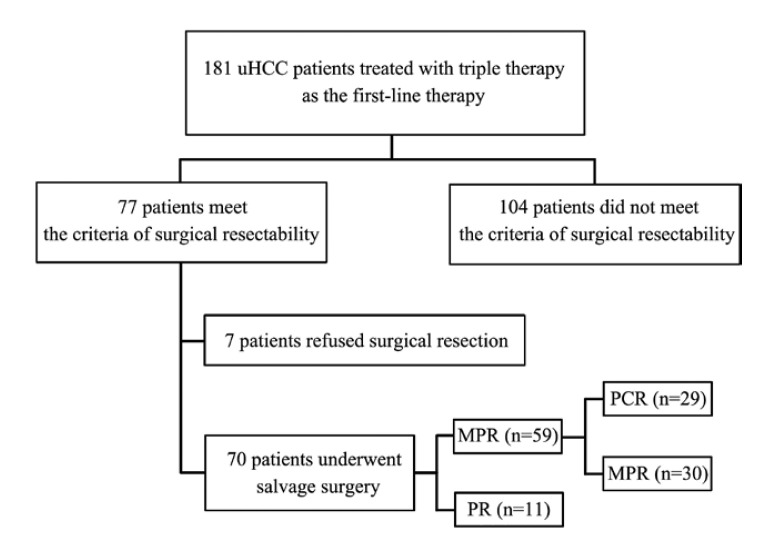
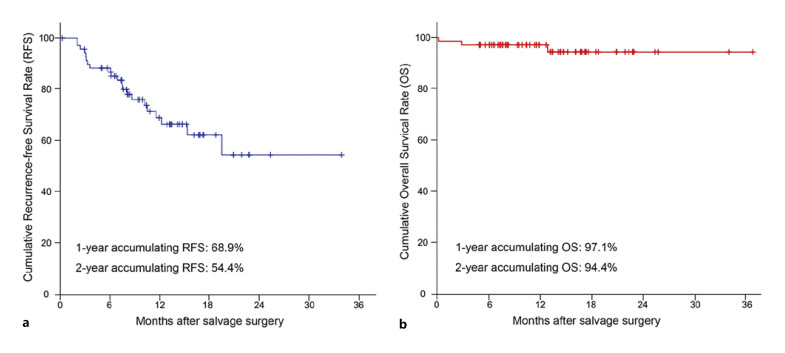
Results: Between June 2018 and December 2021, 70 patients diagnosed with uHCC who underwent triple therapy and salvage surgery were analyzed: 39 with Barcelona Clinic Liver Cancer (BCLC) stage C, 22 with BCLC stage B, and 9 with BCLC stage A disease. The median interval between the start of triple therapy and salvage surgery was 4.3 months (range, 1.7-14.2 months). Pathological complete response and major pathological response were observed in 29 (41.4%) and 59 (84.3%) patients, respectively. There were 2 cases of perioperative mortality (4.3%) and 5 cases of severe perioperative complications (7.1%). With a median follow-up of 12.9 months after surgery (range, 0.3-36.8 months), the median OS and RFS were not reached. The 1- and 2-year OS rates were 97.1% and 94.4%, respectively, and the corresponding RFS rates were 68.9% and 54.4%, respectively.
Conclusion: First-line combination of TACE, lenvatinib, and anti-PD-1 antibodies provides a better chance of conversion therapy in patients with initially uHCC. Furthermore, salvage surgery after conversion therapy is effective and safe and has the potential to provide excellent long-term survival benefits.
Keywords: Conversion therapy; Hepatocellular carcinoma; Salvage surgery; Systemic treatment; Transcatheter arterial chemoembolization.
Copyright © 2022 by The Author(s). Published by S. Karger AG, Basel.
Conflict of interest statement
The authors have no conflicts of interest to declare.
Figures
References
-
- Roayaie S, Jibara G, Tabrizian P, Park JW, Yang J, Yan L, et al. The role of hepatic resection in the treatment of hepatocellular cancer. Hepatology. 2015 Aug;62((2)):440–451. - PubMed
-
- European Association for the Study of the Liver EASL clinical practice guidelines management of hepatocellular carcinoma. J Hepatol. 2018 Jul;69((1)):182–236. - PubMed
-
- Villanueva A. Hepatocellular carcinoma. N Engl J Med. 2019 Apr;380((15)):1450–1462. - PubMed
LinkOut - more resources
Full Text Sources
Miscellaneous
