


Navigating the kidney organoid: insights into assessment and enhancement of nephron function
- PMID: 37767571
- PMCID: PMC10878724
- DOI: 10.1152/ajprenal.00166.2023
Navigating the kidney organoid: insights into assessment and enhancement of nephron function
Abstract
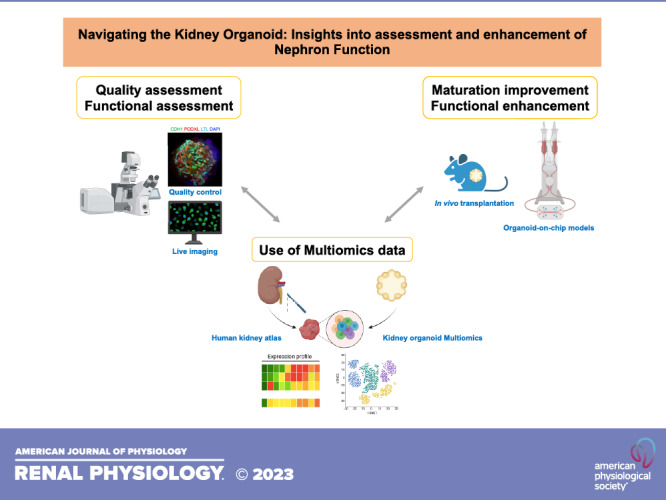
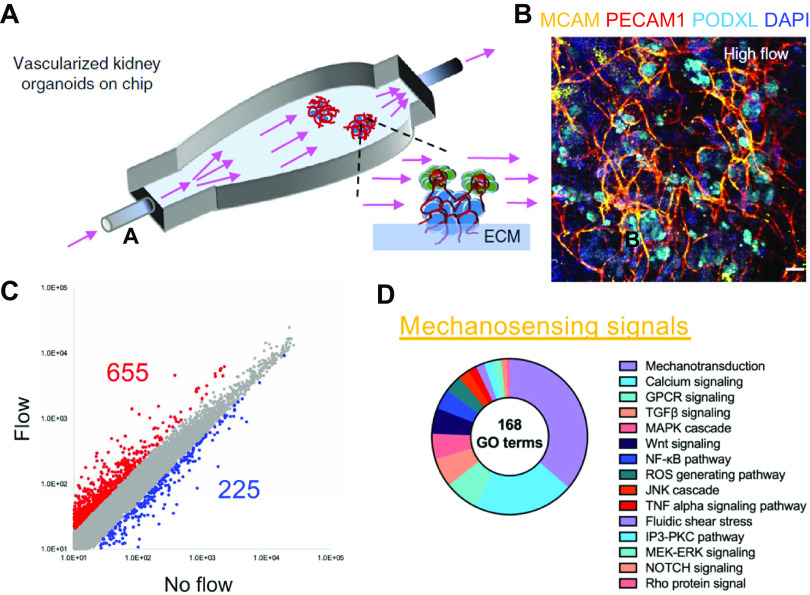
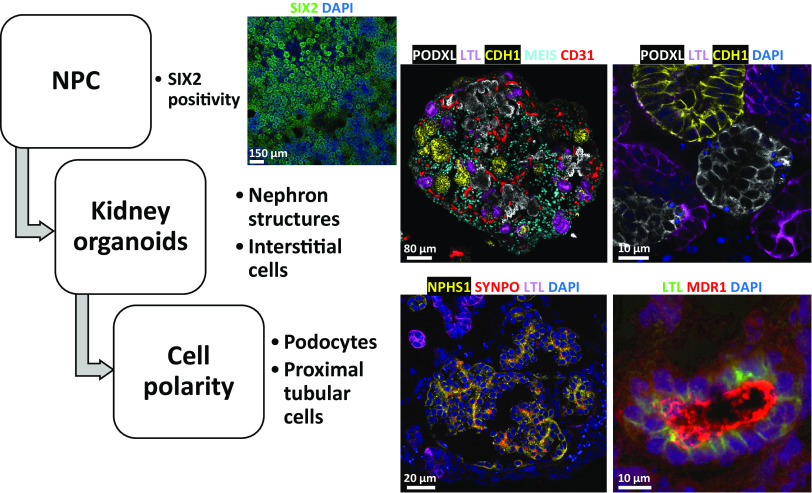
Kidney organoids are three-dimensional structures generated from pluripotent stem cells (PSCs) that are capable of recapitulating the major structures of mammalian kidneys. As this technology is expected to be a promising tool for studying renal biology, drug discovery, and regenerative medicine, the functional capacity of kidney organoids has emerged as a critical question in the field. Kidney organoids produced using several protocols harbor key structures of native kidneys. Here, we review the current state, recent advances, and future challenges in the functional characterization of kidney organoids, strategies to accelerate and enhance kidney organoid functions, and access to PSC resources to advance organoid research. The strategies to construct physiologically relevant kidney organoids include the use of organ-on-a-chip technologies that integrate fluid circulation and improve organoid maturation. These approaches result in increased expression of the major tubular transporters and elements of mechanosensory signaling pathways suggestive of improved functionality. Nevertheless, continuous efforts remain crucial to create kidney tissue that more faithfully replicates physiological conditions for future applications in kidney regeneration medicine and their ethical use in patient care.NEW & NOTEWORTHY Kidney organoids are three-dimensional structures derived from stem cells, mimicking the major components of mammalian kidneys. Although they show great promise, their functional capacity has become a critical question. This review explores the advancements and challenges in evaluating and enhancing kidney organoid function, including the use of organ-on-chip technologies, multiomics data, and in vivo transplantation. Integrating these approaches to further enhance their physiological relevance will continue to advance disease modeling and regenerative medicine applications.
Keywords: development; function; kidney; organoid; physiology.
Conflict of interest statement
R.M. is an inventor on a patent related to this work filed by the President and Fellows of Harvard College and Mass General Brigham (PCT/US2018/036677). R.M. holds a stock option in Trestle Biotherapeutics. None of the other authors has any conflicts of interest, financial or otherwise, to disclose.
Figures
References
Publication types
MeSH terms
Grants and funding
- U24 DK135157/DK/NIDDK NIH HHS/United States
- P50 DK133943/DK/NIDDK NIH HHS/United States
- U54 DK137329/DK/NIDDK NIH HHS/United States
- U01 EB028899/EB/NIBIB NIH HHS/United States
- UG3 DK114933/DK/NIDDK NIH HHS/United States
- R01 DK129285/DK/NIDDK NIH HHS/United States
- R21 DK129909/DK/NIDDK NIH HHS/United States
- U01 DK114933/DK/NIDDK NIH HHS/United States
- UC2 DK126023/DK/NIDDK NIH HHS/United States
- R01 DK038470/DK/NIDDK NIH HHS/United States
- U54 DK134301/DK/NIDDK NIH HHS/United States
- U01 DK127587/DK/NIDDK NIH HHS/United States
- DP2 DK133821/DK/NIDDK NIH HHS/United States
- UH3 DK114933/DK/NIDDK NIH HHS/United States
LinkOut - more resources
Full Text Sources
Research Materials
