. 2023 Sep 28;14(1):6050.
doi: 10.1038/s41467-023-41748-y.

An amide to thioamide substitution improves the permeability and bioavailability of macrocyclic peptides

Affiliations

An amide to thioamide substitution improves the permeability and bioavailability of macrocyclic peptides

Pritha Ghosh et al. Nat Commun. .

Abstract

Solvent shielding of the amide hydrogen bond donor (NH groups) through chemical modification or conformational control has been successfully utilized to impart membrane permeability to macrocyclic peptides. We demonstrate that passive membrane permeability can also be conferred by masking the amide hydrogen bond acceptor (>C = O) through a thioamide substitution (>C = S). The membrane permeability is a consequence of the lower desolvation penalty of the macrocycle resulting from a concerted effect of conformational restriction, local desolvation of the thioamide bond, and solvent shielding of the amide NH groups. The enhanced permeability and metabolic stability on thioamidation improve the bioavailability of a macrocyclic peptide composed of hydrophobic amino acids when administered through the oral route in rats. Thioamidation of a bioactive macrocyclic peptide composed of polar amino acids results in analogs with longer duration of action in rats when delivered subcutaneously. These results highlight the potential of O to S substitution as a stable backbone modification in improving the pharmacological properties of peptide macrocycles.


Conflict of interest statement

The authors declare no competing interests.

Figures

Fig. 1
Fig. 1. Effect of O to S substitution on the lipophilicity and permeability of peptides.
a Octanol-water partition coefficient (logD7.4) of oxo (grey), thioamidated (yellow), and N-methylated (blue) dipeptides with the common sequence FX. The “X” residues are mentioned at the bottom of the bars. b logD7.4 of the cyclic pentaalanine (8) and hexaalanine (9) peptides with their respective thioamidated analogs indicated by small letters, which denote the site of thioamidation. c AlogP of cyclo(-D-Leu1-Leu-Leu-D-Pro-Tyr-Leu6-)(10), cyclo(-Ile1-Ala-Ala-Phe-Pro-Ile-Pro7-)(11), and cyclo(-D-Leu1-Leu-D-Pro-D-Leu-Leu-D-Ala-Pro-Leu8-)(12). The small letters denote the site of thioamidation in the individual scaffolds. d logD7.4 of 10, 11, 12 and their respective thioamidated analogs. e Membrane permeability of the macrocyclic peptides determined by the PAMPA (Pe). Propranolol and PC (cyclo(-D-Leu1-Leu-D-Leu-Pro-Tyr-Leu6)) were used as the markers for transcellular transport. f The plot of logD7.4 vs. PAMPA permeability of all the 24 macrocyclic peptides. The blue shaded region highlights the lipophilicity zone of macrocycles with permeability > 2.5 ×10⁻⁶ cm/s; for clarity only the mean values are plotted. n = 3 ± SEM. Each bar represents mean values of three biological replicates: dots are individual data points. Statistical significance of the analogs was measured against the (all-amide) parent molecule by a one-tailed unpaired t-test. *p < 0.05, **p < 0.01, ***p < 0.001, ****p < 0.0001, ns (non-significant) > 0.05. p (1 vs 1a, 1b) = 0.0339, 0.0045; p (2 vs 2a, 2b) = 0.0003, 0.002; p (3 vs 3a, 3b) = 0.0213, 0.0257; p (4 vs 4a, 4b) = 0.001, 0.0603; p (5 vs 5a, 5b) = 0.1513, 0.0716; p (6 vs 6a, 6b) = 0.0084, 0.0418; p (7 vs 7a, 7b) = 0.021, 0.0105; p (8 vs 8a, 8b 8c, 8d, 8e) = 0.002, <0.0001, 0.0001, 0.0006, 0.0005; p (9 vs 9a, 9b 9c, 9d, 9e, 9f) = 0.0308, 0.0310, 0.0267, 0.0308, 0.0237, 0.0154; p (10 vs 10a, 10b, 10c, 10d, 10e, 10f) = 0.0011, 0.0003, 0.0014, 0.0009, 0.0003, 0.0005; p (11 vs 11a, 11b, 11c, 11d, 11e, 11f, 11g) = <0.0001, 0.0050, <0.0001, 0.0016, <0.0001, <0.0001, 0.0027; p (12 vs 12a, 12b, 12c, 12d, 12e, 12f, 12g, 12h) = 0.0002, <0.0001, 0.0007, <0.0001, <0.0001, 0.0022, 0.0014, <0.0001 for logD7.4. p (10 vs 10a, 10b, 10c, 10d, 10e, 10f) = 0.0019, 0.0239, 0.0503, 0.0815, 0.0005, 0.016; p (11 vs 11a, 11b, 11c, 11d, 11e, 11f, 11g) = 0.0019, 0.4776, 0.0114, 0.4596, 0.0299, 0.0207, 0.3486; p (12 vs 12a, 12b, 12c, 12d, 12e, 12f, 12g, 12h) = 0.0839, 0.3126, 0.0344, 0.0017, 0.0130, 0.0199, 0.0123 for Pe by PAMPA. Source data are provided as a Source Data file.
Fig. 2
Fig. 2. Structural impact of thioamidation on macrocyclic peptides.
a Chemical structure of 10, with each amide proton color coded. The small letters denote the site of thioamidation. b Dot plots representing the half-lives (t1/2) of the individual amide protons of 10, 10af deduced from the HDX experiment in 20% D2O in DMSO-d6, and c in 20% CD3OD in CDCl3. The slow exchanging amide protons whose t1/2 could not be determined have been represented as % remaining after 24 hours. The average solution structure determined by 200 ns fMD simulation of (d) 10, (e) 10a, (f) 10e, and (g) 10f in DMSO-d6. The amino acid residue numbers are shown only in 10. The backbone superimposed average structures obtained from the 200 ns rMD (iron) and fMD (aqua) simulation of (h) 10, (i) 10a, (j) 10e, and (k) 10f. The structures are generated using ChimeraX. The Ramachandran plot shows the deviation in torsion angles (ϕ,ψ) of the residues in the average structures obtained from the rMD and fMD simulation by the broken arrows. Source data are provided as a Source Data file.
Fig. 3
Fig. 3. Influence of desolvation on the permeability of macrocyclic peptides.
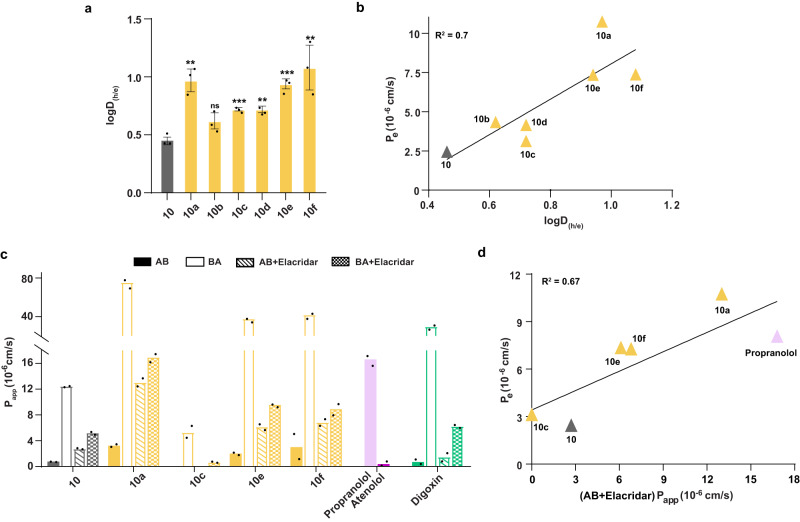
a Partition coefficient of 10 and 10a10f in heptane-ethylene glycol (h/e) solvent system. n = 3 ± SEM. b Linear correlation plot of Pe(PAMPA) vs. logD(h/e). c Bidirectional Caco-2 permeability in the presence and absence of P-gp efflux pump inhibitor elacridar, represented in bars as Papp. Propranolol and Atenolol were used markers of high and low permeability, respectively. Digoxin was used as the control substrate of P-gp efflux pumps. n = 2. Since n < 3, error bars and associated statistics has not been derived. d Linear correlation plot of Pe(PAMPA) vs. (AB + Elacridar) Papp(Caco-2). Each bar represents mean values of three biological replicates: dots are individual data points. Statistical significance was measured against the (all-amide) parent molecule by a one-tailed unpaired t-test. *p < 0.05, **p < 0.01, ***p < 0.001, ****p < 0.0001, ns (non-significant) > 0.05. p (10 vs 10a, 10b, 10c, 10d, 10e, 10f) = 0.0028, 0.0511, 0.0007, 0.0019, 0.0003, 0.0088 for logD(h/e). Source data are provided as a Source Data file.
Fig. 4
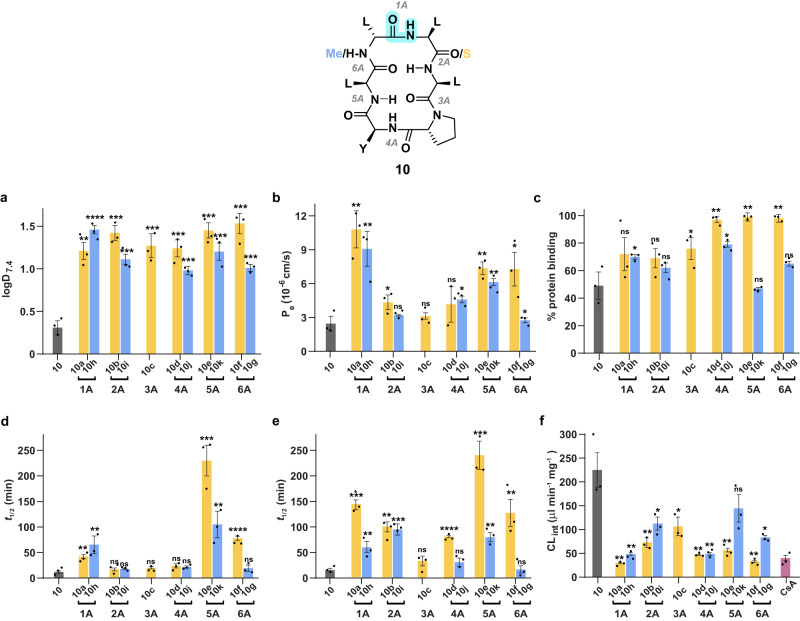
Fig. 4. Comparison of HBA and HBD-masking on the in vitro PK properties.
1A-6A refer to the amide bonds in 10. The yellow and the blue bars in the individual panels represent the thioamidated (10a10f) and the N-methylated (10g10k) counterparts, respectively, at a specific amide bond. a Octanol-water partition coefficient (logD7.4). b Membrane permeability (Pe) of the macrocyclic peptides determined by the PAMPA. c Extent of the peptides to bind non-specifically to plasma proteins determined through Rapid Equilibrium Dialysis (RED) represented in percentage (%). Half-lives (t1/2) of the peptides in d simulated gastric fluid (SGF), and e simulated intestinal fluid (SIF). f Intrinsic clearance (CLint) of the peptides in human liver microsomes deduced from their t1/2 values. Cyclosporin A (CsA) was taken as a control (CLint: 40 ± 5.5 μL min−1 mg−1). n = 3 ± SEM. Each bar represents mean values of three biological replicates: dots are individual data points. Statistical significance was measured against the (all-amide) parent molecule by a one-tailed unpaired t-test. *p < 0.05, **p < 0.01, ***p < 0.001, ****p < 0.0001, ns (non-significant) > 0.05. p (10 vs 10a, 10b, 10c, 10d, 10e, 10f) = 0.0013, 0.0002, 0.0007, 0.0005, 0.0002, 0.0003; p (10 vs 10g, 10h, 10i, 10j, 10k) = 0.0003, <0.0001, 0.0004, 0.0005, 0.0008 for logD7.4. p (10 vs 10a, 10b, 10c, 10d, 10e, 10f) = 0.0024, 0.0449, 0.1704, 0.1228, 0.0015, 0.0194; p (10 vs 10g, 10h, 10i, 10j, 10k) = 0.3501, 0.0065, 0.1232, 0.0102, 0.0021 for Pe by PAMPA. p (10 vs 10a, 10b, 10c, 10d, 10e, 10f) = 0.1022, 0.0802, 0.0418, 0.0032, 0.0026, 0.0026; p (10 vs 10g, 10h, 10i, 10j, 10k) = 0.0802, 0.0421, 0.1372, 0.0158, 0.3868 for plasma-protein binding. p (10 vs 10a, 10b, 10c, 10d, 10e, 10f) = 0.0012, 0.1085, 0.168, 0.107, 0.0008, <0.0001; p (10 vs 10g, 10h, 10i, 10j, 10k) = 0.1142, 0.0095, 0.245, 0.113, 0.0045 for t1/2 in SGF. p (10 vs 10a, 10b, 10c, 10d, 10e, 10f) = 0.0002, 0.0023, 0.0509, <0.0001, 0.0007, 0.0080; p (10 vs 10g, 10h, 10i, 10j, 10k) = 0.2716, 0.0081, 0.0001, 0.324, 0.0095 for t1/2 in SIF. p (10 vs 10a, 10b, 10c, 10d, 10e, 10f) = 0.0033, 0.0080, 0.0246, 0.0046, 0.0056, 0.0035; p (10 vs 10g, 10h, 10i, 10j, 10k) = 0.0100, 0.0048, 0.0241, 0.0048, 0.0801 for CLint. Source data are provided as a Source Data file.
Fig. 5
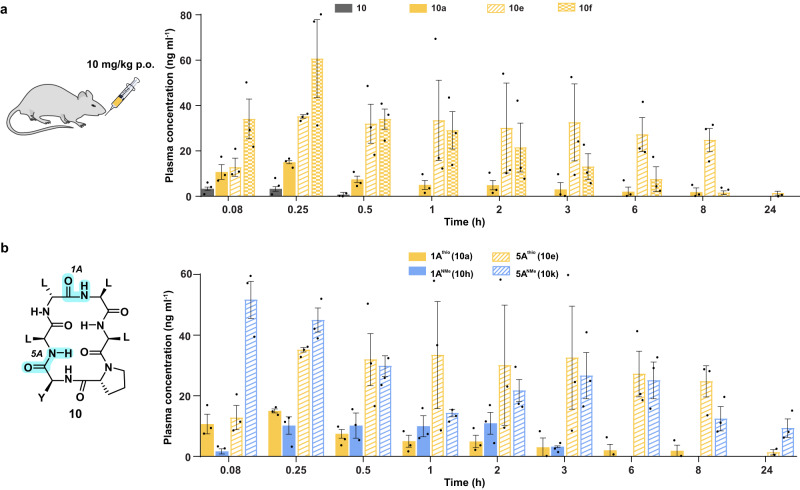
Fig. 5. Plasma exposure of thioamidated and N-methylated macrocyclic peptides post oral administration.
a Plasma concentration vs time plot of 10, 10a, 10e, and 10f after a single dose oral administration (10 mg/Kg) in male Wistar rats. n = 3 ± SEM. b Comparison of the plasma concentration with respect to time of the macrocycles obtained by thioamidation and N-methylation of amide bonds 1 A (10a, 10h) and 5 A (10e, 10k), following a single dose oral administration (10 mg/Kg) in male Wistar rats. n = 3 ± SEM. Each bar represents mean values of three biological replicates: dots are individual data points. Source data are provided as a Source Data file.
Fig. 6
Fig. 6. Impact of thioamide on hydrophilic macrocyclic peptide.
a The sequence of the cyclic hexapeptide analog of Somatostatin (13) and its mono-thioamidated regioisomers (13a13f). b Partition coefficient of 13, 13a13f in heptane-ethylene glycol (h/e) solvent system indicating their desolvation penalty. c Membrane permeability of the macrocyclic peptides determined by the PAMPA (Pe). Propranolol was used as the marker for transcellular transport. n = 3 ± SEM. Each bar represents mean values of three biological replicates: dots are individual data points. Statistical significance was measured against the (all-amide) parent molecule by a one-tailed unpaired t-test. *p < 0.05, **p < 0.01, ***p < 0.001, ****p < 0.0001, ns (non-significant) > 0.05. p (13 vs 13a, 13b, 13c, 13d, 13e, 13f) = 0.0002, <0.0001, 0.0052, 0.0002, 0.0020, 0.0005 for logD(h/e). p (13 vs 13a, 13b, 13c, 13d, 13e, 13f) = 0.0347, 0.0183, 0.2371, 0.0472, 0.2610, 0.3540 for Pe by PAMPA. Source data are provided as a Source Data file.
Fig. 7
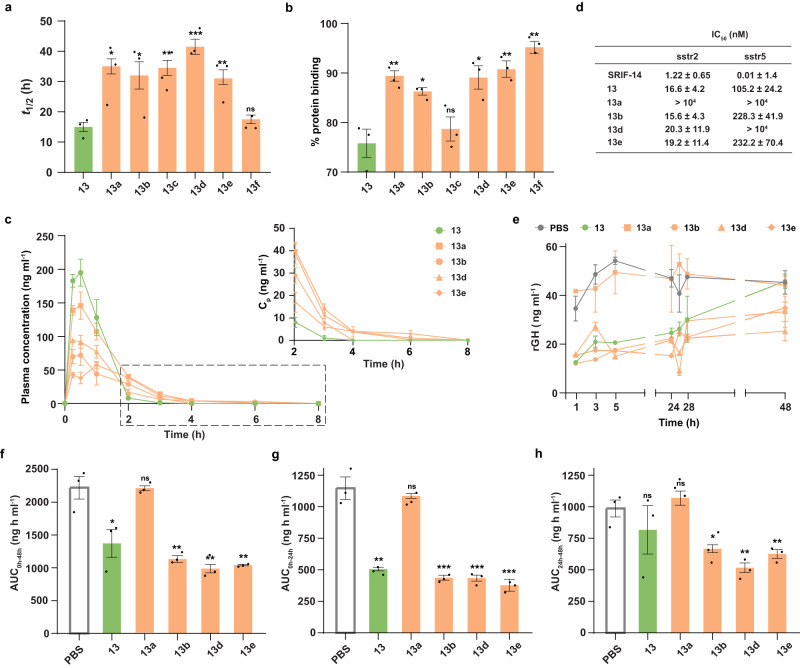
Fig. 7. Effect of thioamide on the PK and in vivo efficacy of somatostatin analogs.
a Half-lives (t1/2) of 13, 13a13f determined in human blood plasma. b % protein binding of the peptides in plasma, as measured through RED. c Plasma concentration vs time plot of 13, 13a, 13b, 13d, and 13e after a single dose (250 μg/Kg) s.c. administration in male Sprague-Dawley rats. The rapid drop in the concentration of 13 as opposed to its four thio analogs in plasma at later time points (2-8 h) are shown in the inset. d The IC50 values of the peptides determined from dose-dependent inhibition of forskolin-induced cAMP production in HEK293T cells expressing SSTR2 and SSTR5. n = 3 ± SEM. e Inhibition of rat growth hormone (rGH) levels over 48 hours post single dose (250 μg/Kg) peptide (13, 13a, 13b, 13d, 13e) and PBS (Untreated) administration via the s.c. route. f Bar plots represent the area under the concentration-time curve (AUCs) of rGH for (f) 0–48 h, (g) 0–24 h, and (h) 24-48 h. n = 3 ± SEM (a to d); n = 3 ± SEM (e); n = 3 ± SEM (f to h), Each bar represents mean values of three biological replicates: dots are individual data points. Statistical significance was measured against the (all-amide) parent molecule by a one-tailed unpaired t-test. *p < 0.05, **p < 0.01, ***p < 0.001, ****p < 0.0001, ns (non-significant) > 0.05. p (13 vs 13a, 13b, 13c, 13d, 13e, 13f) = 0.0110, 0.0332, 0.0037, 0.0005, 0.0083, 0.1674 for t1/2 in human blood plasma. p (13 vs 13a, 13b, 13c, 13d, 13e, 13f) = 0.0051, 0.0109, 0.2305, 0.0124, 0.0050, 0.0016 for plasma-protein binding. For AUC0h-48h, p (PBS vs 13, 13a, 13b, 13d, 13e) = 0.0189, 0.3960, 0.0022, 0.0015, 0.0014. For AUC0h-24h, p (PBS vs 13, 13a, 13b, 13d, 13e) = 0.0010, 0.2861, 0.0007, 0.0007, 0.0005. For AUC24h-48h, p (PBS vs 13, 13a, 13b, 13d, 13e) = 0.2236, 0.0552, 0.0113, 0.0018, 0.0041. Source data are provided as a Source Data file.

References

    1. Pattabiraman VR, Bode JW. Rethinking amide bond synthesis. Nature. 2011;480:471–479. doi: 10.1038/nature10702. - DOI - PubMed
    1. Muttenthaler M, King GE, Adams DJ, Alewood PE. Trends in peptide drug discovery. Nat. Rev. Drug Discov. 2021;20:309–325. doi: 10.1038/s41573-020-00135-8. - DOI - PubMed
    1. White AM, Craik DJ. Discovery and optimization of peptide macrocycles. Expert Opin. Drug Discov. 2016;11:1151–1163. doi: 10.1080/17460441.2016.1245720. - DOI - PubMed
    1. Yudin AK. Macrocycles: lessons from the distant past, recent developments, and future directions. Chem. Sci. 2015;6:30–49. doi: 10.1039/C4SC03089C. - DOI - PMC - PubMed
    1. Hosseinzadeh, P. et al. Anchor extension: a structure-guided approach to design cyclic peptides targeting enzyme active sites. Nat. Commun. 12, 3384 (2021). - PMC - PubMed

Publication types