


Assessment of the diagnostic accuracy of Vibrasense compared to a biothesiometer and nerve conduction study for screening diabetic peripheral neuropathy
- PMID: 37770911
- PMCID: PMC10537102
- DOI: 10.1186/s13047-023-00667-3
Assessment of the diagnostic accuracy of Vibrasense compared to a biothesiometer and nerve conduction study for screening diabetic peripheral neuropathy
Abstract
Aims: Peripheral neuropathy is a common microvascular complication in diabetes and a risk factor for the development of diabetic foot ulcers and amputations. Vibrasense (Ayati Devices) is a handheld, battery-operated, rapid screening device for diabetic peripheral neuropathy (DPN) that works by quantifying vibration perception threshold (VPT). In this study, we compared Vibrasense against a biothesiometer and nerve conduction study for screening DPN.
Methods: A total of 562 subjects with type 2 diabetes mellitus underwent neuropathy assessments including clinical examination, 10-g monofilament test, VPT evaluation with Vibrasense and a standard biothesiometer. Those with an average VPT ≥ 15 V with Vibrasense were noted to have DPN. A subset of these patients (N = 61) underwent nerve conduction study (NCS). Diagnostic accuracy of Vibrasense was compared against a standard biothesiometer and abnormal NCS.
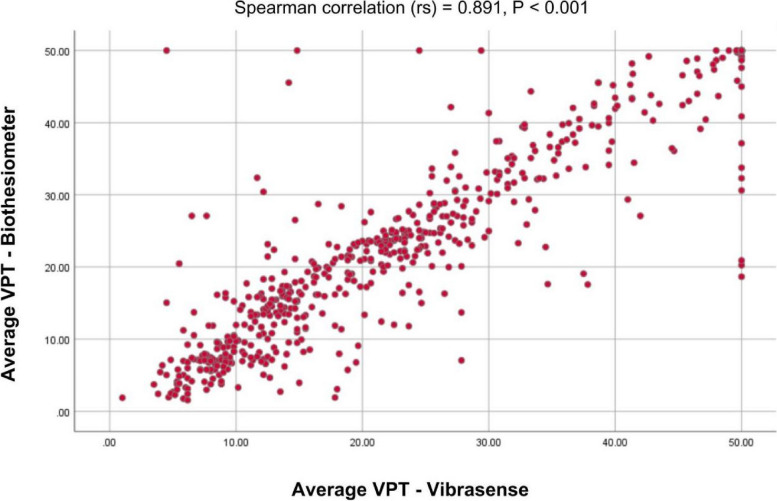
Results: Average VPTs measured with Vibrasense had a strong positive correlation with standard biothesiometer values (Spearman's correlation 0.891, P < 0.001). Vibrasense showed sensitivity and specificity of 87.89% and 86.81% compared to biothesiometer, and 82.14% and 78.79% compared to NCS, respectively.
Conclusions: Vibrasense demonstrated good diagnostic accuracy for detecting peripheral neuropathy in type 2 diabetes and can be an effective screening device in routine clinical settings.
Trial registration: Clinical trials registry of India (CTRI/2022/11/047002). Registered 3 November 2022. https://ctri.nic.in/Clinicaltrials/pmaindet2.php?trialid=76167 .
Keywords: Biothesiometer; Diabetic peripheral neuropathy; Quantitative sensory testing; Type 2 diabetes mellitus; Vibration perception threshold.
© 2023. The Author(s).
Conflict of interest statement
The authors declare that they have no competing interests.
Figures
References
-
- Boulton AJ, Armstrong DG, Albert SF, Frykberg RG, Hellman R, Kirkman MS, Lavery LA, Lemaster JW, Mills JL, Sr, Mueller MJ, Sheehan P, Wukich DK, American Diabetes Association; American Association of Clinical Endocrinologists Comprehensive foot examination and risk assessment: a report of the task force of the foot care interest group of the American Diabetes Association, with endorsement by the American Association of Clinical Endocrinologists. Diabetes Care. 2008;31(8):1679–85. doi: 10.2337/dc08-9021. - DOI - PMC - PubMed
-
- Schaper NC, van Netten JJ, Apelqvist J, Bus SA, Fitridge R, Game F, Monteiro-Soares M, Senneville E. IWGDF Editorial Board. Practical guidelines on the prevention and management of diabetes-related foot disease (IWGDF 2023 update). Diabetes Metab Res Rev. 2023:e3657. 10.1002/dmrr.3657. - PubMed
-
- ElSayed NA, Aleppo G, Aroda VR, Bannuru RR, Brown FM, Bruemmer D, Collins BS, Gibbons CH, Giurini JM, Hilliard ME, Isaacs D, Johnson EL, Kahan S, Khunti K, Leon J, Lyons SK, Perry ML, Prahalad P, Pratley RE, Seley JJ, Stanton RC, Sun JK, Gabbay RA, on behalf of the American Diabetes Association 12. Retinopathy, neuropathy, and foot care: standards of care in diabetes-2023. Diabetes Care. 2023;46(Suppl 1):S203–S215. doi: 10.2337/dc23-S012. - DOI - PMC - PubMed
MeSH terms
LinkOut - more resources
Full Text Sources
Medical
