


Assessment of public knowledge and attitude toward antibiotics use and resistance: a community pharmacy-based survey
- PMID: 37770989
- PMCID: PMC10537841
- DOI: 10.1186/s40545-023-00619-z
Assessment of public knowledge and attitude toward antibiotics use and resistance: a community pharmacy-based survey
Abstract
Background: Antimicrobial resistance is a public health challenge affecting all aspects of healthcare systems. Policies to reduce antimicrobial resistance should be implemented and monitored in community pharmacies, because they are patients' first point of care. Public awareness of relevant knowledge and attitudes on antimicrobials is a feasible strategy to mitigate the spread of antimicrobial resistance by exploiting the relationship between pharmacists and patients in the community pharmacy setting. The study evaluated and determined predictors of antibiotic knowledge and attitudes toward antibiotic use and resistance in community pharmacy patients.
Methods: A cross-sectional design was used to retrieve data in five randomly selected community pharmacies in Lagos and Abuja using a self-administered questionnaire. Descriptive and inferential statistics were utilized for characterizing and determining the associations between predictors and outcomes at p < 0.05. Logistic regression was used to identify predictors of patients' knowledge and attitude to antibiotic use.
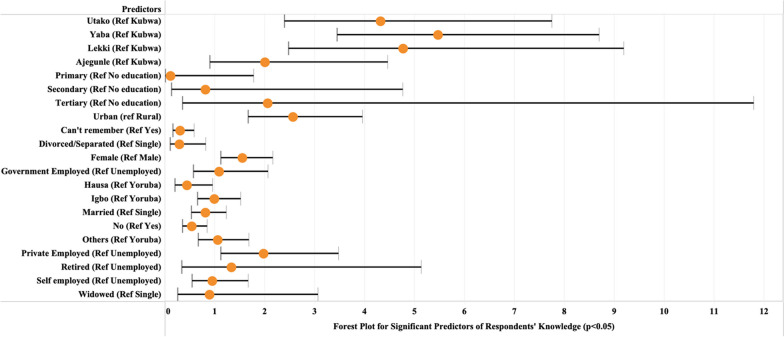
Results: A total of 964 clients participated in the study: 526(54.7%) were females, and 358(37.3%) were aged 25-34. chlorpheniramine-maleate and levonorgestrel were wrongly identified as antibiotics by 621 (64%) and 490 (50%) respondents, respectively. Many respondents, 448(46.5%), strongly agree that antibiotic creams should be mixed with body creams. The result of the multivariable logistic regression showed secondary education [Odds Ratio (OR): 0.31, 95% CI 0.10-0.97, p value: 0.044], urban residence (OR: 1.45, 95% CI 1.01-2.08, p value: 0.043) and age 34 (OR: 1.55, 95% CI 1.01-2.37, p value: 0.045) were strong predictors of knowledge on antibiotics, while community pharmacy location (OR: 5.48, 95% CI 3.45-8.70, p value: ≤ 0.001), urban residence (OR: 2.57, 95% CI 1.67-3.96, p value: ≤ 0.001), and antibiotic recommender (OR: 0.55, 95% CI 0.35-0.85, p value: 0.008) were predictors of respondents' attitude to antibiotic use.
Conclusions: The study established that sociodemographic factors could impact community pharmacy clients' knowledge and attitude toward antibiotic use and resistance and should be considered when developing policies to curb the spread of resistant microbes. Community pharmacies should educate community pharmacy clients on the dangers associated with the misuse of antibiotics with stringent antibiotic stewardship programs and restrict access to antibiotics over-the-counter.
Keywords: Antibiotics; Attitude; Community pharmacy; Knowledge; Resistance.
© 2023. The Author(s).
Conflict of interest statement
The authors declare that there is no conflict of interest as regard this research.
Figures



References
-
- Tabish S, Syed N. The future of humanity and microbes: impact of emerging infectious diseases on global health and economies. Int J Sci Res. 2015;4:2427–2442.
-
- Muley D, Shahin M, Dias C, et al. Role of transport during outbreak of infectious diseases: evidence from the past. Sustainability. 2020;12:7367. doi: 10.3390/su12187367. - DOI
-
- World Health Organization. Infections and infectious diseases: A manual for nurses and midwives in the WHO European Region. 2001; 271.
-
- World Health Organization . World Health Statististics 2019: monitoring health for the SDGs. Geneva: Sustainable Development Goals; 2019.
LinkOut - more resources
Full Text Sources
