. 2023 Oct;11(19):e15824.
doi: 10.14814/phy2.15824.

Genetic background influences arterial vasomotor function in male and female mice

Affiliations

Genetic background influences arterial vasomotor function in male and female mice

Dylan Holly et al. Physiol Rep. 2023 Oct.

Abstract

The purpose of this study was to assess the influence of genetic background and sex on nitric oxide (NO)-mediated vasomotor function in arteries from different vascular territories. Vasomotor function was assessed in thoracic aorta, abdominal aorta, carotid arteries, and femoral arteries from the following mouse strains: SJL/J, DBA/2J, NZW/LacJ, and C57BL/6J. Contractile responses were assessed using the α1-adrenergic receptor agonist phenylephrine (PE, 10-9 -10-5 M). Vasorelaxation responses were assessed by examining relaxation to an endothelium-dependent vasodilator acetylcholine (ACh, 10-9 -10-5 M) and an endothelium-independent vasodilator sodium nitroprusside (SNP, 10-9 -10-5 M). To evaluate the role of NO, relaxation responses to ACh and SNP were assessed in the absence or presence of a nitric oxide synthase inhibitor (N omega-nitro-l-arginine methyl ester hydrochloride: 10-4 M). Vasomotor responses to ACh and PE varied across strains and among the arteries tested with some strains exhibiting artery-specific impairment. Results indicated some concentration-response heterogeneity in response to ACh and SNP between vessels from females and males, but no significant differences in responses to PE. Collectively, these findings indicate that vasomotor responses vary by genetic background, sex, and artery type.

Keywords: aorta; carotid artery; endothelium; femoral artery; inbred mice; sex differences.


Conflict of interest statement

The authors declare that the research was conducted in the absence of any commercial or financial relationships that could be construed as a potential conflict of interest.

Figures

FIGURE 1
FIGURE 1
Strain and sex differences in endothelium‐dependent relaxation to acetylcholine (ACh) in thoracic and abdominal aorta, and carotid and femoral arteries. Cumulative concentration–response curves to ACh (10−9 to 10−5 M) were assessed in isolated arteries from female (left) and male (right) mice from four inbred strains, C57BL/6J (B6), DBA2/J (DBA), NZW/LacJ (NZW), and SJL/J (SJL). Cumulative concentration–response curves are expressed as percent relaxation (%). Main effects for strain, sex, and their interaction from a factorial repeated measures analysis are shown for each artery. The p‐value for concentration was significant for each artery (p < 0.0001 for all). Strain differences, determined by Tukey post hoc analysis, are indicated by letters B, B6; D, DBA; N, NZW; S, SJL. Sex differences are indicated by M, male; F, female. Males and females are plotted separately for clarity. Numbers in parentheses indicate the number of animals per strain for each artery. Values are expressed as mean ± SEM.
FIGURE 2
FIGURE 2
Maximal responses to acetylcholine differ by strain and sex. Values are expressed as mean ± SEM. Two‐way analysis of variance was used to determine the main effects of strain, sex, and interaction for (a) thoracic aorta (p strain ≤ 0.0001, p sex = 0.5, p int = 0.01), (b) abdominal aorta (p strain = 0.001, p sex = 0.06, p int = 0.2), (c) carotid artery (p strain ≤ 0.0001, p sex = 0.053, p int = 0.3), and (d) femoral artery (p strain ≤ 0.0001, p sex = 0.25, p int = 0.007). Strain differences, determined by Tukey post hoc analysis, are indicated by letters B, B6; D, DBA; N, NZW; S, SJL. *p < 0.05 significant pairwise comparison from strain by sex interaction. The number of animals per strain, sex, and artery is listed in Figure 1.
FIGURE 3
FIGURE 3
Strain and sex differences in endothelium‐independent relaxation to sodium nitroprusside (SNP) in thoracic and abdominal aorta, and carotid and femoral arteries. Cumulative concentration–response curves to SNP (10−9 to 10−5 M) were assessed in isolated arteries from female (left) and male (right) mice from four inbred strains, C57BL/6J (B6), DBA2/J (DBA), NZW/LacJ (NZW), and SJL/J (SJL). Cumulative concentration–response curves are expressed as percent relaxation (%). Main effects for strain, sex, and their interaction from a factorial repeated measures analysis are shown for each artery. The p‐value for concentration was significant for each artery (p < 0.0001 for all). Strain differences, determined by Tukey post hoc analysis, are indicated by letters B, B6; D, DBA; N, NZW; S, SJL. Sex differences are indicated by M, male; F, female. Males and females are plotted separately for clarity. Numbers in parentheses indicate the number of animals per strain for each artery. Values are expressed as mean ± SEM.
FIGURE 4
FIGURE 4
Strain differences in maximal responses to sodium nitroprusside. Values are expressed as mean ± SEM. Two‐way analysis of variance was used to determine the main effects of strain, sex, and interaction for (a) thoracic aorta (p strain = 0.3, p sex = 0.4, p int = 0.7), (b) abdominal aorta (p strain = 0.2, p sex = 0.5, p int = 0.07), (c) carotid artery (p strain ≤ 0.0001, p sex = 0.8, p int = 0.005), and (d) femoral artery (p strain = 0.03, p sex = 0.3, p int = 0.005). Strain differences, determined by Tukey post hoc analysis, are indicated by letters B, B6; D, DBA; N, NZW. The number of animals per strain, sex, and artery is listed in Figure 3.
FIGURE 5
FIGURE 5
Effect of l‐NAME on relaxation responses to acetylcholine (ACh) in thoracic and abdominal aorta, and carotid and femoral arteries. Cumulative concentration–response curves to ACh (10−9 to 10−5 M) after incubation with l‐NAME (10−4 M, 30 min) were assessed in isolated arteries from female (left) and male (right) mice from four inbred strains, C57BL/6J (B6), DBA2/J (DBA), NZW/LacJ (NZW), and SJL/J (SJL). Cumulative concentration–response curves are expressed as percent relaxation (%). Negative numbers indicate contraction. Main effects for strain, sex, and their interaction from a factorial repeated measures analysis are shown for each artery. The p‐value for concentration was significant for each artery (p < 0.0001 for all). Strain differences, determined by Tukey post hoc analysis, are indicated by letters B, B6; S, SJL. Males and females are plotted separately for clarity. Numbers in parentheses indicate the number of animals per strain for each artery. Values are expressed as mean ± SEM. l‐NAME, N omega‐nitro‐l‐arginine methyl ester hydrochloride.
FIGURE 6
FIGURE 6
Inhibiting endothelial nitric oxide synthase (eNOS) alters maximal relaxation responses to acetylcholine (ACh) in an artery‐dependent manner. Responses to ACh were obtained in the absence (ACh, gray bars) or presence of l‐NAME (ACh + l‐NAME, black bars) from the thoracic (TA) and abdominal (AA) aorta, and carotid (CA) and femoral (FA) arteries. Arteries from C57BL/6J (B6), DBA2/J (DBA), NZW/LacJ (NZW), and SJL/J (SJL) were incubated with l‐NAME (10−4 M, 30 min) prior to generating concentration–responses curves (Figure 5). Male and female data for each condition per strain are combined for each artery. Values are expressed as mean ± SEM. *p < 0.05 ACh + l‐NAME is significantly different from ACh. l‐NAME, N omega‐nitro‐l‐arginine methyl ester hydrochloride.
FIGURE 7
FIGURE 7
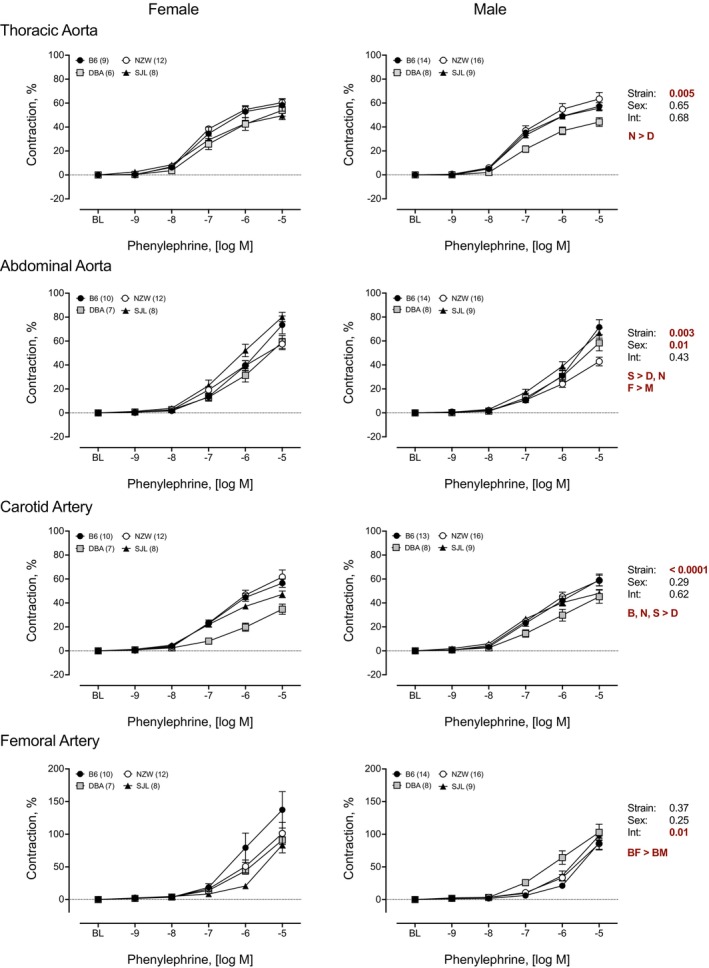
Strain and sex differences in contractile responses to phenylephrine (PE) in thoracic and abdominal aorta, and carotid and femoral arteries. Cumulative concentration–response curves to PE (10−9 to 10−5 M) were assessed in isolated arteries from female (left) and male (right) mice from four inbred strains, C57BL/6J (B6), DBA2/J (DBA), NZW/LacJ (NZW), and SJL/J (SJL). Cumulative concentration–response curves are expressed as percent relaxation (%). Main effects for strain, sex, and their interaction from a factorial repeated measures analysis are shown for each artery. The p‐value for concentration was significant for each artery (p < 0.0001 for all). Strain differences, determined by Tukey post hoc analysis, are indicated by letters B, B6; D, DBA; N, NZW; S, SJL. Sex differences are indicated by M, male; F, female. Males and females are plotted separately for clarity. Numbers in parentheses indicate the number of animals per strain for each artery. Values are expressed as mean ± SEM.
FIGURE 8
FIGURE 8
Maximal responses to phenylephrine differ by strain. Values are expressed as mean ± SEM. Two‐way analysis of variance was used to determine the main effects of strain, sex, and interaction for (a) thoracic aorta (p strain = 0.03, p sex = 0.9, p int = 0.04), (b) abdominal aorta (p strain ≤ 0.0001, p sex = 0.058, p int = 0.4), (c) carotid artery (p strain = 0.0003, p sex = 0.4, p int = 0.6), and (d) femoral artery (p strain = 0.4, p sex = 0.4, p int = 0.1). Strain differences, determined by Tukey post hoc analysis, are indicated by letters B, B6; N, NZW; S, SJL. The number of animals per strain, sex, and artery is listed in Figure 7.

References

    1. Aird, W. C. (2007). Phenotypic heterogeneity of the endothelium: I. Structure, function, and mechanisms. Circulation Research, 100, 158–173. 10.1161/01.RES.0000255691.76142.4a - DOI - PubMed
    1. Bots, S. H. , Peters, S. A. E. , & Woodward, M. (2017). Sex differences in coronary heart disease and stroke mortality: A global assessment of the effect of ageing between 1980 and 2010. BMJ Global Health, 2, e000298. 10.1136/bmjgh-2017-000298 - DOI - PMC - PubMed
    1. Celermajer, D. S. , Sorensen, K. E. , Spiegelhalter, D. J. , Georgakopoulos, D. , Robinson, J. , & Deanfield, J. E. (1994). Aging is associated with endothelial dysfunction in healthy men years before the age‐related decline in women. Journal of the American College of Cardiology, 24, 471–476. 10.1016/0735-1097(94)90305-0 - DOI - PubMed
    1. Chen, C. , Korshunov, V. A. , Massett, M. P. , Yan, C. , & Berk, B. C. (2007). Impaired vasorelaxation in inbred mice is associated with alterations in both nitric oxide and super oxide pathways. Journal of Vascular Research, 44, 504–512. 10.1159/000106751 - DOI - PubMed
    1. Cohen, J. (1988). Statistical power analysis for the behavioral sciences. L. Erlbaum Associates.

Publication types

LinkOut - more resources