


Understanding inequalities in access to adult mental health services in the UK: a systematic mapping review
- PMID: 37773154
- PMCID: PMC10542667
- DOI: 10.1186/s12913-023-10030-8
Understanding inequalities in access to adult mental health services in the UK: a systematic mapping review
Abstract
Background: Population groups experience differential access to timely and high-quality mental healthcare. Despite efforts of recent UK policies to improve the accessibility of mental health services, there remains a lack of comprehensive understanding of inequalities in access to services needed to do this. This systematic mapping review aimed to address this gap by identifying which population groups continue to be poorly served by access to adult mental health services in the UK, how access has been measured, and what research methods have been applied.
Methods: Seven electronic databases were searched from January 2014 up to May 2022. Primary research studies of any design were included if they examined access to adult NHS mental health services in the UK by population groups at risk of experiencing inequalities. Study characteristics, measures of access, inequalities studied, and key findings were extracted. A best-fit framework approach was used, applying Levesque's Conceptual Framework for Healthcare Access to synthesise measures of access, and applying a template derived from Cochrane Progress-Plus and NHS Long Term Plan equality characteristics to synthesise key findings associated with inequalities.
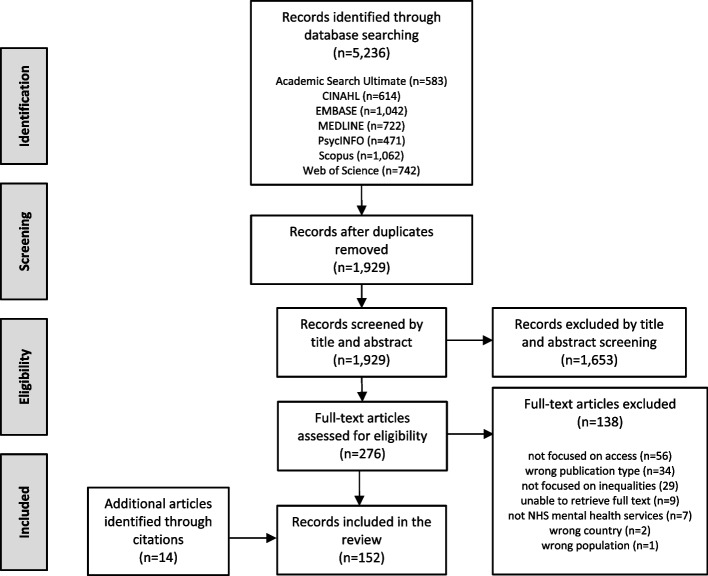
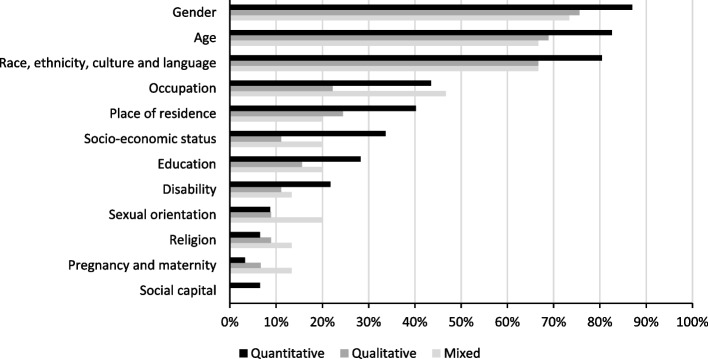
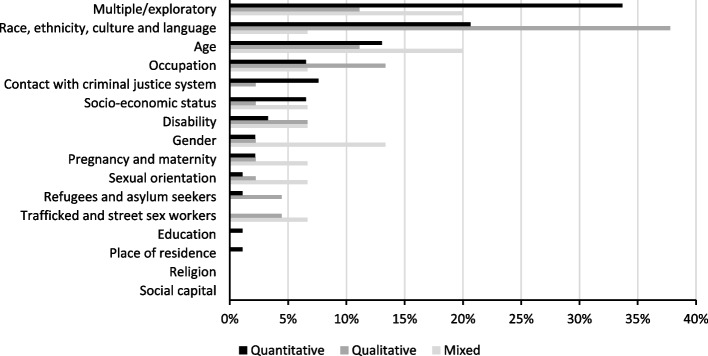
Results: Of 1,929 publications retrieved, 152 studies of various types were included. The most frequently considered dimensions of inequality were gender, age, and ethnicity, whilst social capital, religion, and sexual orientation were least frequently considered. Most studies researched access by measuring "healthcare utilisation", followed by studies that measured "healthcare seeking". Key barriers to access were associated with individuals' "ability to seek" (e.g. stigma and discrimination) and "ability to reach" (e.g. availability of services). Almost half of the studies used routinely collected patient data, and only 16% of studies reported patient and public involvement.
Conclusions: Little appears to have changed in the nature and extent of inequalities, suggesting that mental health services have not become more accessible. Actions to reduce inequalities should address barriers to population groups' abilities to seek and reach services such as stigma-reducing interventions, and re-designing services and pathways. Significant benefits exist in using routinely collected patient data, but its limitations should not be ignored. More theoretically informed research, using a holistic measurement of access, is needed in this area.
Review registration: https://doi.org/10.17605/OSF.IO/RQ5U7 .
Keywords: Healthcare access; Inequalities; Mental health services; Systematic mapping review; United Kingdom.
© 2023. BioMed Central Ltd., part of Springer Nature.
Conflict of interest statement
The authors declare no competing interests.
Figures
References
-
- GBD 2019 Mental Disorders Collaborators Global, regional, and national burden of 12 mental disorders in 204 countries and territories, 1990–2019: a systematic analysis for the Global Burden of Disease Study 2019. Lancet Psychiatry. 2022;9(2):137–50. doi: 10.1016/S2215-0366(21)00395-3. - DOI - PMC - PubMed
-
- World Health Organisation. World mental health report: transforming mental health for all. 2022. Available from: https://www.who.int/teams/mental-health-and-substance-use/world-mental-h....
-
- McManus S, Bebbington P, Jenkins R, Brugha T. Mental health and wellbeing in England: Adult Psychiatric Morbidity Survey 2014. Leeds: NHS Digital; 2016. Available from: https://files.digital.nhs.uk/pdf/q/3/mental_health_and_wellbeing_in_engl....
-
- National Audit Office. Progress in improving mental health services in England. 2023. Available from: https://www.nao.org.uk/wp-content/uploads/2023/02/Progress-in-improving-....
-
- Commission for Equality in Mental Health. Access to mental health support. 2020. Available from: https://www.centreformentalhealth.org.uk/publications/commission-equalit....
Publication types
MeSH terms
Grants and funding
LinkOut - more resources
Full Text Sources
Miscellaneous
