


Epstein-Barr virus (EBV) antibody changes over time in a general population cohort in rural Uganda, 1992-2008
- PMID: 37775773
- PMCID: PMC10543268
- DOI: 10.1186/s13027-023-00534-7
Epstein-Barr virus (EBV) antibody changes over time in a general population cohort in rural Uganda, 1992-2008
Abstract
Background: Epstein-Barr virus (EBV) infection is ubiquitous and in sub-Saharan Africa, occurs early in life. In a population-based rural African cohort, we leveraged historical samples from the General Population Cohort (GPC) in Uganda to examine the epidemiology of infection with EBV over time, in the era of HIV.
Methods: We used 9024 serum samples collected from the GPC in 1992, 2000, 2008, from 7576 participants across the age range (0-99 years of age) and tested for anti-EBV immunoglobulin G (IgG) antibodies to EAd, VCA, and EBNA-1 using a multiplex bead-based assay. The related gammaherpesvirus, Kaposi's sarcoma-associated herpesvirus (KSHV) seropositivity was also determined by detection of anti-KSHV IgG antibodies to K8.1 or ORF73 measured by recombinant protein enzyme-linked immunosorbent assay. Data on sex, age, and HIV serostatus were also collected. EBV seropositivity was modeled with age (excluding those under one year, who may have had maternal antibodies), sex, HIV serostatus, and KSHV serostatus using generalized linear mixed effects models to produce beta estimates.
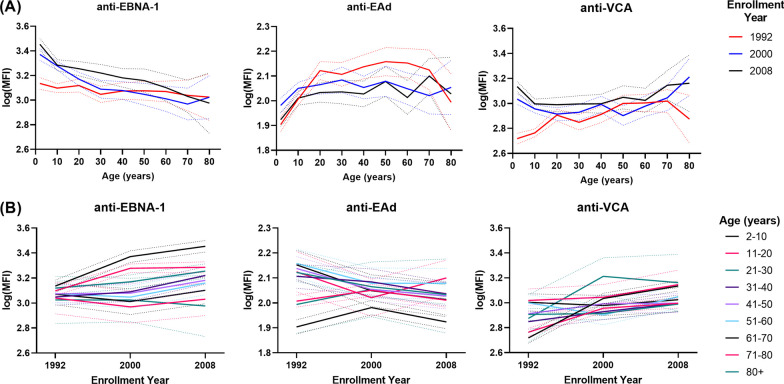
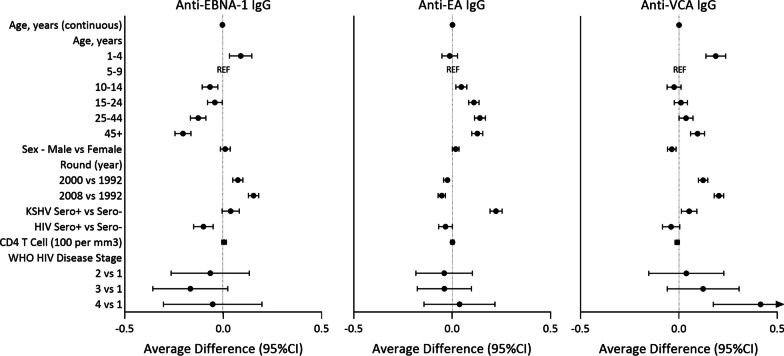
Results: More than 93% of children were EBV seropositive by one year of age. EBV seropositivity was significantly associated with KSHV seropositivity. Anti-EBNA-1 antibody levels decreased with increasing age and were lower on average in people living with HIV. In general, anti-EAd antibody levels increased with age, were higher in males and KSHV seropositive persons, but decreased over calendar time. Anti-VCA antibody levels increased with age and with calendar time and were higher in KSHV seropositive persons but lower in males.
Conclusions: This is the first study to identify factors associated with EBV antibodies across the entire life-course in rural sub-Saharan Africa. Consistent with other studies, EBV was near ubiquitous in the population by age one year. Patterns of antibodies show changes by age, sex and calendar time, but no association with HIV was evident, suggesting no relationship between EBV sero-epidemiology and the spread of HIV in the population over time in Uganda.
Keywords: Antibodies; Epstein–Barr virus (EBV); HIV; Kaposi’s sarcoma-associated herpesvirus (KSHV); Life course; Pre-ART; Serology; Sub-Saharan Africa; Uganda.
© 2023. BioMed Central Ltd., part of Springer Nature.
Conflict of interest statement
The authors declare that they have no competing interests.
Figures

References
-
- Piriou E, Asito AS, Sumba PO, Fiore N, Middeldorp JM, Moormann AM, et al. Early age at time of primary Epstein–Barr virus infection results in poorly controlled viral infection in infants from Western Kenya: clues to the etiology of endemic Burkitt lymphoma. J Infect Dis. 2012;205(6):906–913. doi: 10.1093/infdis/jir872. - DOI - PMC - PubMed
-
- de The G, Day NE, Geser A, Lavoue MF, Ho JH, Simons MJ, et al. Sero-epidemiology of the Epstein–Barr virus: preliminary analysis of an international study - a review. IARC Sci Publ. 1975;11:3–16. - PubMed
Grants and funding
LinkOut - more resources
Full Text Sources
Research Materials
