Review
. 2023 Dec;41(6):681-697.
doi: 10.1007/s12640-023-00669-w. Epub 2023 Sep 30.

RNA-Binding Proteins: A Role in Neurotoxicity?

Affiliations
Review

RNA-Binding Proteins: A Role in Neurotoxicity?

Andrea Ocharán-Mercado et al. Neurotox Res. 2023 Dec.

Abstract

Despite sustained efforts to treat neurodegenerative diseases, little is known at the molecular level to understand and generate novel therapeutic approaches for these malignancies. Therefore, it is not surprising that neurogenerative diseases are among the leading causes of death in the aged population. Neurons require sophisticated cellular mechanisms to maintain proper protein homeostasis. These cells are generally sensitive to loss of gene expression control at the post-transcriptional level. Post-translational control responds to signals that can arise from intracellular processes or environmental factors that can be regulated through RNA-binding proteins. These proteins recognize RNA through one or more RNA-binding domains and form ribonucleoproteins that are critically involved in the regulation of post-transcriptional processes from splicing to the regulation of association of the translation machinery allowing a relatively rapid and precise modulation of the transcriptome. Neurotoxicity is the result of the biological, chemical, or physical interaction of agents with an adverse effect on the structure and function of the central nervous system. The disruption of the proper levels or function of RBPs in neurons and glial cells triggers neurotoxic events that are linked to neurodegenerative diseases such as spinal muscular atrophy (SMA), amyotrophic lateral sclerosis (ALS), fragile X syndrome (FXS), and frontotemporal dementia (FTD) among many others. The connection between RBPs and neurodegenerative diseases opens a new landscape for potentially novel therapeutic targets for the intervention of these neurodegenerative pathologies. In this contribution, a summary of the recent findings of the molecular mechanisms involved in the plausible role of RBPs in RNA processing in neurodegenerative disease is discussed.

Keywords: Neurodegenerative diseases; Neurotoxicity; Post-transcriptional modifications; RNA-binding proteins.


Conflict of interest statement

The authors declare no competing interests.

The authors declare that they have no conflict of interest.

Figures
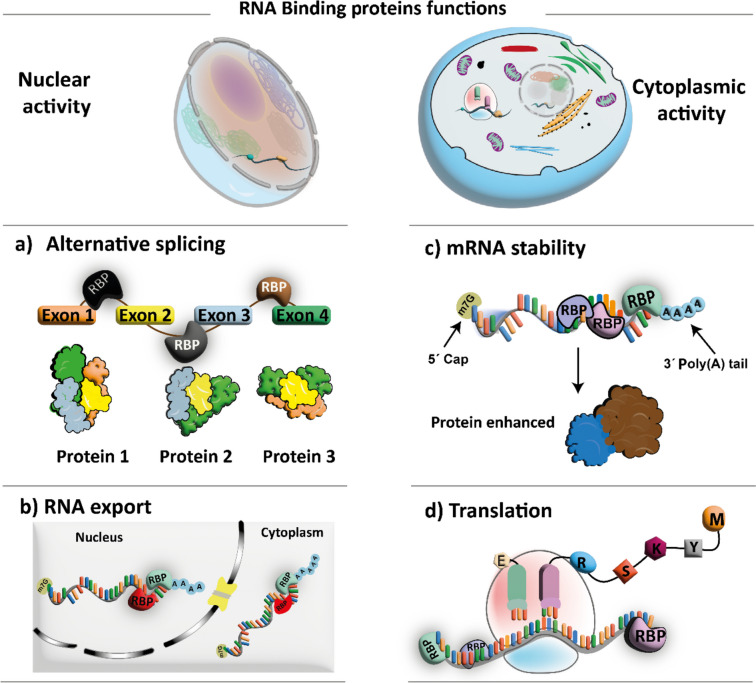
Fig. 1
Fig. 1
Representative summary of the different RBPs functions. The RBPs functions can be divided into nuclear and cytoplasmic activities. For example, in the nucleus, a) RBPs regulate the splicing of multi-exon genes and the exon skipping results in different protein isoforms from one unique gene. b) The RNA nuclear export by RBPs determines the proper out in the amount and correct timing from the nucleus. While in the cytoplasm, c) RBPs regulate mRNA stability and d) translation in the correct cytoplasmic localization
Fig. 2
Fig. 2
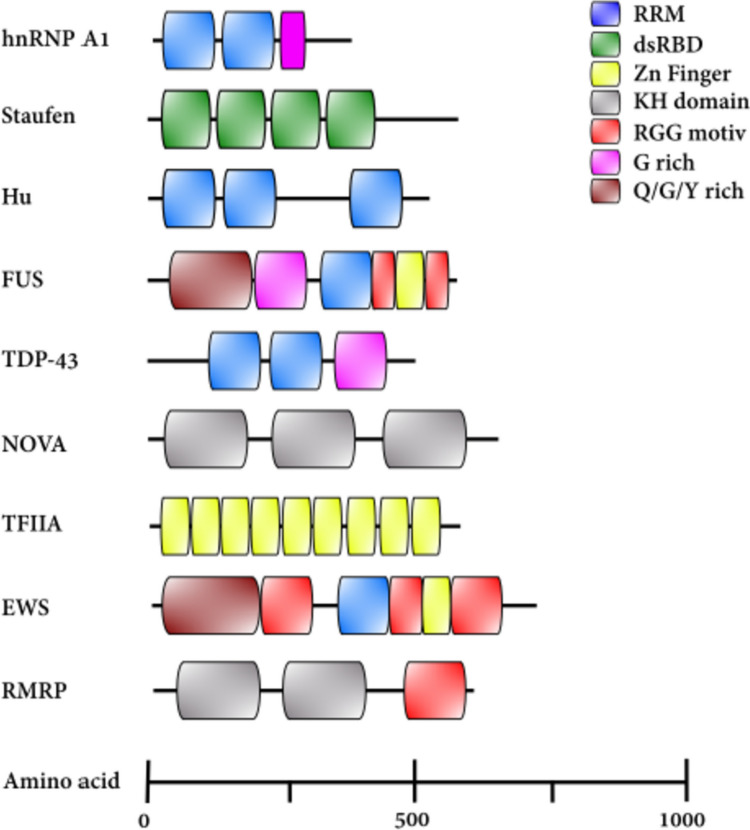
Modular structures of RBPs. Representative examples from some of the most common RNA-binding proteins involved in neurodegeneration. RNA-binding domains (RBDs) can act independently or when RBDs are found in multiple modules can act synergistically. Proteins are sized according to their amino acid lengths. RRM, RNA recognition motif; dsRBD, double-stranded RNA-binding motif; ZnF, zinc finger motif; KH, K-homology domain; RGG, Arg-Gly-Gly motiv; G, Gly motiv; Q/G/S/Y, Gln-Gly-Ser-Tyr motif. Modified from (Shotwell et al. 2020)
Fig. 3
Fig. 3
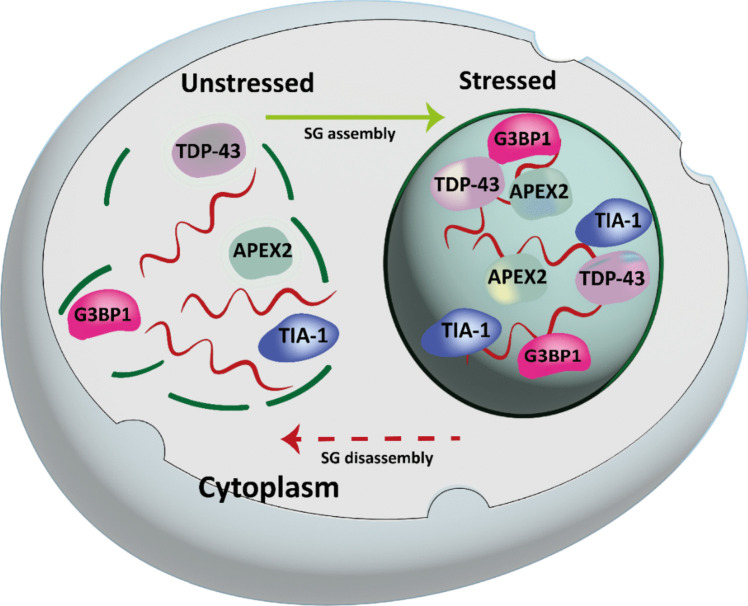
Assembly and disassembly of stress granules. Under unstressed conditions, mRNA exists in the cytoplasm and is normally translated. Upon stress, mRNAs are protected within stress granules. Once the stress has been removed, the stress granules disassemble. The dynamic assembly of SG is also promoted by RBPs such as TIA-1. TDP-43, TAR DNA-binding protein 43; TIA-1, T-cell internal antigen-1; G3BP1, stress granule assembly factor 1; APEX2, apurinic/apyrimidinic endodeoxyribonuclease 2. Modified from (Hofmann et al. 2020)
Fig. 4
Fig. 4
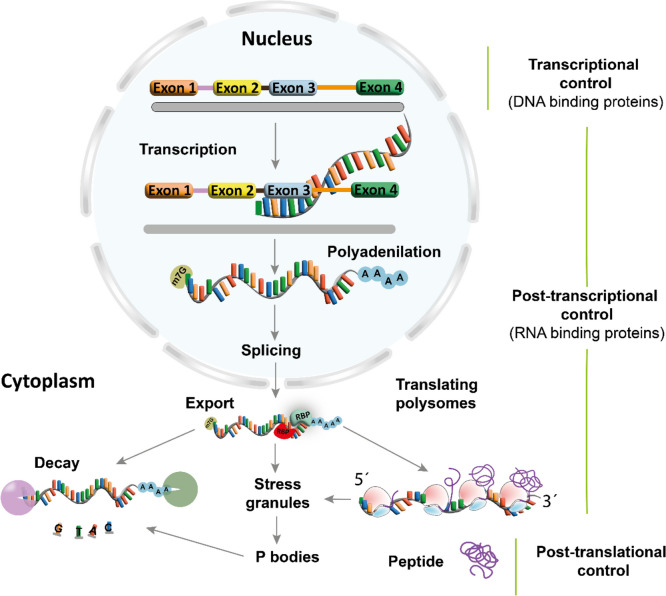
RNA regulation cascade by RBPs from the nucleus to the cytoplasm. From DNA to RNA transcription, there are RBPs involved in the isoform length by two mechanisms: the alternative exons selection (splicing) and the alternative polyadenylation sites. After RNA export at the post-translational level is regulated by some RBPs that can conduce to decoy, protection mechanisms such as the formation of dynamic stress granules and P-bodies or ensure the performance of mRNA through translating polysomes that ensure a high peptide-protein expression rate, all processes in at post-translational level

References

    1. Adeli K (2011) Translational control mechanisms in metabolic regulation: critical role of RNA binding proteins, microRNAs, and cytoplasmic RNA granules. Am J Physiol Endocrinol Metabol 301 (6). 10.1152/ajpendo.00399.2011 - PubMed
    1. Afroz T, Cienikova Z, Cléry A, Allain FHT. One, two, three, four! How multiple RRMs read the genome sequence. Methods Enzymol. 2015;558(1):235–278. doi: 10.1016/bs.mie.2015.01.015. - DOI - PubMed
    1. Ainsley JA, Drane L, Jacobs J, Kittelberger KA, Reijmers LG (2014) Functionally diverse dendritic mRNAs rapidly associate with ribosomes following a novel experience,” (in eng). Nat Commun 5:4510 - PMC - PubMed
    1. Alves LR. RNA-binding proteins related to stress response and differentiation in protozoa. World J Biol Chem. 2016;7(1):78–78. doi: 10.4331/wjbc.v7.i1.78. - DOI - PMC - PubMed
    1. Anderson P, Kedersha N. RNA granules: post-transcriptional and epigenetic modulators of gene expression. Nat Rev Mol Cell Biol. 2009;10(6):430–436. doi: 10.1038/nrm2694. - DOI - PubMed

Substances