. 2023 Nov:67:102901.
doi: 10.1016/j.redox.2023.102901. Epub 2023 Sep 22.

Small molecule screen identifies pyrimethamine as an inhibitor of NRF2-driven esophageal hyperplasia

Affiliations

Small molecule screen identifies pyrimethamine as an inhibitor of NRF2-driven esophageal hyperplasia

Chorlada Paiboonrungruang et al. Redox Biol. 2023 Nov.

Abstract

Objective: NRF2 is a master transcription factor that regulates the stress response. NRF2 is frequently mutated and activated in human esophageal squamous cell carcinoma (ESCC), which drives resistance to chemotherapy and radiation therapy. Therefore, a great need exists for NRF2 inhibitors for targeted therapy of NRF2high ESCC.

Design: We performed high-throughput screening of two compound libraries from which hit compounds were further validated in human ESCC cells and a genetically modified mouse model. The mechanism of action of one compound was explored by biochemical assays.

Results: Using high-throughput screening of two small molecule compound libraries, we identified 11 hit compounds as potential NRF2 inhibitors with minimal cytotoxicity at specified concentrations. We then validated two of these compounds, pyrimethamine and mitoxantrone, by demonstrating their dose- and time-dependent inhibitory effects on the expression of NRF2 and its target genes in two NRF2Mut human ESCC cells (KYSE70 and KYSE180). RNAseq and qPCR confirmed the suppression of global NRF2 signaling by these two compounds. Mechanistically, pyrimethamine reduced NRF2 half-life by promoting NRF2 ubiquitination and degradation in KYSE70 and KYSE180 cells. Expression of an Nrf2E79Q allele in mouse esophageal epithelium (Sox2CreER;LSL-Nrf2E79Q/+) resulted in an NRF2high phenotype, which included squamous hyperplasia, hyperkeratinization, and hyperactive glycolysis. Treatment with pyrimethamine (30 mg/kg/day, p.o.) suppressed the NRF2high esophageal phenotype with no observed toxicity.

Conclusion: We have identified and validated pyrimethamine as an NRF2 inhibitor that may be rapidly tested in the clinic for NRF2high ESCC.

Keywords: Esophageal squamous cell carcinoma; KEAP1; Mitoxantrone; NRF2; Pyrimethamine.


Conflict of interest statement

Declaration of competing interest The authors declare no potential conflicts of interest.

Figures

Image 1
Graphical abstract
Fig. 1
Fig. 1
High-throughput screening for NRF2 inhibitors from two compound libraries (1 μM) using NQO1-YFP H1299 cells. (A) Flow chart of the screening strategy; (B) Time-dependent changes of the YFP signal (NRF2 activity); (C) Time-dependent changes of the mCherry signal (cell viability); Negative control: exposure to a known NRF2 activator (CDDO, 200 nM); Positive control: exposure to the vehicle. (D) Prestwick library (1280 FDA-approved drug compounds); (E) Asinex library (34,560 compounds). Hit compounds were selected if the CDDO-induced NRF2 activity was inhibited by >50% and cell survival was >80%. Three compounds from the Asinex library were defined as borderline hits because their inhibition of NRF2 activity was >50%, yet their effects on cell survival were ∼80%.
Fig. 2
Fig. 2
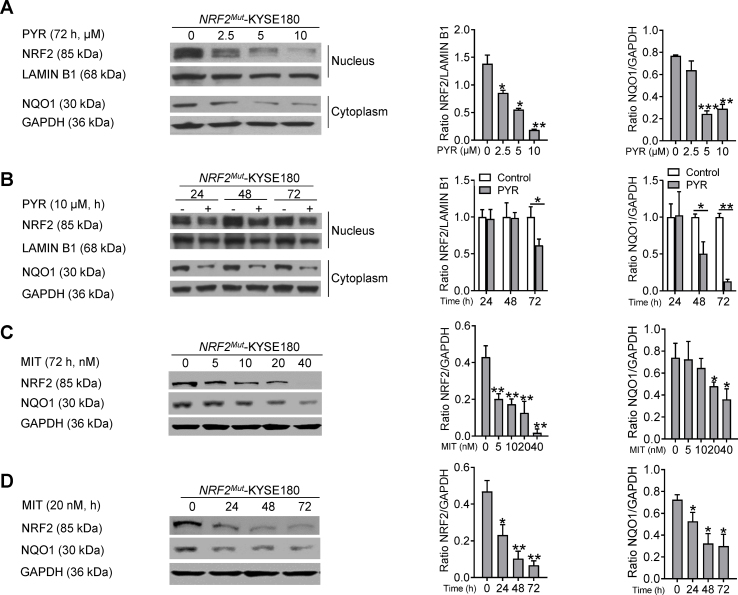
PYR and MIT downregulated NRF2 and NQO1 expression in NRF2Mut-KYSE70 cells in a dose- and time-dependent manner. (A) Dose-dependent downregulation of the expression of nuclear NRF2 and cytoplasmic NQO1 by PYR; (B) Time-dependent downregulation of the expression of nuclear NRF2 and cytoplasmic NQO1 by PYR (10 μM); (C) Dose-dependent downregulation of NRF2 and NQO1 expression by MIT; (D) Time-dependent downregulation of NFR2 and NQO1 expression by MIT (10 nM). *P < 0.05, **P < 0.01.
Fig. 3
Fig. 3
PYR shortened NRF2 half-life and promoted NRF2 ubiquitination in NRF2MutESCC cells. (A) NRF2 half-life was shortened by PYR (10 μM) and MIT (20 nM), but not by MTX (50 nM), in NRF2Mut-KYSE70 cells. (B) NRF2 half-life was reduced by PYR (10 μM) and MIT (20 nM) in NRF2Mut-KYSE180 cells. (C) NRF2 half-life was not changed by PYR (10 μM) and MIT (20 nM) in NRF2WT-KYSE450 cells. (D) PYR (10 μM), but not MIT (20 nM), promoted NRF2 ubiquitination in NRF2Mut-KYSE70 cells in the presence or absence of MG132 (a proteasomal inhibitor). (E) PYR (10 μM), but not MIT (20 nM), promoted NRF2 ubiquitination in NRF2Mut-KYSE180 cells in the presence or absence of MG132. (F) PYR (10 μM), but not MIT (20 nM), slightly promoted NRF2 ubiquitination in NRF2WT-KYSE450 cells only in the presence of MG132. *P < 0.05.
Fig. 4
Fig. 4
NRF2highesophageal phenotype in Sox2CreER;LSL-Nrf2E79Q/+mice. (A) Schematic figure of the LSL-Nrf2E79Q allele and experimental design. (B) Expression of NRF2, NRF2 target genes (GCLC and GCLM), and a keratinization marker (loricrin) in the esophageal epithelium of Sox2CreER;LSL-Nrf2E79Q/+ mice as detected with Western blotting; (C) Histology of the esophageal epithelium at 4 and 6 weeks after tamoxifen activation (H&E) and expression of NRF2, loricrin, and a proliferation marker (BrdU) in the mouse esophageal epithelium as detected with IHC. (D) 18F-FDG PET/CT of mouse esophagus before tamoxifen induction (Week 0) and after tamoxifen induction (Week 1). Transverse views of the esophagus (arrow, highlighted by the contrast agent) of one mouse (M313) are shown. ****P < 0.001.
Fig. 5
Fig. 5
PYR inhibited NRF2 expression in the esophageal epithelium of Sox2CreER;LSL-Nrf2E79Q/+mice. (A) Experimental design to test the effect of PYR (30 mg/kg/day, p.o.) on the NRF2high phenotype in the mouse esophagus; (B) Expression of NRF2 and its target genes (GCLC, GCLM, PKM2) in the esophageal epithelium of Sox2CreER;LSL-Nrf2E79Q/+ mice as detected with Western blotting; (C) Histology and expression of NRF2, NRF2 target genes, and BrdU in the esophageal epithelium of Sox2CreER;LSL-Nrf2E79Q/+ mice as detected with IHC. Scale bar = 50 μm.
figs1
figs1
figs2
figs2
figs3
figs3
figs4
figs4
figs5
figs5
figs6
figs6
figs7
figs7

References

    1. Liu Y., Xiong Z., Beasley A., D'Amico T., Chen X.L. Personalized and targeted therapy of esophageal squamous cell carcinoma: an update. Ann. N. Y. Acad. Sci. 2016;1381:66–73. - PMC - PubMed
    1. Kang X., Chen K., Li Y., Li J., D'Amico T.A., Chen X. Personalized targeted therapy for esophageal squamous cell carcinoma. World J. Gastroenterol. 2015;21:7648–7658. - PMC - PubMed
    1. Cancer Genome Atlas Research N. Analysis Working Group: asan U, Agency BCC, Brigham, Women's H, Broad I, et al. Integrated genomic characterization of oesophageal carcinoma. Nature. 2017;541:169–175. - PMC - PubMed
    1. Hirose W., Oshikiri H., Taguchi K., Yamamoto M. The KEAP1-NRF2 system and esophageal cancer. Cancers. 2022;14 - PMC - PubMed
    1. Cloer E.W., Goldfarb D., Schrank T.P., Weissman B.E., Major M.B. NRF2 activation in cancer: from DNA to protein. Cancer Res. 2019;79:889–898. - PMC - PubMed

Publication types