


A comparison of the NIRUDAK models and WHO algorithm for dehydration assessment in older children and adults with acute diarrhoea: a prospective, observational study
- PMID: 37776870
- PMCID: PMC10593153
- DOI: 10.1016/S2214-109X(23)00403-5
A comparison of the NIRUDAK models and WHO algorithm for dehydration assessment in older children and adults with acute diarrhoea: a prospective, observational study
Abstract
Background: Despite the importance of accurate and rapid assessment of hydration status in patients with acute diarrhoea, no validated tools exist to help clinicians assess dehydration severity in older children and adults. The aim of this study is to validate a clinical decision support tool (CDST) and a simplified score for dehydration severity in older children and adults with acute diarrhoea (both developed during the NIRUDAK study) and compare their accuracy and reliability with current WHO guidelines.
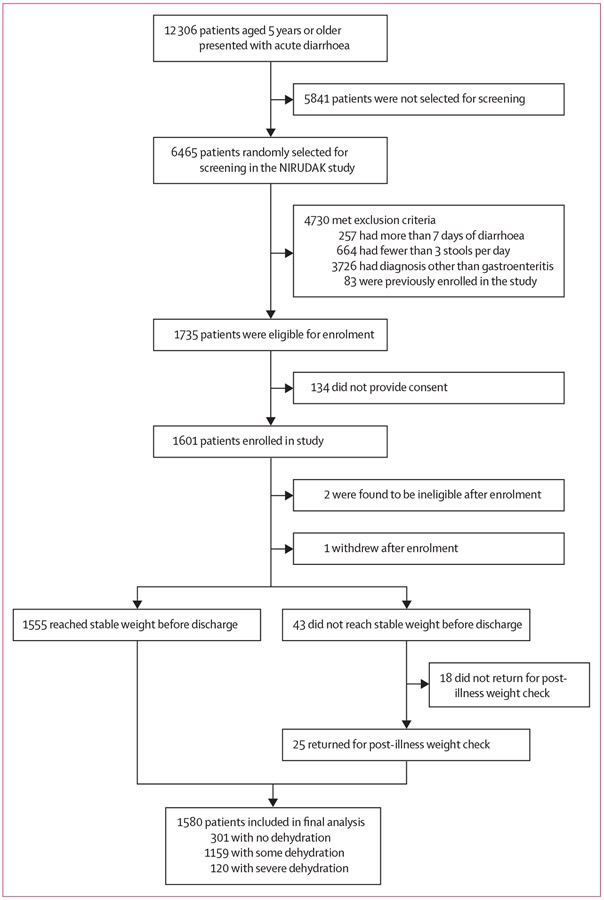
Methods: A random sample of patients aged 5 years or older presenting with diarrhoea to the icddr,b Dhaka Hospital in Bangladesh between Jan 30 and Dec 13, 2022 were included in this prospective cohort study. Patients with fewer than three loose stools per day, more than 7 days of symptoms, previous enrolment in the study, or a diagnosis other than acute gastroenteritis were excluded. Patients were weighed on arrival and assessed separately by two nurses using both our novel clinical tools and WHO guidelines. Patients were weighed every 4 h to determine their percent weight change with rehydration, our criterion standard for dehydration. Accuracy for the diagnosis of dehydration category (none, some, or severe) was assessed using the ordinal c-index (ORC). Reliability was assessed by comparing the prediction of severe dehydration from each nurse's independent assessment using the intraclass correlation coefficient (ICC).
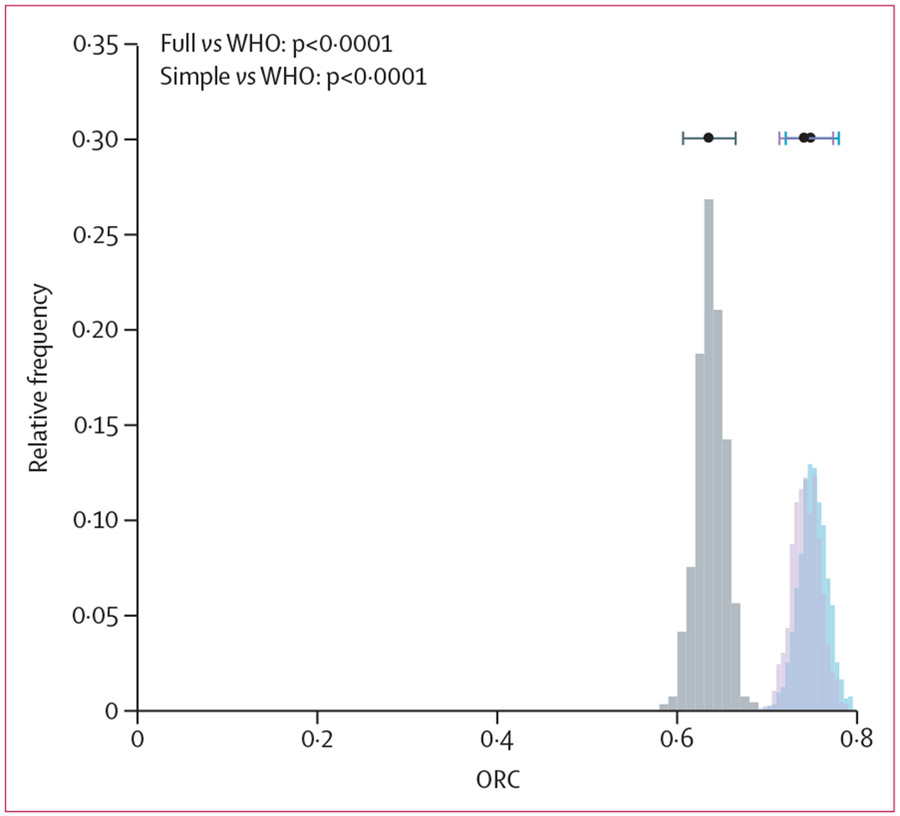
Findings: 1580 patients were included in our primary analysis, of whom 921 (58·3%) were female and 659 (41·7%) male. The ORC was 0·74 (95% CI 0·71-0·77) for the CDST, 0·75 (0·71-0·78) for the simplified score, and 0·64 (0·61-0·67) for the WHO guidelines. The ICC was 0·98 (95% CI 0·97-0·98) for the CDST, 0·94 (0·93-0·95) for the simplified score, and 0·56 (0·52-0·60) for the WHO guidelines.
Interpretation: Use of our CDST or simplified score by clinicians could reduce undertreatment and overtreatment of older children and adults with acute diarrhoea, potentially reducing morbidity and mortality for this common disease.
Funding: US National Institutes of Health.
Translation: For the Bangla translation of the abstract see Supplementary Materials section.
Copyright © 2023 The Author(s). Published by Elsevier Ltd. This is an Open Access article under the CC BY-NC-ND 4.0 license. Published by Elsevier Ltd.. All rights reserved.
Conflict of interest statement
Declaration of interests We declare no competing interests.
Figures
Comment in
-
Severity assessment tools for dehydration associated with diarrhoea in a low-resource setting.Lancet Glob Health. 2023 Nov;11(11):e1668-e1669. doi: 10.1016/S2214-109X(23)00452-7. Epub 2023 Sep 27. Lancet Glob Health. 2023. PMID: 37776868 No abstract available.
References
-
- United Nations. UN News Global Perspective Human Stories. “2022 year in health: new Ebola and cholera outbreaks, mpox emergency, COVID-19 ‘not over’. https://news.un.org/en/story/2022/12/1131967 (accessed Jan 13, 2023).
-
- Walker CL, Black RE. Diarrhoea morbidity and mortality in older children, adolescents, and adults. Epidemiol Infect 2010; 138: 1215–26. - PubMed
-
- Faruque ASG, Malek MA, Khan AI, Huq S, Salam MA, Sack DA. Diarrhoea in elderly people: aetiology, and clinical characteristics. Scand J Infect Dis 2004; 36: 204–08. - PubMed
Publication types
MeSH terms
Grants and funding
LinkOut - more resources
Full Text Sources
Medical
Research Materials
