


Update on the Obesity Epidemic: After the Sudden Rise, Is the Upward Trajectory Beginning to Flatten?
- PMID: 37779155
- PMCID: PMC10748771
- DOI: 10.1007/s13679-023-00527-y
Update on the Obesity Epidemic: After the Sudden Rise, Is the Upward Trajectory Beginning to Flatten?
Erratum in
-
Correction to: Update on the Obesity Epidemic: After the Sudden Rise, Is the Upward Trajectory Beginning to Flatten?Curr Obes Rep. 2023 Dec;12(4):528. doi: 10.1007/s13679-023-00533-0. Curr Obes Rep. 2023. PMID: 37845468 Free PMC article. No abstract available.
Abstract
Purpose of review: To provide an update on current obesity prevalence trends and summarize the available evidence suggesting a possible plateau or stabilization in obesity rates after the previous sudden global rise.
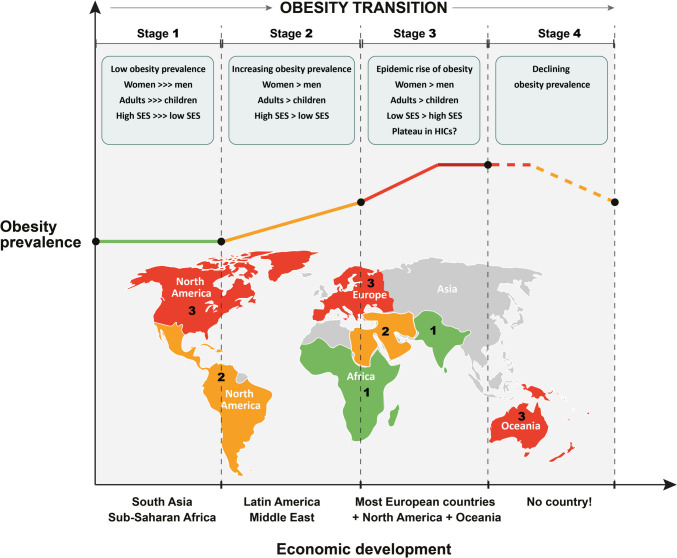
Recent findings: The escalating global obesity epidemic represents one of the most serious public health challenges. There have been some indications that in high-income populations, the rate of obesity increase in adults has been stabilized after the decade 2000-2010, suggesting a possible plateau. Current evidence also suggests that obesity rates have been stabilized in children and adolescents of most economically advanced countries since 2000, which is possibly related to healthier dietary habits and increased levels of physical activity. On the other hand, there is a steady uninterrupted rise in low-income nations, and the universal trend is obesity escalation rather than slowdown, mainly driven by sharp increases in the obesity prevalence of low-income populations. Furthermore, an increasing number of high- and middle-income countries are currently experiencing an epidemic of severe obesity. In high-income populations, severe obesity is expected to double its prevalence from 10 to 20% between 2020 and 2035, posing an enormous threat for healthcare systems. Even if transiently stabilized, the obesity prevalence remains globally at unacceptably high levels, and there is no guarantee that the current stability (if any) will be maintained for long. In this review, we explore the underlying drivers of the global obesity epidemic; we provide possible explanations for the reported slowdown of the obesity rates in some countries; and we overall take a critical perspective on the obesity plateau hypothesis, emphasizing the urgent need for immediate effective actions at population and regional level in order to halt the alarming obesity escalation and its serious health risks.
Keywords: Adiposity; Body mass index; Epidemiology; Obesity; Overweight; Plateau; Prevalence; Stabilization; Trend.
© 2023. The Author(s).
Conflict of interest statement
The authors have nothing to disclose.
Figures

References
-
- World Health Organization. Obesity : preventing and managing the global epidemic : report of a WHO consultation. World Health Organization; 2000. - PubMed
-
- Swinburn BA, Sacks G, Hall KD, McPherson K, Finegood DT, Moodie ML, et al. The global obesity pandemic: shaped by global drivers and local environments. The Lancet. Elsevier B.V.; 2011. p. 804–14. - PubMed
-
- •• Lobstein T, Jackson-Leach R, Powis J, Brinsden H, Gray M. 2023. Available from: https://www.worldobesity.org/resources/resource-library/world-obesity-at.... Compiled by the World Obesity Federation, the World Obesity Atlas 2023 provides obesity prevalence projections and insights into the growing economic impact of overweight/obesity for the period 2020–2035. Alarmingly, over half of the global population is expected to have a high body mass index by the end of this period, and 1 in 4 people will be living with obesity compared to 1 in 7 today. Childhood obesity rates are rising very fast, and lower income countries are facing rapid increases in obesity prevalence.
Publication types
MeSH terms
LinkOut - more resources
Full Text Sources
Research Materials
