. 2023 Aug 30:16:e00469.
doi: 10.1016/j.ohx.2023.e00469. eCollection 2023 Dec.

Low-cost, low-power, clockwork syringe pump

Affiliations

Low-cost, low-power, clockwork syringe pump

Francis Pooke et al. HardwareX. .

Abstract

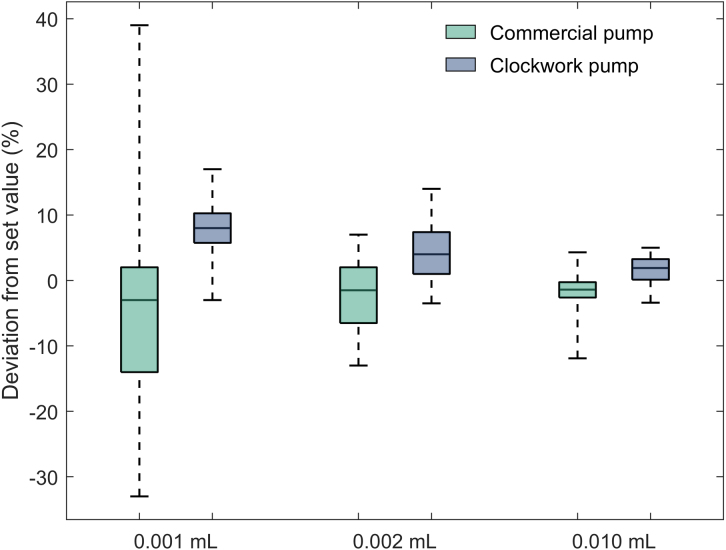
A low-cost ($120 NZD, $75 USD), low-power (1-year battery life), portable, and programmable syringe pump design is presented, which offers an alternative to high-cost commercial devices with limited battery life. Contrary to typical motor-driven syringe pumps, the design utilizes a compression spring coupled with a clockwork escapement mechanism to advance the syringe plunger. Full control over flow-rate and discrete (bolus) deliveries is achieved through actuation of a clockwork escapement using programmable, low-power electronics. The escapement mechanism allows the syringe plunger to advance a fixed linear distance, delivering a dose size of 0.001 ml in the configuration presented. The modular pump assembly is easily reconfigured for different applications by interchanging components to alter the minimum dose size. Testing to IEC 60601-2-24(2012), the average error of the clockwork syringe pump was 8.0%, 4.0%, and 1.9% for 0.001 ml, 0.002 ml, and 0.01 ml volumes, respectively. An overall mean error of 1.0% was recorded for a flow-rate of 0.01 ml h-1. Compared to a commercial insulin pump, the clockwork pump demonstrated reduced variability but greater average error due to consistent over-delivery. Further development of the design and/or manufacture should yield a device with similar performance to a commercial pump.

Keywords: Escapement; Insulin pump; Micro-litre pump; Programmable; Spring-driven.


Conflict of interest statement

None.

Figures

None
Graphical abstract
Fig. 1
Fig. 1
Escape wheel and pallet used for dosage control in the clockwork pump.
Fig. 2
Fig. 2
Breakdown of the 6 sub-assemblies in the clockwork pump.
Fig. 3
Fig. 3
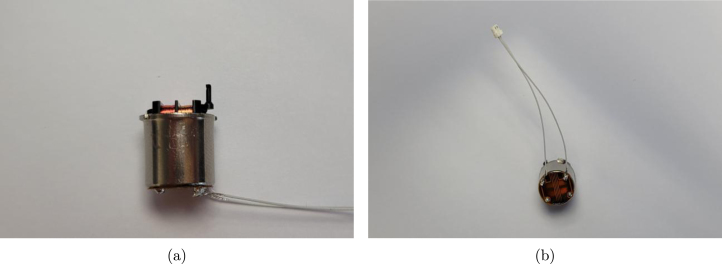
(a) Removal of actuator arm and hook (b) Removal of flex circuit and connection of 2 position cable.
Fig. 4
Fig. 4
Graphical build instructions for the leadscrew sub-assembly.
Fig. 5
Fig. 5
Graphical build and integration instructions for the gearbox sub-assembly.
Fig. 6
Fig. 6
Graphical build instructions for the escapement sub-assembly.
Fig. 7
Fig. 7
Graphical build and integration instructions for the actuator sub-assembly.
Fig. 8
Fig. 8
Graphical build and integration instructions for electronics sub-assembly.
Fig. 9
Fig. 9
Graphical build and integration instructions for the reservoir and plunger sub-assembly.
Fig. 10
Fig. 10
Pinout of the programming header on B2 (27).
Fig. 11
Fig. 11
Testing setup to IEC 60601-2-24.
Fig. 12
Fig. 12
(a) Trumpet curve plot for the commercial insulin pump at a flow-rate of 0.01 ml h−1 (b) Trumpet curve plot for the clockwork pump at a flow-rate of 0.01 ml h−1.
Fig. 13
Fig. 13
Box plot comparing bolus accuracy of commercial insulin pump (Medtronic 640G) to the clockwork pump.
Fig. 14
Fig. 14
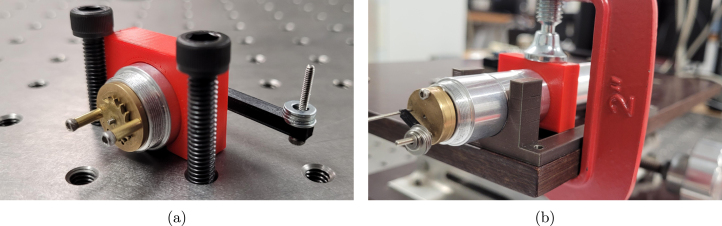
(a) Apparatus for the measurement of escape wheel starting torque (b) Apparatus for the measurement of pallet actuation torque.
Fig. 15
Fig. 15
Free body diagram of leadscrew and plunger.
Fig. 16
Fig. 16
(a) Apparatus for circlip testing (b) Load cell readout with circlip failure load indicated.

References

    1. Stephens E., Riddle M. Evolving approaches to intensive insulin therapy in type 1 diabetes: multiple daily injections, insulin pumps and new methods of monitoring. Rev. Endocr. Metab. Disord. 2003;4(4):325–334. doi: 10.1023/A:1027345927676. - DOI - PubMed
    1. Ziegler R., Waldenmaier D., Kamecke U., Mende J., Haug C., Freckmann G. Accuracy assessment of bolus and basal rate delivery of different insulin pump systems used in insulin pump therapy of children and adolescents. Pediatr. Diabetes. 2020;21(4):649–656. doi: 10.1111/pedi.12993. - DOI - PubMed
    1. Ziegler R., Oliver N., Waldenmaier D., Mende J., Haug C., Freckmann G. Evaluation of the accuracy of current tubeless pumps for continuous subcutaneous insulin infusion. Diabetes Technol. Therapeut. 2021;23(5):350–357. doi: 10.1089/dia.2020.0525. - DOI - PMC - PubMed
    1. Pickup J., Keen H. Continuous subcutaneous insulin infusion at 25 years: Evidence base for the expanding use of insulin pump therapy in type 1 diabetes. Diabetes Care. 2002;25(3):593–598. doi: 10.2337/diacare.25.3.593. - DOI - PubMed
    1. Holder-Pearson L., Chase J.G. Socio-economic inequity: diabetes in New Zealand. Front. Med. 2022;9 - PMC - PubMed

LinkOut - more resources