


ABCA4 c.6480-35A>G, a novel branchpoint variant associated with Stargardt disease
- PMID: 37779911
- PMCID: PMC10539688
- DOI: 10.3389/fgene.2023.1234032
ABCA4 c.6480-35A>G, a novel branchpoint variant associated with Stargardt disease
Abstract
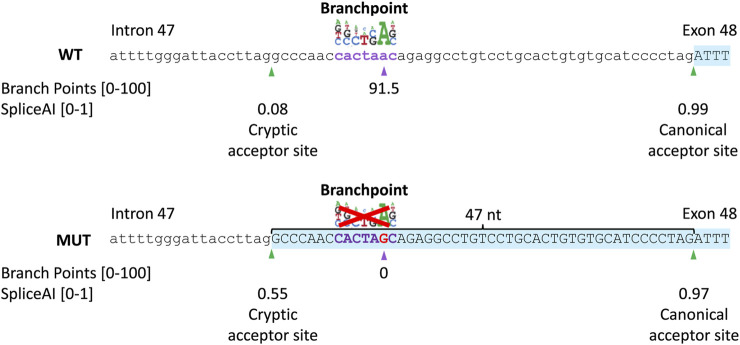
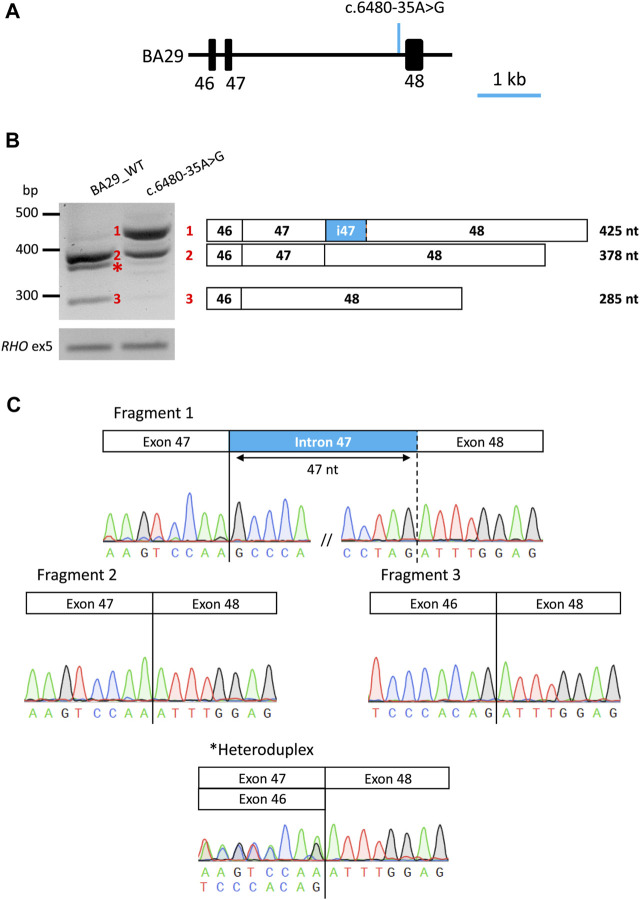
Introduction: Inherited retinal dystrophies (IRDs) can be caused by variants in more than 280 genes. The ATP-binding cassette transporter type A4 (ABCA4) gene is one of these genes and has been linked to Stargardt disease type 1 (STGD1), fundus flavimaculatus, cone-rod dystrophy (CRD), and pan-retinal CRD. Approximately 25% of the reported ABCA4 variants affect RNA splicing. In most cases, it is necessary to perform a functional assay to determine the effect of these variants. Methods: Whole genome sequencing (WGS) was performed in one Spanish proband with Stargardt disease. The putative pathogenicity of c.6480-35A>G on splicing was investigated both in silico and in vitro. The in silico approach was based on the deep-learning tool SpliceAI. For the in vitro approach we used a midigene splice assay in HEK293T cells, based on a previously established wild-type midigene (BA29) containing ABCA4 exons 46 to 48. Results: Through the analysis of WGS data, we identified two candidate variants in ABCA4 in one proband: a previously described deletion, c.699_768+342del (p.(Gln234Phefs*5)), and a novel branchpoint variant, c.6480-35A>G. Segregation analysis confirmed that the variants were in trans. For the branchpoint variant, SpliceAI predicted an acceptor gain with a high score (0.47) at position c.6480-47. A midigene splice assay in HEK293T cells revealed the inclusion of the last 47 nucleotides of intron 47 creating a premature stop codon and allowed to categorize the variant as moderately severe. Subsequent analysis revealed the presence of this variant as a second allele besides c.1958G>A p.(Arg653His) in an additional Spanish proband in a large cohort of IRD cases. Conclusion: A splice-altering effect of the branchpoint variant, confirmed by the midigene splice assay, along with the identification of this variant in a second unrelated individual affected with STGD, provides sufficient evidence to classify the variant as likely pathogenic. In addition, this research highlights the importance of studying non-coding regions and performing functional assays to provide a conclusive molecular diagnosis.
Keywords: ABCA4; Stargardt disease; branchpoint variant; midigene splice assay; whole genome sequencing.
Copyright © 2023 Rodríguez-Hidalgo, de Bruijn, Corradi, Rodenburg, Lara-López, Valverde-Megías, Ávila-Fernández, Fernandez-Caballero, Del Pozo-Valero, Corominas, Gilissen, Irigoyen, Cremers, Ayuso, Ruiz-Ederra and Roosing.
Conflict of interest statement
Author AL-L was employed by Miramoon Pharma S.L. The remaining authors declare that the research was conducted in the absence of any commercial or financial relationships that could be construed as a potential conflict of interest.
Figures
References
-
- Albert S., Garanto A., Sangermano R., Khan M., Bax N. M., Hoyng C. B., et al. (2018). Identification and rescue of splice defects caused by two neighboring deep-intronic ABCA4 mutations underlying Stargardt disease. Am. J. Hum. Genet. 102 (4), 517–527. 10.1016/j.ajhg.2018.02.008 - DOI - PMC - PubMed
-
- Bauwens M., Garanto A., Sangermano R., Naessens S., Weisschuh N., De Zaeytijd J., et al. (2019). ABCA4-associated disease as a model for missing heritability in autosomal recessive disorders: novel noncoding splice, cis-regulatory, structural, and recurrent hypomorphic variants. Genet. Med. 21 (8), 1761–1771. 10.1038/s41436-018-0420-y - DOI - PMC - PubMed
LinkOut - more resources
Full Text Sources
