


Knowledge is power? Cervical cancer prevention in female OB/GYNs compared to other female physicians
- PMID: 37780452
- PMCID: PMC10540616
- DOI: 10.3389/fpubh.2023.1269393
Knowledge is power? Cervical cancer prevention in female OB/GYNs compared to other female physicians
Abstract
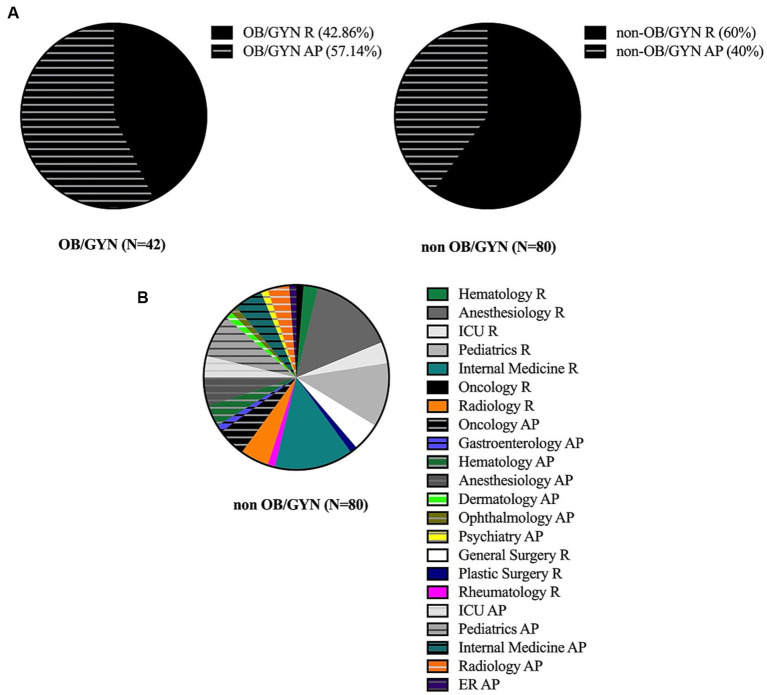
Cervical cancer (CC) screening and prevention are crucial responsibilities of obstetrician-gynecologists (OB/GYNs). Our study aimed to investigate whether knowledge impacts OB/GYNs' (n = 42) adherence to CC prevention measures by comparing them to non-OB/GYN physicians (n = 80). An anonymous questionnaire collected demographic information, personal screening habits and evaluated their knowledge of CC prevention. Results revealed that OB/GYNs exhibited superior knowledge of CC risk factors and prevention compared to non-OB/GYNs. Of note, a lower percentage of OB/GYN residents correctly identified the recommended upper age limit for cervical screening and for HPV vaccination compared to attending OB/GYNs (50% vs. 83%, p = 0.04 and 11% vs. 50%, p = 0.01, respectively). Despite these findings, most physicians from both groups recommended HPV vaccination. Cervical screening rates were similar between OB/GYNs and non-OB/GYNs (75% vs. 83%, p = 0.3). Half of OB/GYNs initiated their own cervical screening, similar to non-OB/GYNs. Interestingly, residents had higher HPV vaccination rates compared to attending physicians, irrespective of specialty (OB/GYNs - 38.89% vs. 4.76%, p = 0.0149; non-OB/GYNs - 51.06% vs. 15.38%, p = 0.0028). In conclusion, contrary to the assumption that physicians prioritize personal well-being, our study reveals the opposite. While skilled in guiding patients through CC screening and prevention, female OB/GYNs often neglect their own health. OB/GYNs must also be educated and supported in safeguarding their health, setting an essential example for patients.
Keywords: HPV vaccine; OB/GYN; cervical cancer; cervical screening; female physicians; prevention.
Copyright © 2023 Hershkovitz, Ochshorn, Michaan, Fiszer, Grisaru and Raz.
Conflict of interest statement
The authors declare that the research was conducted in the absence of any commercial or financial relationships that could be construed as a potential conflict of interest.
Figures
References
-
- Berrington de González A, Green J, I.C.O.E.S.O.C . Cancer, comparison of risk factors for invasive squamous cell carcinoma and adenocarcinoma of the cervix: collaborative reanalysis of individual data on 8,097 women with squamous cell carcinoma and 1,374 women with adenocarcinoma from 12 epidemiological studies. Int J Cancer. (2007) 120:885–91. doi: 10.1002/ijc.22357 - DOI - PubMed
-
- Singh D, Vignat J, Lorenzoni V, Eslahi M, Ginsburg O, Lauby-Secretan B, et al. . Global estimates of incidence and mortality of cervical cancer in 2020: a baseline analysis of the WHO global cervical Cancer elimination initiative. Lancet Glob Health. (2023) 11:e197–206. doi: 10.1016/S2214-109X(22)00501-0, PMID: - DOI - PMC - PubMed
