


Longitudinal trajectories of memory among middle-aged and older people with hearing loss: the influence of cochlear implant use on cognitive functioning
- PMID: 37781104
- PMCID: PMC10537213
- DOI: 10.3389/fnagi.2023.1220184
Longitudinal trajectories of memory among middle-aged and older people with hearing loss: the influence of cochlear implant use on cognitive functioning
Abstract
Introduction: Cochlear implants (CI) are the gold standard intervention for severe to profound hearing loss, a known modifiable risk factor for dementia. However, it remains unknown whether CI use might prevent the age-related cognitive decline. Recent studies are encouraging but are limited, mainly by short follow-up periods and, for ethical reasons, lack of appropriate control groups. Further, as age-related cognitive decline is multifaceted and not linear, other statistical approaches have to be evaluated.
Materials and methods: Immediate and delayed recall as measures of cognitive function were assessed in 75 newly implanted CI users (mean age 65.41 years ± 9.19) for up to 5 years (mean 4.5 ± 0.5) of CI use and compared to 8,077 subjects of the same age range from two longitudinal cohort studies, the Health and Retirement Study (HRS) and the English Longitudinal Study of Aging (ELSA). Linear and quadratic changes in cognitive trajectories were analyzed in detail using mixed growth models, considering possible confounders.
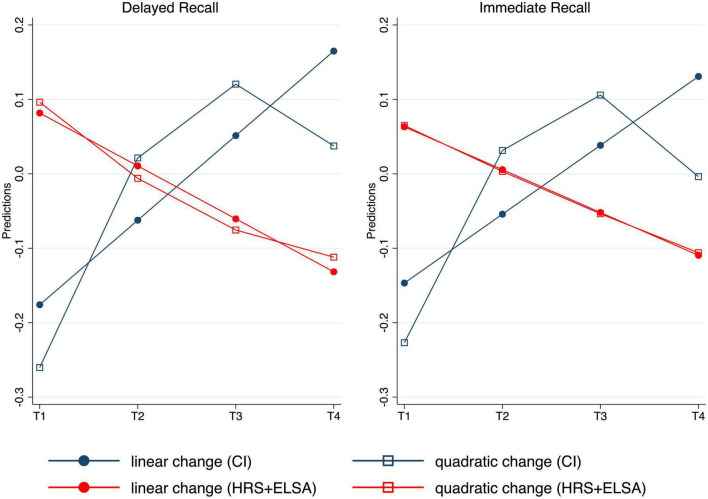
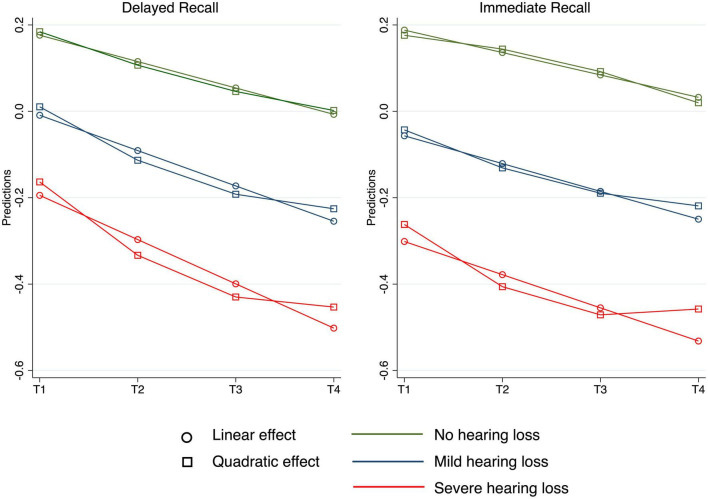
Results: For CI users, the linear time slope showed a significant improvement in the specific domains (recall and delayed recall) over time. The quadratic time slope clearly indicated that the predicted change after CI provision followed an inverted U-shape with a predicted decline 2 years after CI provision. In the hearing-impaired group, a significant decline over time was found, with steeper declines early on and the tendency to flatten out in the follow-up.
Conclusion: Cochlear implant use seems to boost cognitive trajectories in the first years after implantation. However, long-term prevention of dementia seems to need far more than restoration of hearing loss.
Keywords: cochlear implantation; cognitive decline; dementia; hearing loss; multilevel growth model.
Copyright © 2023 Völter, Götze, Dazert, Thomas and Kamin.
Conflict of interest statement
CV, JT, and SD have received reimbursement of scientific meeting participation fees and accommodation expenses, as well as honoraria for preparing continuing medical education events and funding for research projects that they initiated, from MED-EL. The remaining authors declare that the research was conducted in the absence of any commercial or financial relationships that could be construed as a potential conflict of interest.
Figures
References
-
- Abes G. T., Reyes-Quintos M. R. T., Tantoco M. L. S. (2011). Accuracy of Siemens HearCheck™ navigator as a screening tool for hearing loss. Philipp. J. Otolaryngol. Head Neck Surg. 26 10–15.
-
- Albert M. S., DeKosky S. T., Dickson D., Dubois B., Feldman H. H., Fox N. C., et al. (2013). The diagnosis of mild cognitive impairment due to Alzheimer’s disease: Recommendations from the National Institute on Aging-Alzheimer’s Association workgroups on diagnostic guidelines for Alzheimer’s disease. Focus 11 96–106. - PMC - PubMed
-
- Arbeitsgemeinschaft der Wissenschaftlichen Medizinischen Fachgesellschaften (AWMF) (2020). S2k guideline. Cochlea- Implant Versorgung 2020. Available online at: https://register.awmf.org/assets/guidelines/017-071l_S2k_Cochlea-Implant... (accessed August 19, 2023).
Grants and funding
LinkOut - more resources
Full Text Sources
