Review
. 2023 Oct 2;133(19):e170501.
doi: 10.1172/JCI170501.

Alveolar macrophages in tissue homeostasis, inflammation, and infection: evolving concepts of therapeutic targeting

Affiliations
Review

Alveolar macrophages in tissue homeostasis, inflammation, and infection: evolving concepts of therapeutic targeting

Christina Malainou et al. J Clin Invest. .

Abstract

Alveolar macrophages (AMs) are the sentinel cells of the alveolar space, maintaining homeostasis, fending off pathogens, and controlling lung inflammation. During acute lung injury, AMs orchestrate the initiation and resolution of inflammation in order to ultimately restore homeostasis. This central role in acute lung inflammation makes AMs attractive targets for therapeutic interventions. Single-cell RNA-Seq and spatial omics approaches, together with methodological advances such as the generation of human macrophages from pluripotent stem cells, have increased understanding of the ontogeny, function, and plasticity of AMs during infectious and sterile lung inflammation, which could move the field closer to clinical application. However, proresolution phenotypes might conflict with proinflammatory and antibacterial responses. Therefore, therapeutic targeting of AMs at vulnerable time points over the course of infectious lung injury might harbor the risk of serious side effects, such as loss of antibacterial host defense capacity. Thus, the identification of key signaling hubs that determine functional fate decisions in AMs is of the utmost importance to harness their therapeutic potential.


Figures
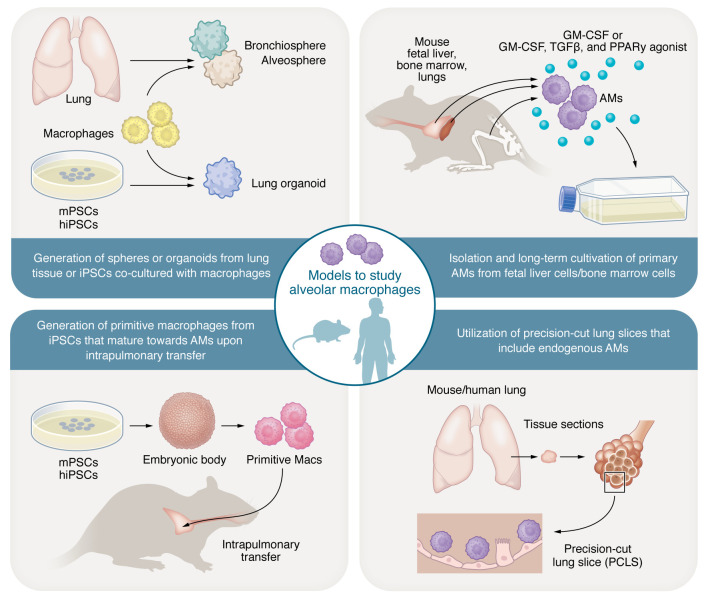
Figure 1
Figure 1. Depiction of diverse murine/human-based AM culturing models promoting translational AM research.
The figure summarizes the various modern ex vivo culturing approaches that have used murine or human-derived AMs in combination with human induced pluripotent stem cells (hiPSCs) or murine pluripotent stem cells (mPSCs), mediating the transition to 3D culturing systems (organoids, precision-cut lung slices, etc.), all dedicated to studying the biology of AMs and potential therapies targeting these cells.
Figure 2
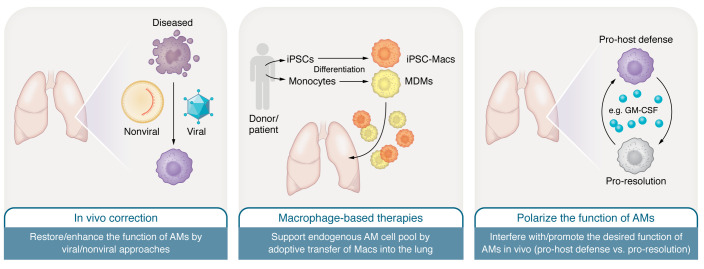
Figure 2. AM-targeting strategies for the treatment of pulmonary diseases.
Different approaches to support and/or repair the pool of endogenous AMs are pursued. AMs can either be targeted by viral and nonviral approaches to restore and/or enhance their function in vivo (left), or be modified by different molecules to influence and/or promote a certain stage of activation to promote lung tissue repair or antibacterial function (right). An alternative and innovative approach would be the direct transfer of macrophages into the lungs of patients (middle). Suitable macrophages can be derived from human iPSCs (iMacs) or classical monocytes (monocyte-derived macrophages [MDMs]) by new immune cell farming strategies.

References

    1. Hume PS, et al. Localization of macrophages in the human lung via design-based stereology. Am J Respir Crit Care Med. 2020;201(10):1209–1217. doi: 10.1164/rccm.201911-2105OC. - DOI - PMC - PubMed
    1. Aegerter H, et al. Biology of lung macrophages in health and disease. Immunity. 2022;55(9):1564–1580. doi: 10.1016/j.immuni.2022.08.010. - DOI - PMC - PubMed
    1. Bain CC, MacDonald AS. The impact of the lung environment on macrophage development, activation and function: diversity in the face of adversity. Mucosal Immunol. 2022;15(2):223–234. doi: 10.1038/s41385-021-00480-w. - DOI - PMC - PubMed
    1. Hou F, et al. Diversity of macrophages in lung homeostasis and diseases. Front Immunol. 2021;12:753940. doi: 10.3389/fimmu.2021.753940. - DOI - PMC - PubMed
    1. Guilliams M, et al. Alveolar macrophages develop from fetal monocytes that differentiate into long-lived cells in the first week of life via GM-CSF. J Exp Med. 2013;210(10):1977–1992. doi: 10.1084/jem.20131199. - DOI - PMC - PubMed

Publication types