. 2023 Nov 1;80(11):1199-1208.
doi: 10.1001/jamaneurol.2023.3344.

Underlying Causes of TIA and Minor Ischemic Stroke and Risk of Major Vascular Events

Collaborators, Affiliations

Underlying Causes of TIA and Minor Ischemic Stroke and Risk of Major Vascular Events

Philippa C Lavallée et al. JAMA Neurol. .

Abstract

Importance: The coexistence of underlying causes in patients with transient ischemic attack (TIA) or minor ischemic stroke as well as their associated 5-year risks are not well known.

Objective: To apply the ASCOD (atherosclerosis, small vessel disease, cardiac pathology, other cause, or dissection) grading system to assess coexistence of underlying causes of TIA and minor ischemic stroke and the 5-year risk for major vascular events.

Design, setting, and participants: This international registry cohort (TIAregistry.org) study enrolled 4789 patients from June 1, 2009, to December 31, 2011, with 1- to 5-year follow-up at 61 sites in 21 countries. Eligible patients had a TIA or minor stroke (with modified Rankin Scale score of 0 or 1) within the last 7 days. Among these, 3847 patients completed the 5-year follow-up by December 31, 2016. Data were analyzed from October 1, 2022, to June 15, 2023.

Exposure: Five-year follow-up.

Main outcomes and measures: Estimated 5-year risk of the composite outcome of stroke, acute coronary syndrome, or cardiovascular death.

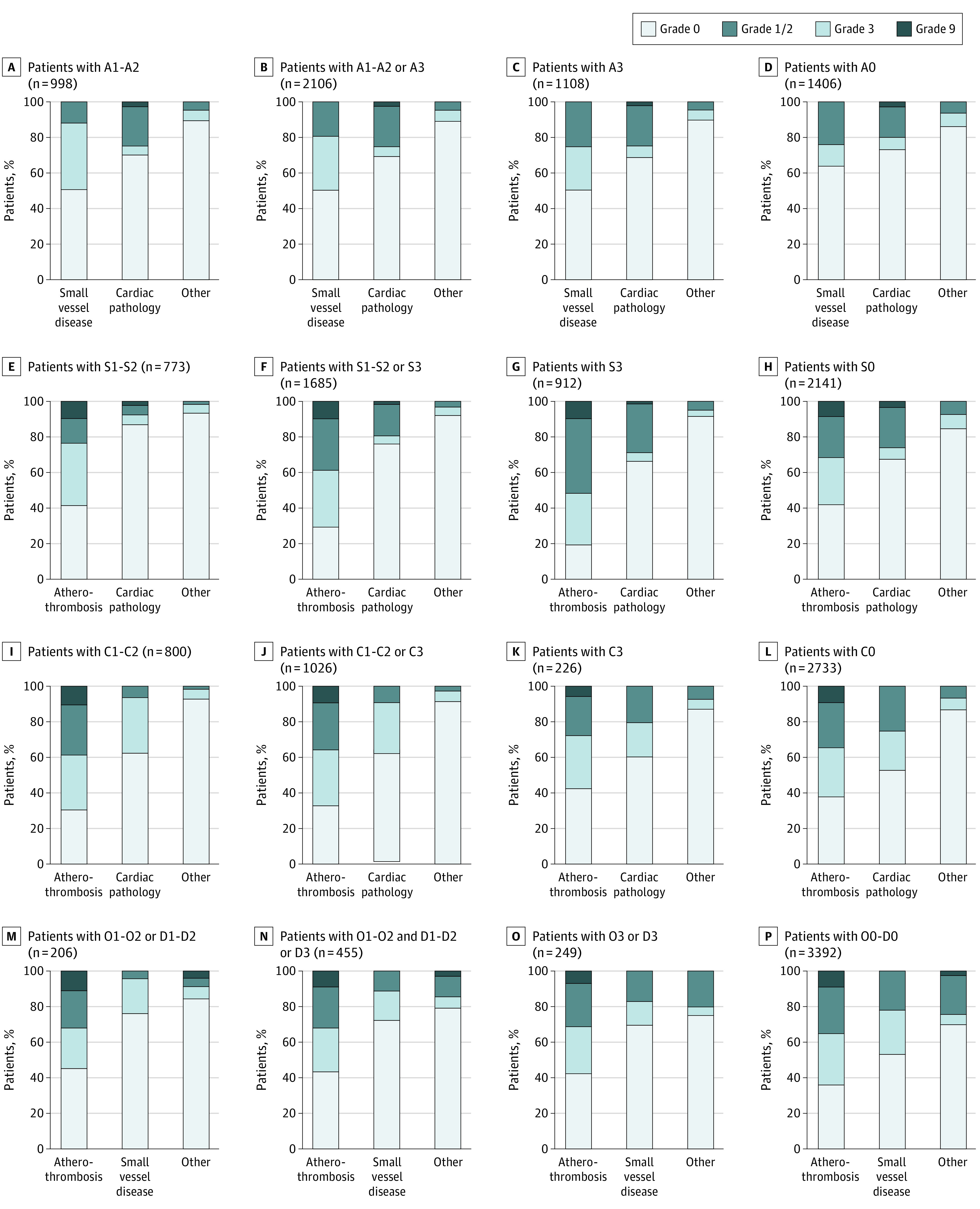
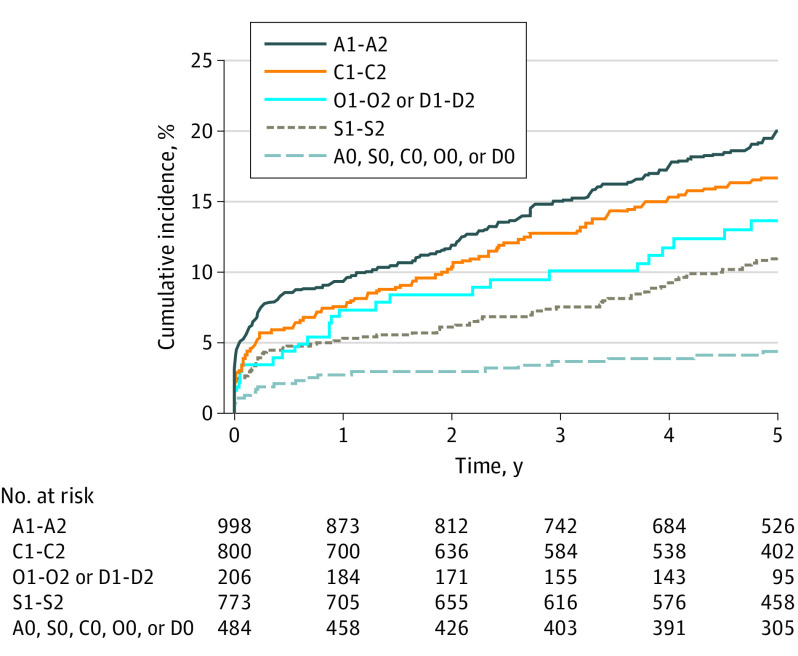
Results: A total of 3847 patients (mean [SD] age, 66.4 [13.2] years; 2295 men [59.7%]) in 42 sites were enrolled and participated in the 5-year follow-up cohort (median percentage of 5-year follow-up per center was 92.3% [IQR, 83.4%-97.8%]). In 998 patients with probable or possible causal atherosclerotic disease, 489 (49.0%) had some form of small vessel disease (SVD), including 110 (11.0%) in whom a lacunar stroke was also probably or possibly causal, and 504 (50.5%) had no SVD; 275 (27.6%) had some cardiac findings, including 225 (22.6%) in whom cardiac pathology was also probably or possibly causal, and 702 (70.3%) had no cardiac findings. Compared with patients with none of the 5 ASCOD categories of disease (n = 484), the 5-year rate of major vascular events was almost 5 times higher (hazard ratio [HR], 4.86 [95% CI, 3.07-7.72]; P < .001) in patients with causal atherosclerosis, 2.5 times higher (HR, 2.57 [95% CI, 1.58-4.20]; P < .001) in patients with causal lacunar stroke or lacunar syndrome, and 4 times higher (HR, 4.01 [95% CI, 2.50-6.44]; P < .001) in patients with causal cardiac pathology.

Conclusion and relevance: The findings of this cohort study suggest that in patients with TIA and minor ischemic stroke, the coexistence of atherosclerosis, SVD, cardiac pathology, dissection, or other causes is substantial, and the 5-year risk of a major vascular event varies considerably across the 5 categories of underlying diseases. These findings further suggest the need for secondary prevention strategies based on pathophysiology rather than a one-size-fits-all approach.


Conflict of interest statement

Conflict of Interest Disclosures: Dr Albers reported having equity in iSchemaView, Inc, and consulting for iSchemaView Inc, Janssen, and Biogen Inc outside the submitted work. Professor Ferro reported receiving speakers bureau fees from Boehringer Ingelheim and consulting for GSK PLC, Ferrer, and Servier Laboratories outside the submitted work. Professor Rothwell reported receiving advisory board and data monitoring committee fees from Sanofi SA, Bristol Myers Squibb, and Bayer AG outside the submitted work. Professor Steg reported receiving grant funding from Amarin Pharmaceuticals Ireland Limited, Bayer AG, Sanofi SA, and Servier Laboratories and personal fees from Amarin Pharmaceuticals Ireland Limited, Amgen Inc, AstraZeneca, Bayer AG, Bristol Myers Squibb, Idorsia, Merck & Co, Inc, Novartis AG, Novo Nordisk A/S, Pfizer Inc, PhaseBio Pharmaceuticals, Regeneron Pharmaceuticals, Inc, Sanofi SA, and Servier Laboratories outside the submitted work; having a patent for use of alirocumab to reduce cardiovascular risk (assigned to Sanofi SA) issued; and serving as senior associate editor at Circulation. Professor Vicaut reported receiving personal fees from Eli Lilly and Company; consulting for Pfizer Inc, Sanofi SA, Laboratoire Français du Fractionnement et des Biotechnologies, Abbott Laboratories, Fresenius Kabi, Medtronic Inc, and Hexacath; serving on the data safety monitoring board for the Cardiovascular European Research Center; receiving lecture fees from Novartis AG; and receiving grant funding from Boehringer Ingelheim and Sanofi SA outside the submitted work. Professor Wong reported receiving honoraria as a member of a steering committee for Johnson & Johnson, AstraZeneca, and Bayer AG and honoraria for participation in clinical trials, contributions to advisory boards, or oral presentations from Bayer AG, Sanofi-Aventis, Bristol Myers Squibb, Boehringer Ingelheim, and Pfizer Inc. Professor Amarenco reported receiving grants directed to the TIAregistry.org from Sanofi SA, Bristol Myers Squibb, AstraZeneca, and SOS-Attaque Cerebrale Association during the conduct of the study; grant funding for the Treat Stroke to Target Trial from Pfizer Inc, AstraZeneca, Bristol Myers Squibb, and AltaThera Pharmaceuticals; advisory board fees from Novartis AG and Janssen Pharmaceuticals; and speakers’ fees from Amgen Inc and Viatris Inc outside the submitted work. No other disclosures were reported.

Figures

Figure 1.
Figure 1.. Coexistence of ASCOD (Atherosclerosis, Small Vessel Disease, Cardiac Pathology, Other Cause, or Dissection) Grades Among Patients With Transient Ischemic Attack (TIA) or Minor Ischemic Stroke
For atherosclerosis, A0 indicates none; A1-A2, atherosclerotic stenosis ipsilateral to the cerebral ischemia, intracranial and/or extracranial, probably or possibly causal; and A3, unlikely causal. For small vessel disease, S0 indicates none; S1-S2, lacunar stroke or lacunar syndrome probably or possibly causal; and S3, unlikely causal. For cardiac pathology, C0 indicates none; C1-C2, probably or possibly causal; and C3, unlikely causal. For other cause or dissection, O0 or D0 indicates none; O1-O2 or D1-D2, probably or possibly causal; and O3 or D3, unlikely causal.
Figure 2.
Figure 2.. Five-Year Cumulative Incidence of a Major Cardiovascular Event
We used the ASCOD (Atherosclerosis, Small Vessel Disease, Cardiac Pathology, Other Cause, or Dissection) grading system. For atherosclerosis, A0 indicates none and A1-A2, atherosclerotic stenosis ipsilateral to the cerebral ischemia, intracranial and/or extracranial, probably or possibly causal. For small vessel disease, S0 indicates none and S1-S2, lacunar stroke or lacunar syndrome probably or possibly causal. For cardiac pathology, C0 indicates none and C1-C2, probably or possibly causal. For other cause or dissection, O0 or D0 indicates none and O1-O2 or D1-D2, probably or possibly causal.

References

    1. Adams HP Jr, Bendixen BH, Kappelle LJ, et al. . Classification of subtype of acute ischemic stroke. Definitions for use in a multicenter clinical trial. TOAST. Trial of Org 10172 in Acute Stroke Treatment. Stroke. 1993;24(1):35-41. doi:10.1161/01.STR.24.1.35 - DOI - PubMed
    1. Goldstein LB, Jones MR, Matchar DB, et al. . Improving the reliability of stroke subgroup classification using the Trial of ORG 10172 in Acute Stroke Treatment (TOAST) criteria. Stroke. 2001;32(5):1091-1098. doi:10.1161/01.STR.32.5.1091 - DOI - PubMed
    1. Landau WM, Nassief A. Editorial comment—time to burn the TOAST. Stroke. 2005;36(4):902-904. doi:10.1161/str.36.4.902 - DOI - PubMed
    1. Amarenco P, Bogousslavsky J, Caplan LR, Donnan GA, Wolf ME, Hennerici MG. The ASCOD phenotyping of ischemic stroke (updated ASCO phenotyping). Cerebrovasc Dis. 2013;36(1):1-5. doi:10.1159/000352050 - DOI - PubMed
    1. Sirimarco G, Lavallée PC, Labreuche J, et al. . Overlap of diseases underlying ischemic stroke: the ASCOD phenotyping. Stroke. 2013;44(9):2427-2433. doi:10.1161/STROKEAHA.113.001363 - DOI - PubMed

Publication types