Review
. 2023 Oct 2;22(1):159.
doi: 10.1186/s12943-023-01860-5.

Define cancer-associated fibroblasts (CAFs) in the tumor microenvironment: new opportunities in cancer immunotherapy and advances in clinical trials

Affiliations
Review

Define cancer-associated fibroblasts (CAFs) in the tumor microenvironment: new opportunities in cancer immunotherapy and advances in clinical trials

Hao Zhang et al. Mol Cancer. .

Abstract

Despite centuries since the discovery and study of cancer, cancer is still a lethal and intractable health issue worldwide. Cancer-associated fibroblasts (CAFs) have gained much attention as a pivotal component of the tumor microenvironment. The versatility and sophisticated mechanisms of CAFs in facilitating cancer progression have been elucidated extensively, including promoting cancer angiogenesis and metastasis, inducing drug resistance, reshaping the extracellular matrix, and developing an immunosuppressive microenvironment. Owing to their robust tumor-promoting function, CAFs are considered a promising target for oncotherapy. However, CAFs are a highly heterogeneous group of cells. Some subpopulations exert an inhibitory role in tumor growth, which implies that CAF-targeting approaches must be more precise and individualized. This review comprehensively summarize the origin, phenotypical, and functional heterogeneity of CAFs. More importantly, we underscore advances in strategies and clinical trials to target CAF in various cancers, and we also summarize progressions of CAF in cancer immunotherapy.

Keywords: CAF; Clinical trial; Immunotherapy; Microenvironment; Target.


Conflict of interest statement

The authors declare no competing interests.

Figures
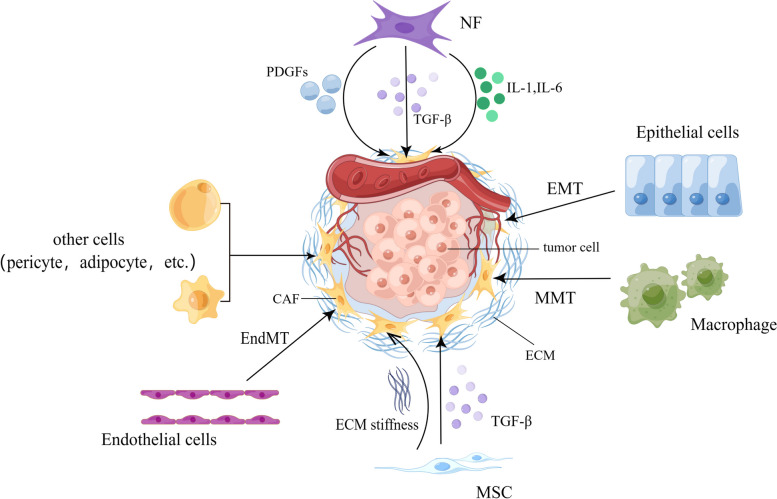
Fig. 1
Fig. 1
Possible origins of CAF. ECM, extracellular matrix; EMT, epithelial-to-mesenchymal transition; EndMT, endothelial-to-mesenchymal transition; IL, interleukin; MMT, macrophage-to-mesenchymal transition; MSC, mesenchymal stem cells; NF, normal fibroblast; PDGF, platelet-derived growth factor; TGF-β, transforming growth factor beta. By Figdraw
Fig. 2
Fig. 2
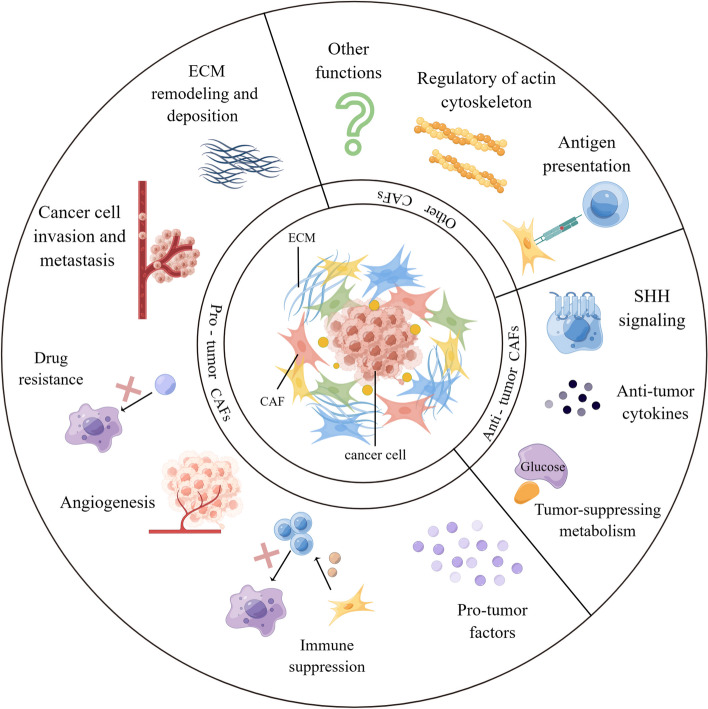
Functional heterogeneity of CAF. CAF is broadly classified as pro-tumor CAF and tumor-suppressing CAF, both of which affect tumor progression through multifaceted mechanisms. However, there are still other potential functions that have not been discovered, and it is not yet possible to determine whether this function is beneficial or harmful to tumor progression. ECM, extracellular matrix; SHH, Sonic Hedgehog. By Figdraw
Fig. 3
Fig. 3
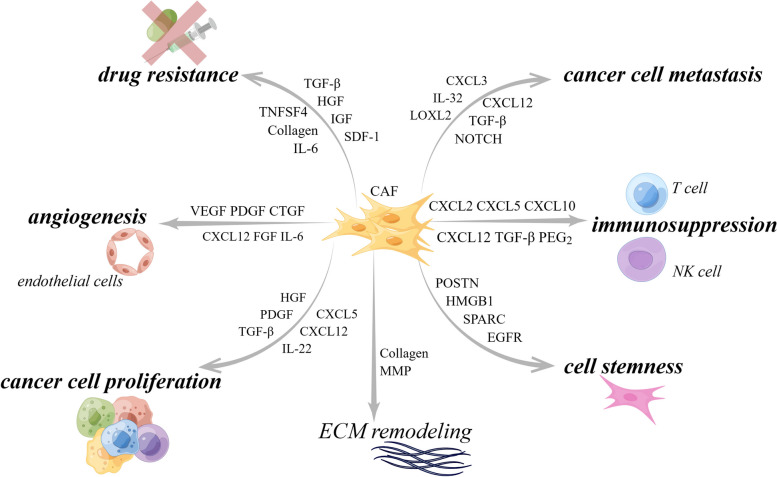
CAF interacts with a variety of tumor-promoting components through multiple signaling pathways. CAF can exert its pro-tumor function by promoting tumor neovascularization, promoting tumor cell proliferation and metastasis, regulating tumor microenvironment to an immunosuppressive state, and reconstructing ECM, etc. CAF, cancer-associated fibroblast; CTGF, connective tissue growth factor; CXCL, C–X–C motif chemokine; EGFR, epidermal growth factor receptor; FGF, fibroblast growth factor; HGF, hepatocyte growth factor; HMGB1, high mobility group protein 1; IGF, insulin-like growth factor; IL, interleukin; NOTCH3, neurogenic locus notch homolog protein 3; LOXL2, lysyl oxidase like 2; MMP, matrix metalloproteinase; PDGF, platelet-derived growth factor; PGE2, prostaglandin E2; POSTN, periostin; SDF-1, super dimensional fortress-1; SPARC, secreted protein acidic and cysteine rich; TGF-β, transforming growth factor beta; TNFSF4, tumor necrosis factor superfamily member 4; VEGF, vascular endothelial growth factor. By Figdraw
Fig. 4
Fig. 4
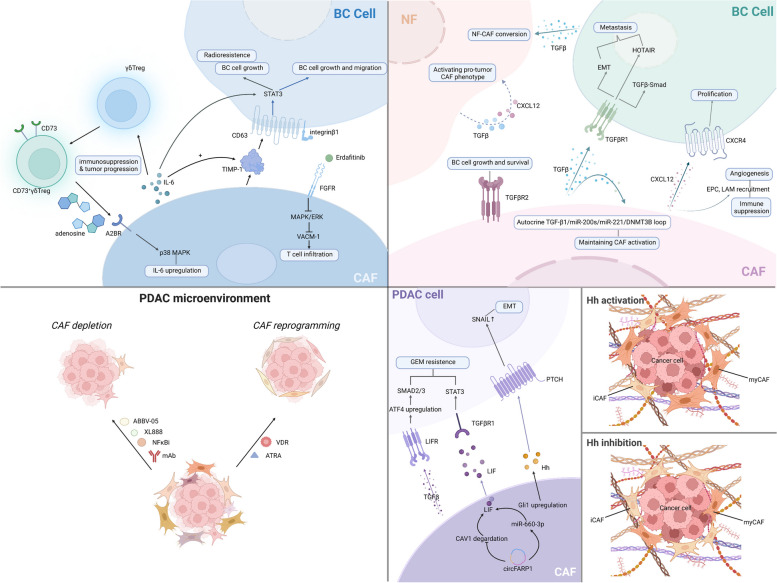
Schematic diagram of the interaction of CAF with cells in BC and PDAC TME. The IL6-adenosine loop potentiates immunosuppression and BC progression, and the TIMP-1/CD63/integrin β1/STAT3 loop is associated with BC cell growth. Erdafitinib promotes T lymphocyte infiltration via inhibiting MARK/ERK signaling. Moreover, CAF-secreted TGF-β1 activates the transcription of HOTAIR to promote BC cell metastasis; the autocrine TGF-β1/miR-200 s/miR-221/DNMT3B loop maintains CAF activity and promotes BC progression. CAF-secreted CXCL12 favors BC cell proliferation and EPC, LAM recruitment. In PDAC, CAF reduction can be achieved by depleting or reprogramming CAF. CAF-derived circFARP1 and TGF-β can both lead to gemcitabine resistance in PDAC cells, and CAF-secreted Hh promotes EMT via upregulating SNAIL transcription. In the end, Hh inhibition changes the proportion of CAF phenotypes in PDAC TME. By Biorender
Fig. 5
Fig. 5
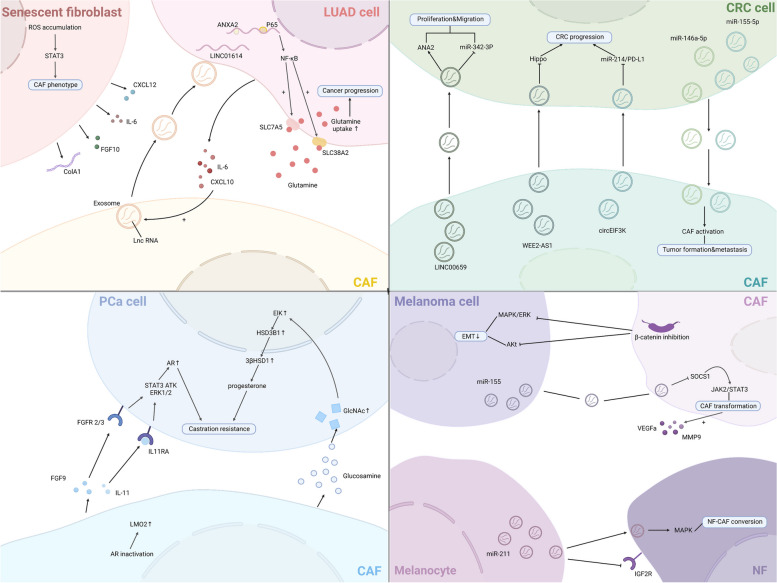
Schematic diagram of the interaction of CAF with cells in LC, CRC, PCa, and Melanoma TME. CAF-secreted exosome LINC01614 activates the NF-κB signaling pathway, thus upregulating the glutamine transporters SLC38A2 and SLC7A5 to promote glutamine uptake. In CRC, the exosomal LINC00659, WEE2-AS1, and circEIF3K from CAF enhance CRC progression through various mechanisms, and the miR-146a-5p and miR-155-5p from CRC cells activate CAF. Moreover, through FGF9, IL-11, and glucosamine secretion, CAF expedites castration resistance in PCa cells. At last, inhibition of β-catenin in CAFs downregulates AKT and MAPK/ERK signaling and blocks EMT in BrafV600E; Ptenlox5/lox5 melanoma. Melanoma cell-secreted miR-155 and melanocyte-secreted miR-211 promote CAF transformation and NF-CAF transition respectively. By Biorender

References

    1. Giraldo NA, Sanchez-Salas R, Peske JD, Vano Y, Becht E, Petitprez F, et al. The clinical role of the TME in solid cancer. Br J Cancer. 2019;120:45–53. - PMC - PubMed
    1. Li H, Fan X, Houghton J. Tumor microenvironment: The role of the tumor stroma in cancer. J Cell Biochem. 2007;101:805–815. - PubMed
    1. Sahai E, Astsaturov I, Cukierman E, DeNardo DG, Egeblad M, Evans RM, et al. A framework for advancing our understanding of cancer-associated fibroblasts. Nat Rev Cancer. 2020;20:174–186. - PMC - PubMed
    1. Lavie D, Ben-Shmuel A, Erez N, Scherz-Shouval R. Cancer-associated fibroblasts in the single-cell era. Nat Cancer. 2022;3:793–807. - PMC - PubMed
    1. Chen Y, McAndrews KM, Kalluri R. Clinical and therapeutic relevance of cancer-associated fibroblasts. Nat Rev Clin Oncol. 2021;18:792–804. - PMC - PubMed

Publication types