Review
. 2024 Jan;40(1):113-126.
doi: 10.1007/s12264-023-01130-w. Epub 2023 Oct 3.

Stem Cell-Based Hair Cell Regeneration and Therapy in the Inner Ear

Affiliations
Review

Stem Cell-Based Hair Cell Regeneration and Therapy in the Inner Ear

Jieyu Qi et al. Neurosci Bull. 2024 Jan.

Abstract

Hearing loss has become increasingly prevalent and causes considerable disability, thus gravely burdening the global economy. Irreversible loss of hair cells is a main cause of sensorineural hearing loss, and currently, the only relatively effective clinical treatments are limited to digital hearing equipment like cochlear implants and hearing aids, but these are of limited benefit in patients. It is therefore urgent to understand the mechanisms of damage repair in order to develop new neuroprotective strategies. At present, how to promote the regeneration of functional hair cells is a key scientific question in the field of hearing research. Multiple signaling pathways and transcriptional factors trigger the activation of hair cell progenitors and ensure the maturation of newborn hair cells, and in this article, we first review the principal mechanisms underlying hair cell reproduction. We then further discuss therapeutic strategies involving the co-regulation of multiple signaling pathways in order to induce effective functional hair cell regeneration after degeneration, and we summarize current achievements in hair cell regeneration. Lastly, we discuss potential future approaches, such as small molecule drugs and gene therapy, which might be applied for regenerating functional hair cells in the clinic.

Keywords: Cochlea; Hair cell regeneration; Hearing loss; Stem cell.


Conflict of interest statement

The authors declare that there are no conflicts of interest.

Figures
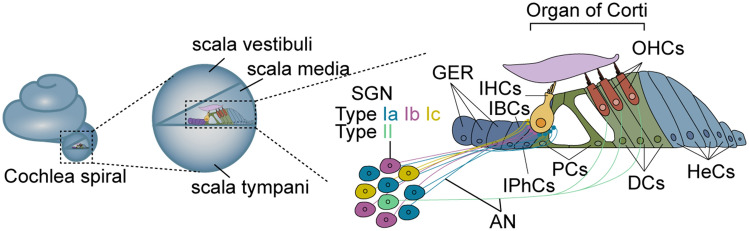
Fig. 1
Fig. 1
Structure of the cochlea. The cochlear duct is a spiral-shaped bony labyrinth with three separate cavities called the scala vestibule, scala media, and scala tympani. The sensory epithelium includes three rows of OHCs, one row of IHCs, and supporting cells (GER cells, inner border cells (IBCs), inner phalangeal cells (IPhCs), pillar cells (PCs), Deiters’ cells (DCs), and Hensen’s cells (HeCs)) and SGNs. AN: auditory nerve
Fig. 2
Fig. 2
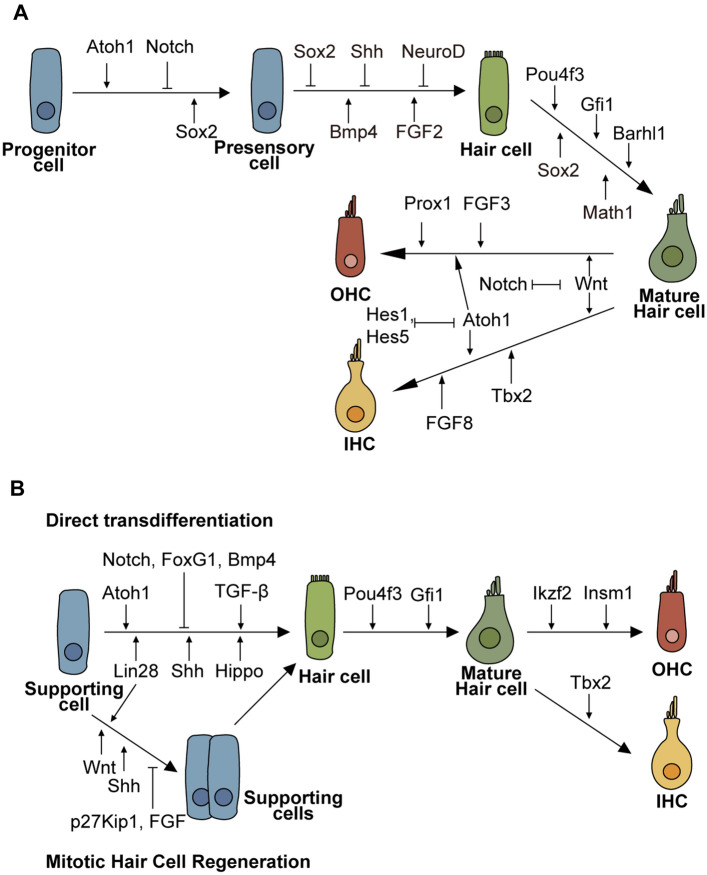
Signaling pathways and transcription factors involved in hair cell reprogramming. A Schematic of the hair cell developmental cascade. B The two pathways of direct hair cell transdifferentiation and mitotic hair cell regeneration in which supporting cells first undergo mitosis before differentiating into hair cells
Fig. 3
Fig. 3
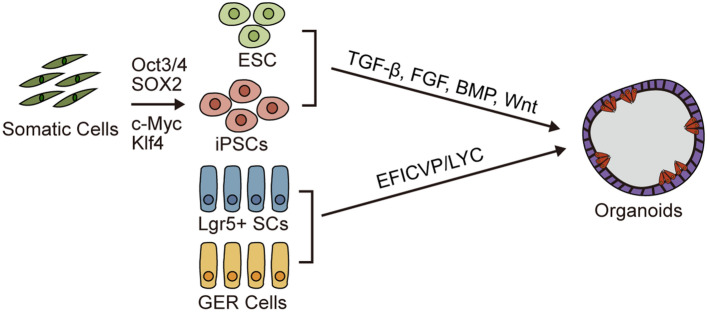
Stem cell-derived inner ear organoids. Four cell resources for cochlear organoid formation. The induction molecules are shown, respectively
Fig. 4
Fig. 4
Hair cell regeneration therapy via AAV and small molecules. A Synthetic AAV vectors with high transduction rate in hair cells and supporting cells. The cells marked by dark blue indicate the cell types transduced by AAVs in the organ of Corti. The light blue indicates the low-efficiency selective expression of AAV-PHP.eGFP in the inner pillar cells driven by the Gfap promoter. B AAV-mediated transgene transduction, together with small molecules, facilitates multi-gene co-regulation during hair cell regeneration

References

    1. Fettiplace R. Hair cell transduction, tuning, and synaptic transmission in the mammalian cochlea. Compr Physiol. 2017;7:1197–1227. doi: 10.1002/cphy.c160049. - DOI - PMC - PubMed
    1. Javitt DC, Sweet RA. Auditory dysfunction in schizophrenia: Integrating clinical and basic features. Nat Rev Neurosci. 2015;16:535–550. doi: 10.1038/nrn4002. - DOI - PMC - PubMed
    1. Chen Y, Zhang S, Chai R, Li H. Hair cell regeneration. Adv Exp Med Biol. 2019;1130:1–16. doi: 10.1007/978-981-13-6123-4_1. - DOI - PubMed
    1. Koehler KR, Mikosz AM, Molosh AI, Patel D, Hashino E. Generation of inner ear sensory epithelia from pluripotent stem cells in 3D culture. Nature. 2013;500:217–221. doi: 10.1038/nature12298. - DOI - PMC - PubMed
    1. Nie J, Hashino E. Generation of inner ear organoids from human pluripotent stem cells. Methods in Cell Biology. Amsterdam: Elsevier, 2020: 303–321. - PubMed

LinkOut - more resources