. 2023 Oct 3;14(1):6163.
doi: 10.1038/s41467-023-41900-8.

Radiolytically reworked Archean organic matter in a habitable deep ancient high-temperature brine

Affiliations

Radiolytically reworked Archean organic matter in a habitable deep ancient high-temperature brine

Devan M Nisson et al. Nat Commun. .

Abstract

Investigations of abiotic and biotic contributions to dissolved organic carbon (DOC) are required to constrain microbial habitability in continental subsurface fluids. Here we investigate a large (101-283 mg C/L) DOC pool in an ancient (>1Ga), high temperature (45-55 °C), low biomass (102-104 cells/mL), and deep (3.2 km) brine from an uranium-enriched South African gold mine. Excitation-emission matrices (EEMs), negative electrospray ionization (-ESI) 21 tesla Fourier-transform ion cyclotron resonance mass spectrometry (FT-ICR MS), and amino acid analyses suggest the brine DOC is primarily radiolytically oxidized kerogen-rich shales or reefs, methane and ethane, with trace amounts of C3-C6 hydrocarbons and organic sulfides. δ2H and δ13C of C1-C3 hydrocarbons are consistent with abiotic origins. These findings suggest water-rock processes control redox and C cycling, helping support a meagre, slow biosphere over geologic time. A radiolytic-driven, habitable brine may signal similar settings are good targets in the search for life beyond Earth.


Conflict of interest statement

The authors declare no competing interests.

Figures
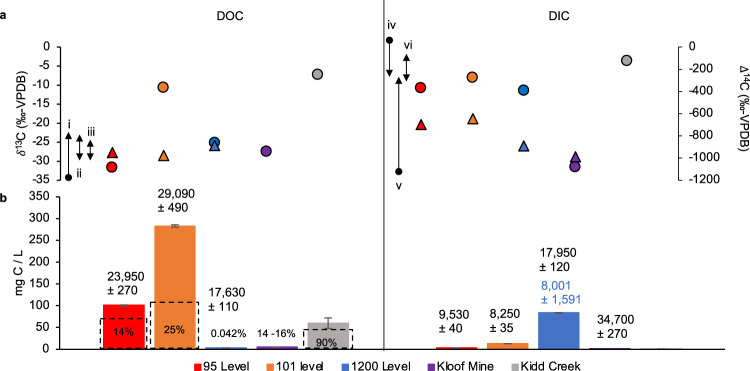
Fig. 1
Fig. 1. Dissolved organic and inorganic carbon (DOC/DIC) and δ13C, Δ14C signatures.
a δ13C (circles) and Δ14C measurements (triangles), relative to Vienna Pee Dee Belemnite (V-PDB), for DOC and DIC pools from (b). Reproducibility of δ13C is ±0.3‰ for Moab Khotsong and Kloof samples, and ±2.5‰ for Kidd Creek. δ13CDOC ranges include: (i) reported values for DOC of Witwatersrand Basin fracture waters (full range -24 to -57‰,), (ii) extractable organic carbon from Vaal Reef, (iii) extractable organic carbon from the Kimberley Shales. δ13CDIC ranges include: (iv) acetogenesis or methanogenesis (full range of −7 to 12‰,), (v) reported values for DIC of Witwatersrand Basin fracture waters (full range of -12 to -43‰,) (vi) calcites from Moab Khotsong. δ13CDIC of 0.6‰ for Transvaal Dolomites is out of range. b Quantity of DOC and DIC in mg C/L of the Moab Khotsong fracture fluids compared to Kloof Mine and Kidd Creek brine (Kidd Creek DIC (0.7 mg C/L) is smaller than other plotted samples). Error bars represented as relative standard deviation (% RSD) and are ±1% for Moab Khotsong and Kloof Mine samples and ±20% Kidd Creek, and in some cases, are smaller than the symbols. Percentages in dashed boxes indicate the percentage of low molecular weight organic acid (acetate + formate + propionate + oxalate) comprising the DOC pool. Apparent ages based on Δ14C from (a) are shown in years above each carbon pool ± relative error. Blue ages for DIC of the 1200-level include correction for carbonate dissolution upon aquifer recharge.
Fig. 2
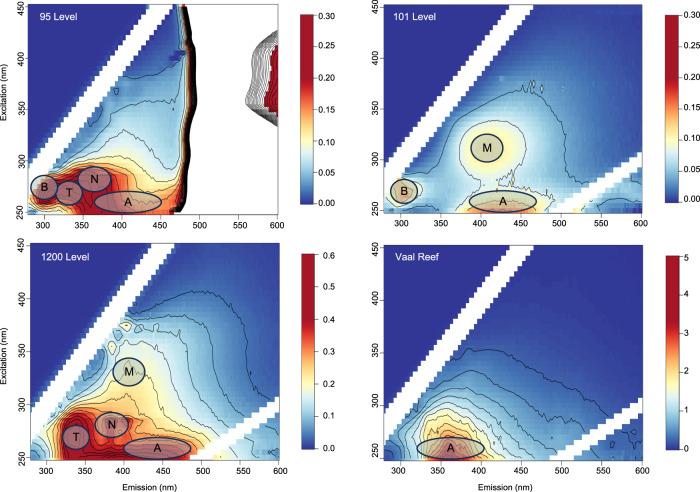
Fig. 2. Excitation emission matrices (EEMs).
EEMs shown are for the 95-level brine, 101-level brine, 1200-level dolomite fluid, and Vaal Reef extract. Scales display fluorescence intensity values with contours at 0, 0.02, and 5. Diagonal features represent first and second order Raman scatter. Peak regions are identified by corresponding lettered circles,: A,N – humic-like; B – tyrosine protein-like; T – tryptophan protein-like; M – autochthonous microbial DOC. The large white area from ~480 to 600 nm emission in the 95-level spectrum is due to the presence of fluorescein dye in this sample and the scale has been adjusted to exclude the high fluorescence of this region. The full spectra for the 95-level 2018 to 2020 spectra with both this excluded vs. included fluorescein signal can be seen in Supplementary Information Fig. S2.
Fig. 3
Fig. 3. Van Krevelen diagrams from negative electrospray ionization 21 tesla Fourier-transform ion cyclotron resonance mass spectrometry (FT-ICR MS).
Samples shown include the 95 and 101-level brines compared to the 1200-level dolomite fluid, and an extract from the Vaal Reef. Dashed red lines and arrows indicate regions of increasing (1) aliphatic, (2) aromatic, and (3) condensed aromaticity of molecules. Circles included on the 95-level diagram represent typical H/C vs. O/C regions for broad organics classes.
Fig. 4
Fig. 4. Percent relative abundance of organic species.
Major classes Ox, N1Ox, and S1Ox obtained through negative ion ESI 21 tesla FT-ICR MS for 95 and 101-level brines compared to the 1200-level dolomite fluid and an extract of the kerogen-rich Vaal Reef.
Fig. 5
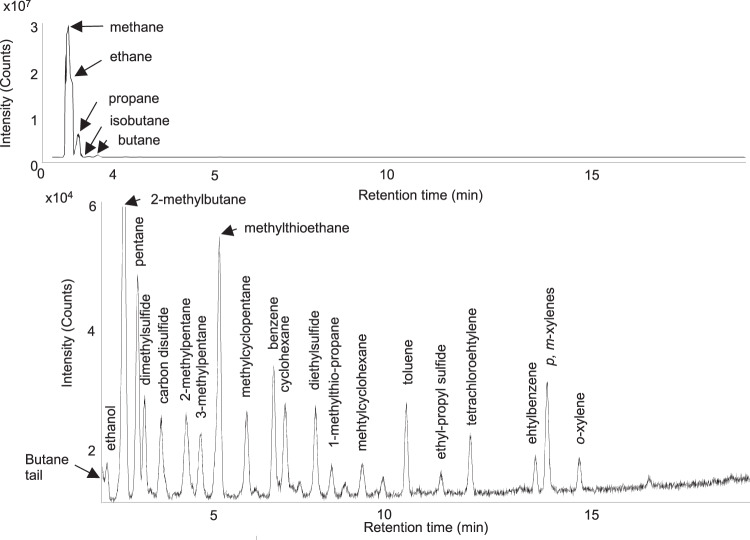
Fig. 5. Chromatographs of volatile organic species from headspace gas in the 95-level brine.
The top panel displays intensity of volatile species’ peaks from 0 to 3 · 107 counts while the bottom panel displays species’ peaks of lower intensity (1.6 · 104 to 6.0 · 104 counts) over a 19.75-minute retention range.
Fig. 6
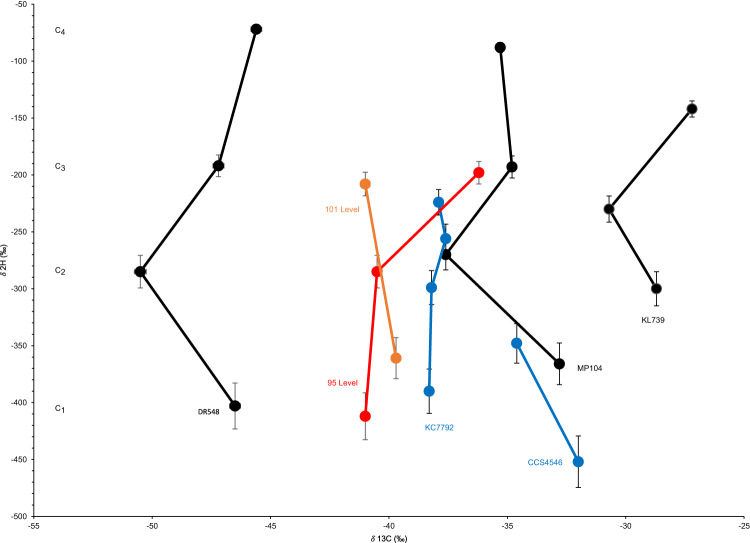
Fig. 6. Isotopic values (‰) for hydrogen and carbon of C1-4 hydrocarbon gases.
Fluid systems including Moab Khotsong brines (95 (red) and 101 (green) levels), other fracture fluids previously sampled from the Witwatersrand Basin (Dreifontein—DR548, Mponeng—MP104, Kloof—KL739), and fluids from the Canadian Shield (Copper Cliff—CCS4546) including fluids from Kidd Creek Mine (KC7792) where residence times of over 1 Ga were identified (Sherwood Lollar et al.). Error bars represent ±0.5‰ and ±5‰ relative to Vienna Pee Dee Belemnite (V-PDB) and Vienna Standard Mean Ocean Water (V-SMOW) for δ13C and δ2H, respectively. Specific isotopic values and gas compositional data for C1-4 hydrocarbons are included in Supplementary Material Table S1.
Fig. 7
Fig. 7. Geographic and stratigraphic location of Moab Khotsong mine sampling sites.
a Location of the Moab Khotsong mine (along with Carltonville-based mines mentioned in this study) within the Witwatersrand Basin of South Africa (b) Stratigraphic location of facture fluid sampling sites in the Moab Khotsong mine showing the relationship of the boreholes in the Transvaal dolomite aquifer [1200-level; 1.2 km], and West Rand quartzites [95-level; 2.9 km and 101-level; 3.1 km], relative to major reef [VCR – Ventersdorp Contact Reef] and shale zones.

References

    1. Sherwood Lollar B, Westgate TD, Ward JA, Slater GF, Lacrampe-Couloume G. Abiogenic formation of alkanes in the Earth’s crust as a minor source for global hydrocarbon reservoirs. Nature. 2002;416:522–524. doi: 10.1038/416522a. - DOI - PubMed
    1. Sherwood Lollar B, et al. Unravelling abiogenic and biogenic sources of methane in the Earth’s deep subsurface. Chem. Geol. 2006;226:328–339. doi: 10.1016/j.chemgeo.2005.09.027. - DOI
    1. Etiope G, Sherwood Lollar B. Abiotic methane on Earth. Rev. Geophys. 2013;51:276–299. doi: 10.1002/rog.20011. - DOI
    1. Kietäväinen R, Ahonen L, Niinikoski P, Nykänen H, Kukkonen IT. Abiotic and biotic controls on methane formation down to 2.5 km depth within the Precambrian Fennoscandian Shield. Geochim. Cosmochim. Acta. 2017;202:124–145. doi: 10.1016/j.gca.2016.12.020. - DOI
    1. Etiope G, Oze C. Microbial vs abiotic origin of methane in continental serpentinized ultramafic rocks: a critical review and the need of a holistic approach. Appl. Geochem. 2022;143:105373. doi: 10.1016/j.apgeochem.2022.105373. - DOI