


Polymorphisms in genes of melatonin biosynthesis and signaling support the light-at-night hypothesis for breast cancer
- PMID: 37789226
- PMCID: PMC10570222
- DOI: 10.1007/s10654-023-01048-7
Polymorphisms in genes of melatonin biosynthesis and signaling support the light-at-night hypothesis for breast cancer
Abstract
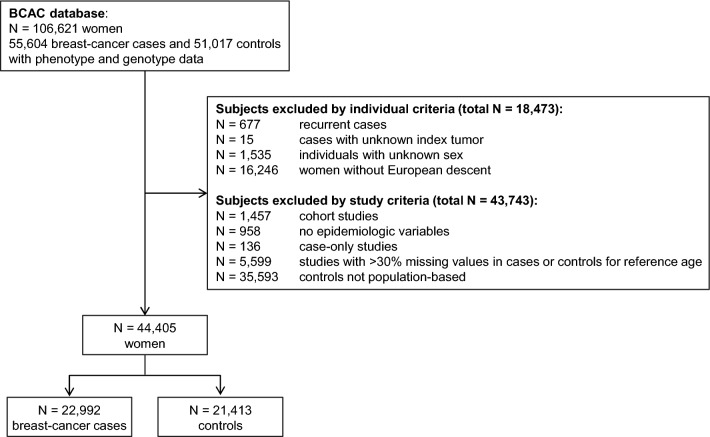
Light-at-night triggers the decline of pineal gland melatonin biosynthesis and secretion and is an IARC-classified probable breast-cancer risk factor. We applied a large-scale molecular epidemiology approach to shed light on the putative role of melatonin in breast cancer. We investigated associations between breast-cancer risk and polymorphisms at genes of melatonin biosynthesis/signaling using a study population of 44,405 women from the Breast Cancer Association Consortium (22,992 cases, 21,413 population-based controls). Genotype data of 97 candidate single nucleotide polymorphisms (SNPs) at 18 defined gene regions were investigated for breast-cancer risk effects. We calculated adjusted odds ratios (ORs) and 95% confidence intervals (CI) by logistic regression for the main-effect analysis as well as stratified analyses by estrogen- and progesterone-receptor (ER, PR) status. SNP-SNP interactions were analyzed via a two-step procedure based on logic regression. The Bayesian false-discovery probability (BFDP) was used for all analyses to account for multiple testing. Noteworthy associations (BFDP < 0.8) included 10 linked SNPs in tryptophan hydroxylase 2 (TPH2) (e.g. rs1386492: OR = 1.07, 95% CI 1.02-1.12), and a SNP in the mitogen-activated protein kinase 8 (MAPK8) (rs10857561: OR = 1.11, 95% CI 1.04-1.18). The SNP-SNP interaction analysis revealed noteworthy interaction terms with TPH2- and MAPK-related SNPs (e.g. rs1386483R ∧ rs1473473D ∧ rs3729931D: OR = 1.20, 95% CI 1.09-1.32). In line with the light-at-night hypothesis that links shift work with elevated breast-cancer risks our results point to SNPs in TPH2 and MAPK-genes that may impact the intricate network of circadian regulation.
Keywords: Circadian rhythm; MAPK8; Serotonin biosynthesis; Shift work; TPH2.
© 2023. The Author(s).
Conflict of interest statement
Hermann Brenner is a member of the Editorial Board. Otherwise, the authors report no conflicts of interest.
Figures
References
MeSH terms
Substances
Grants and funding
- C12292/A11174/CRUK_/Cancer Research UK/United Kingdom
- C5047/A15007/CRUK_/Cancer Research UK/United Kingdom
- UM1 CA164920/CA/NCI NIH HHS/United States
- R01CA100374/GF/NIH HHS/United States
- C1281/A12014/CRUK_/Cancer Research UK/United Kingdom
- C5047/A10692/CRUK_/Cancer Research UK/United Kingdom
- R01 CA100374/CA/NCI NIH HHS/United States
- U19 CA148537/CA/NCI NIH HHS/United States
- C490/A16561/CRUK_/Cancer Research UK/United Kingdom
- C8197/A16565/CRUK_/Cancer Research UK/United Kingdom
- U19 CA148065/CA/NCI NIH HHS/United States
- C490/A10124/CRUK_/Cancer Research UK/United Kingdom
- R01 CA128978/CA/NCI NIH HHS/United States
- C1287/A10118/CRUK_/Cancer Research UK/United Kingdom
- P30 CA068485/CA/NCI NIH HHS/United States
- U01 CA164920/CA/NCI NIH HHS/United States
- CA128978/NH/NIH HHS/United States
- U19 CA148112/CA/NCI NIH HHS/United States
- C1287/A10710/CRUK_/Cancer Research UK/United Kingdom
- C5047/A8384/CRUK_/Cancer Research UK/United Kingdom
LinkOut - more resources
Full Text Sources
Medical
Research Materials
Miscellaneous
