Review
. 2023 Sep 27:15:113-124.
doi: 10.2147/EB.S404642. eCollection 2023.

A Neuro-Ophthalmologist's Guide to Advances in Intracranial Pressure Measurements

Affiliations
Review

A Neuro-Ophthalmologist's Guide to Advances in Intracranial Pressure Measurements

Susan P Mollan et al. Eye Brain. .

Abstract

Cerebrospinal fluid disorders have a wide-ranging impact on vision, headache, cognition and a person's quality of life. Due to advances in technology and accessibility, intracranial pressure measurement and monitoring, usually managed by neurosurgeons, are being employed more widely in clinical practice. These developments are of direct importance for Ophthalmologists and Neurologists because the ability to readily measure intracranial pressure can aide management decisions. The aim of this review is to present the emerging evidence for intracranial pressure measurement methods and interpretation that is relevant to Neuro-ophthalmologists.

Keywords: cerebrospinal fluid; intracranial pressure; intraparenchymal intracranial pressure sensors; lumbar puncture opening pressure; neuro-ophthalmology; non-invasive; pseudotumour cerebri; telemetric intracranial pressure monitor; waveform.


Conflict of interest statement

Professor Alexandra Sinclair reports personal fees from Invex therapeutics in her role as Director with stock holdings. Honoria from Allergan, Novartis, Chiesi and Amgen outside the submitted work. Professor Susan Mollan has received honoraria for speaker events from AbbVie, Heidelberg engineering, Chugai-Roche Ltd and Teva. Honoraria for advisory boards for Invex Therapeutics, Gensight and ocular therapeutix. Consultancy fees from the Velux foundation, Neurodiem and Invex Therapeutics. She also reports grants from National institute of health research and UK space agency. Ms Olivia Grech reports scientific consultancy fee from Index Therapeutics. Professor Alex Sinclair owns shares from Invex Therapeutics. Dr Georgios Tsermoulas was an invited speaker to a “lunch symposium” sponsored by Braun in the Hydrocephalus 2022 meeting in Gothenburg on Mon 12th Sep 2022 and presented on “Intracranial pressure recordings in shunted patients with Idiopathic Intracranial Hypertension”. However, he did not receive any remuneration or any other benefits in relation to this presentation. All declared interested are outside the area of this submitted work. All other authors declare no competing interests in this work.

Figures

Figure 1
Figure 1
Infographic summary of changes in ICP observed. (A) Example ICP trace demonstrating pressure change in LP, supine, sitting, standing positions, with coughing and bending and prolonged supine recording. (B) Cough: representation of ICP waveform with single maximal effort cough. (C) Bend: bending from hips to touch floor with return to standing. (D) Prolonged supine: representation of ICP in supine position whilst intermittently ambulant during day then in supine position overnight with rise in pressure over time.
Figure 2
Figure 2
ICP curves (10 seconds recordings) with the M.scio system in five people with idiopathic intracranial hypertension and a ventricular peritoneal shunt. ICP is plotted on the Y-axis (mmHg) and time on X-axis (seconds). Images are cropped screenshots from the ICPictureTM software, Version: 1.1.0 Last update: 15.03.2022, Christoph Miethke GmbH & Co. KG). Pulsatile curve of functioning shunt in sitting position with P1<P2 (mean ICP 0.6 mmHg, amplitude 8.3).
Figure 3
Figure 3
ICP curves (10 seconds recordings) with the M.scio system in five people with idiopathic intracranial hypertension and a ventricular peritoneal shunt. ICP is plotted on the Y-axis (mmHg) and time on X-axis (seconds). Images are cropped screenshots from the ICPictureTM software, Version: 1.1.0 Last update: 15.03.2022, Christoph Miethke GmbH & Co. KG). Pulsatile curve of shunt with distal block in sitting position with P1<P2 (mean ICP 14.2 mmHg, amplitude 14.9). Amplitude is a property of pulsatile curves and not measured in non-pulsatile ones.
Figure 4
Figure 4
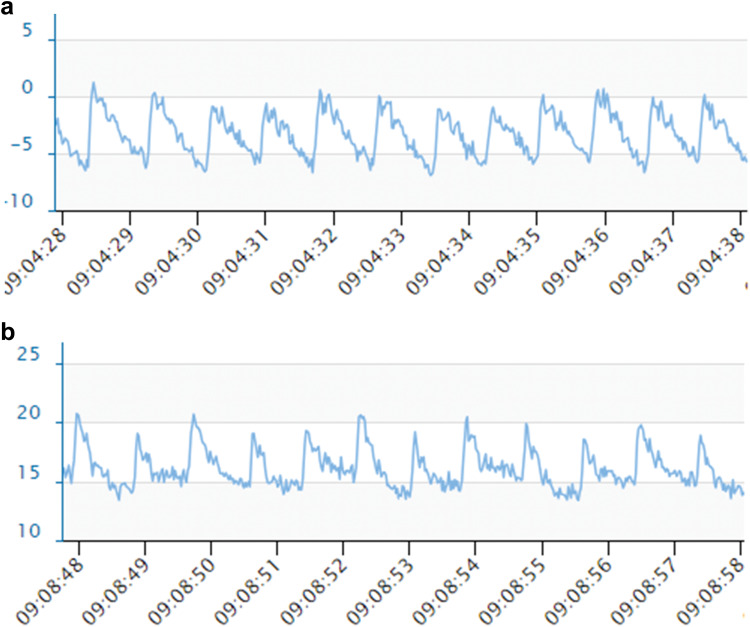
ICP curves (10 seconds recordings) with the M.scio system in five people with idiopathic intracranial hypertension and a ventriculoperitoneal shunt. ICP is plotted on the Y-axis (mmHg) and time on X-axis (seconds). Images are cropped screenshots from the ICPictureTM software, Version: 1.1.0 Last update: 15.03.2022, Christoph Miethke GmbH & Co. KG). (a) Pulsatile curve of functioning shunt in sitting position with P1>P2 (mean ICP −3.4 mmHg, amplitude 6.3), (b) Same patient in supine position with P1>P2 (mean ICP 16.3 mmHg, amplitude 5.5).
Figure 5
Figure 5
ICP curves (10 seconds recordings) with the M.scio system in five people with idiopathic intracranial hypertension and a ventricular peritoneal shunt. ICP is plotted on the Y-axis (mmHg) and time on X-axis (seconds). Images are cropped screenshots from the ICPictureTM software, Version: 1.1.0 Last update: 15.03.2022, Christoph Miethke GmbH & Co. KG).Irregular curve of functioning shunt in sitting position (mean ICP −18mmHg). Amplitude is a property of pulsatile curves and not measured in non-pulsatile ones.
Figure 6
Figure 6
ICP curves (10 seconds recordings) with the M.scio system in five people with idiopathic intracranial hypertension and a ventricular peritoneal shunt. ICP is plotted on the Y-axis (mmHg) and time on X-axis (seconds). Images are cropped screenshots from the ICPictureTM software, Version: 1.1.0 Last update: 15.03.2022, Christoph Miethke GmbH & Co. KG).Irregular curve of shunt with proximal block in sitting position (mean ICP −13.9mmHg).

References

    1. Bothwell SW, Janigro D, Patabendige A. Cerebrospinal fluid dynamics and intracranial pressure elevation in neurological diseases. Fluids Barriers CNS. 2019;16:9. - PMC - PubMed
    1. Loman J, Myerson A, Goldman D. Effects of alterations in posture on the cerebrospinal fluid pressure. Arch Neur Psych. 1935;33:1279–1295. doi:10.1001/archneurpsyc.1935.02250180138007 - DOI
    1. Czosnyka M, Pickard JD. Monitoring and interpretation of intracranial pressure. J Neurol Neurosurg Psychiatry. 2004;75:813–821. doi:10.1136/jnnp.2003.033126 - DOI - PMC - PubMed
    1. Mitchell JL, Buckham R, Lyons H, et al. Evaluation of diurnal and postural intracranial pressure employing telemetric monitoring in idiopathic intracranial hypertension. Fluids Barriers CNS. 2022;19:85. doi:10.1186/s12987-022-00384-2 - DOI - PMC - PubMed
    1. Pedersen SH, Andresen M, Lilja-Cyron A, et al. Lumbar puncture position influences intracranial pressure. Acta Neurochir. 2021;163:1997–2004. doi:10.1007/s00701-021-04813-3 - DOI - PubMed