


Trajectory of external implementation support activities across two states in the United States: A descriptive study
- PMID: 37790177
- PMCID: PMC10293536
- DOI: 10.1177/26334895231154285
Trajectory of external implementation support activities across two states in the United States: A descriptive study
Abstract
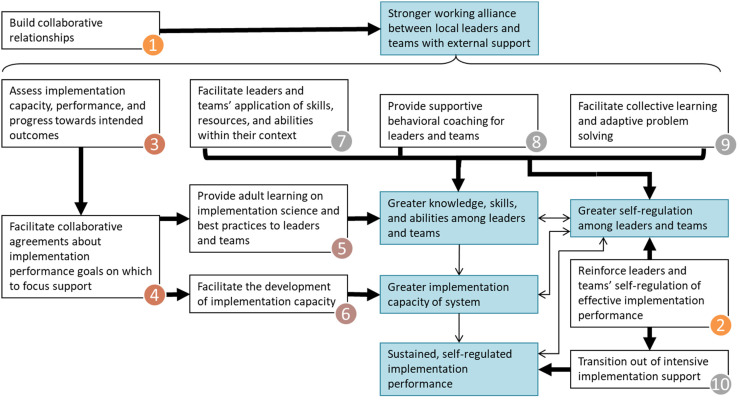
Background: Reporting on strategies to advance implementation outcomes is imperative. The current study reports descriptive information about external implementation support (EIS) provided over 5 years to 13 regions in North Carolina and South Carolina scaling an evidence-based system of parenting and family supports. Regional support teams operating through the Implementation Capacity for Triple P (ICTP) projects employed core practice components (CPCs) for EIS as proposed by Aldridge et al. and further operationalized by members of The Impact Center at FPG Child Development Institute, UNC-Chapel Hill.
Method: Practice activities associated with CPCs were developed and iteratively refined across the study period. ICTP regional support teams systematically tracked their use of CPCs and related activities following each substantive support interaction. Tracking included the duration of time a CPC was employed and the use of specific practice activities associated with that CPC. Data were aggregated by month of the relationship to account for differential start dates across regions.
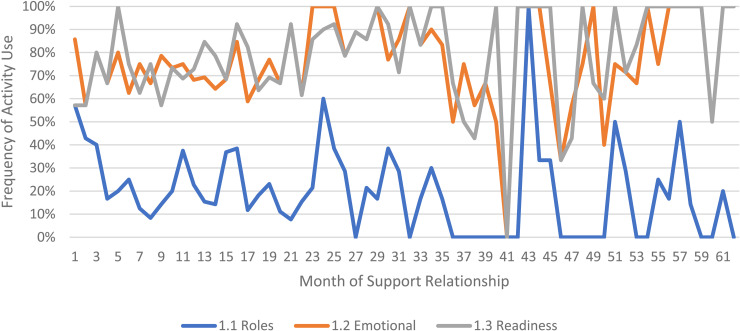
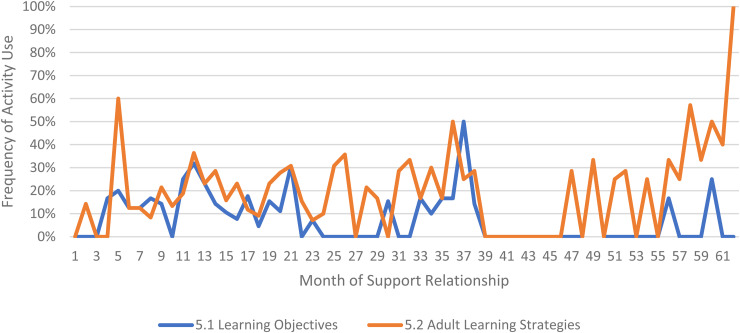
Results: From November 2016 through December 2021, ICTP support teams tracked 749 support interactions with Triple P regions in North Carolina and South Carolina. Monthly support decreased year over year, though dose varied considerably. Patterns of CPC use indicated a high dose of "foundational" and "co-design" CPCs early, followed by a blended and more diverse use thereafter, with some notable trends. Practice activities considered essential to influencing intended practice outcomes were characterized by higher rates of use. Like CPCs, practice activities were used dynamically across the study period.
Conclusions: This descriptive study offers a case study for how EIS might be operationalized, tracked, and employed. Findings suggest several interpretations that might refine our understanding and use of EIS. Although the nature of this practical report precludes generalizability of findings, directions for future research and practice are discussed.
Keywords: facilitation; implementation mechanisms; implementation practice; implementation strategies; implementation support practitioner; intermediaries; technical assistance.
Plain language summary
More needs to be known about how external support providers work with organizational, system, and community partners to improve their efforts to implement innovative programs and practices. Although a handful of models of external support have emerged in the literature, support strategies or activities are not often tracked systematically or prospectively. In the current study, we report on the adoption, operationalization, and use of a recently proposed model of external support across 13 regions in North Carolina and South Carolina scaling an evidence-based system of parenting and family interventions. Teams of external support providers tracked their activities using the model across more than 5 years. Results provide a description of what external support might look like across long-term support engagements, noting key patterns about dose of support and use of activities that might be responsible for influencing intended support outcomes. The study offers several findings that might refine our understanding and use of external support strategies. In addition, the study lays groundwork for examining additional research questions, such as the feasibility of support processes and whether and how support activities influence support outcomes.
© The Author(s) 2023.
Figures





References
-
- Albers B., Metz A., Burke K., Bührmann L., Bartley L., Driessen P., Varsi C. (2021). Implementation support skills: Findings from a systematic integrative review. Research on Social Work Practice, 31(2), 147–170. 10.1177/1049731520967419 - DOI
-
- Aldridge W. A., II, Roppolo R. H., Brown J., Bumbarger B. K., Boothroyd R. I. (2023). Mechanisms of change in external implementation support: A conceptual model and case examples to guide research and practice. Implementation Research and Practice, 1–24. 10.1177/26334895231154285. - DOI - PMC - PubMed
-
- Bandura A. (1986). Social foundations of thought and action: A social cognitive theory. Prentice-Hall, Inc.
LinkOut - more resources
Full Text Sources