This is a preprint.
"Easy women get it": Pre-existing stigma associated with HPV and cervical cancer in a low-resource setting prior to implementation of an HPV screen-and-treat program
- PMID: 37790338
- PMCID: PMC10543436
- DOI: 10.21203/rs.3.rs-3256535/v1
"Easy women get it": Pre-existing stigma associated with HPV and cervical cancer in a low-resource setting prior to implementation of an HPV screen-and-treat program
Update in
-
"Easy women get it": pre-existing stigma associated with HPV and cervical cancer in a low-resource setting prior to implementation of an HPV screen-and-treat program.BMC Public Health. 2023 Dec 2;23(1):2396. doi: 10.1186/s12889-023-17324-w. BMC Public Health. 2023. PMID: 38042779 Free PMC article.
Abstract
Background: Cervical cancer is preventable with vaccination and early detection and treatment programs. However, in order for these programs to work as intended, stigma related to HPV and cervical cancer must be understood and addressed. We explored pre-existing stigma associated with HPV and cervical cancer in the public healthcare system of a low-resource setting prior to implementation of an HPV screen-and-treat program.
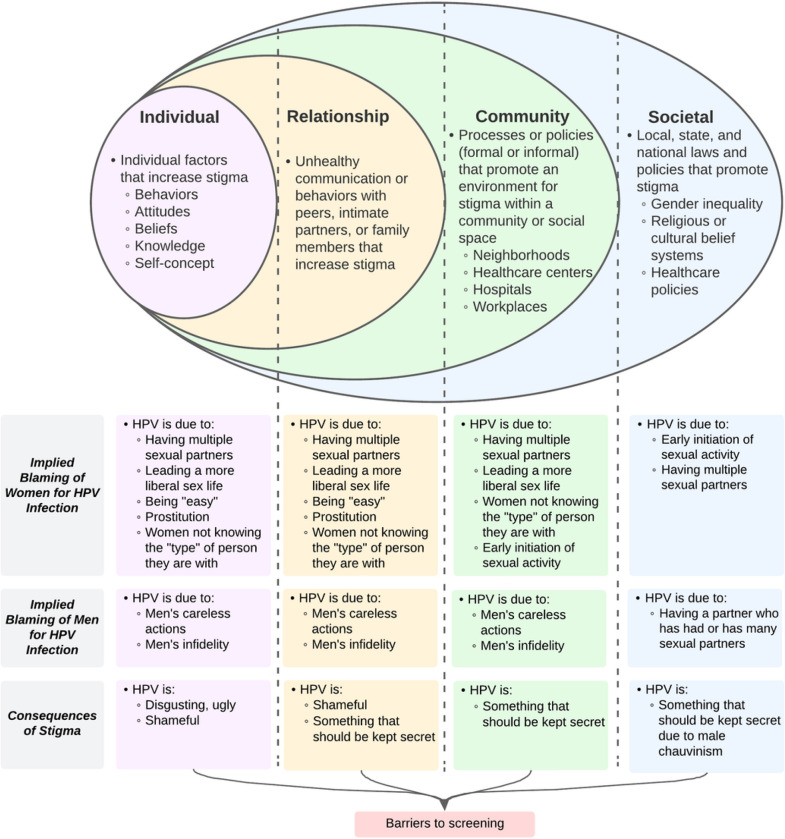
Methods: This study conducted thematic analysis of data collected during implementation of a novel HPV screen-and-treat system for cervical cancer early detection and treatment in Iquitos, Peru. We included 35 semi-structured interviews (19 health professionals, 16 women with cervical precancer or cancer), eight focus groups (70 community women), one workshop (14 health professionals), 210 counseling observations (with 20 nurse-midwives), and a document review. We used the Socio-Ecological Model to organize the analysis.
Results: We identified three main themes: 1. the implication that women are to blame for their HPV infection through characterizations of being easy or promiscuous, 2. the implication that men are to blame for women's HPV infections through being considered careless or unfaithful, 3. HPV is shameful, embarrassing, and something that should be hidden from others. Consequently, in some cases, women refrained from getting screened for HPV. These themes were seen at the individual level among women, relationship level among women, men, and family members, community level among healthcare staff, and societal level within components of cervical cancer guidelines and male chauvinism.
Conclusions: Cervical cancer early detection and treatment programs in limited resource settings must address stigma entrenched throughout the entire healthcare system in order to sustainably and successfully implement and scale-up new programs. Interventions to tackle this stigma can incorporate messages about HPV infections and latency to lessen the focus on the influence of sexual behavior on HPV acquisition, and instead, promote screening and treatment as paramount preventative measures.
Keywords: HPV; cervical cancer; screening; stigma.
Conflict of interest statement
Competing interests: Patti E. Gravitt reports receiving other commercial research support from Cepheid. No potential conflicts of interest were disclosed by the other authors.
Figures
References
-
- Drolet M, Bénard É, Pérez N, Brisson M, HPV Vaccination Impact Study Group. Population-level impact and herd effects following the introduction of human papillomavirus vaccination programmes: updated systematic review and meta-analysis. Lancet Lond Engl. 2019. Aug 10;394(10197):497–509. - PMC - PubMed
-
- World Health Organization, World Health Organization, Reproductive Health and Research. Comprehensive cervical cancer control: a guide to essential practice. [Internet]. 2014. [cited 2021 Mar 21]. Available from: http://apps.who.int/iris/bitstream/10665/144785/1/9789241548953_eng.pdf?... - PubMed
-
- Ngugi CW, Boga H, Muigai AWT, Wanzala P, Mbithi JN. Factors affecting uptake of cervical cancer early detection measures among women in Thika, Kenya. Health Care Women Int. 2012;33(7):595–613. - PubMed
-
- Miller SM, Mischel W, O’Leary A, Mills M. From human papillomavirus (HPV) to cervical cancer: Psychosocial processes in infection, detection, and control. Ann Behav Med. 1996. Dec;18(4):219–28. - PubMed
Publication types
Grants and funding
LinkOut - more resources
Full Text Sources
Research Materials