This is a preprint.
Dendritic Cell Vaccination in Conjunction with a TLR Agonist Polarizes Interferon Immune Responses in Malignant Glioma Patients
- PMID: 37790490
- PMCID: PMC10543402
- DOI: 10.21203/rs.3.rs-3287211/v1
Dendritic Cell Vaccination in Conjunction with a TLR Agonist Polarizes Interferon Immune Responses in Malignant Glioma Patients
Update in
-
TLR agonists polarize interferon responses in conjunction with dendritic cell vaccination in malignant glioma: a randomized phase II Trial.Nat Commun. 2024 May 8;15(1):3882. doi: 10.1038/s41467-024-48073-y. Nat Commun. 2024. PMID: 38719809 Free PMC article. Clinical Trial.
Abstract
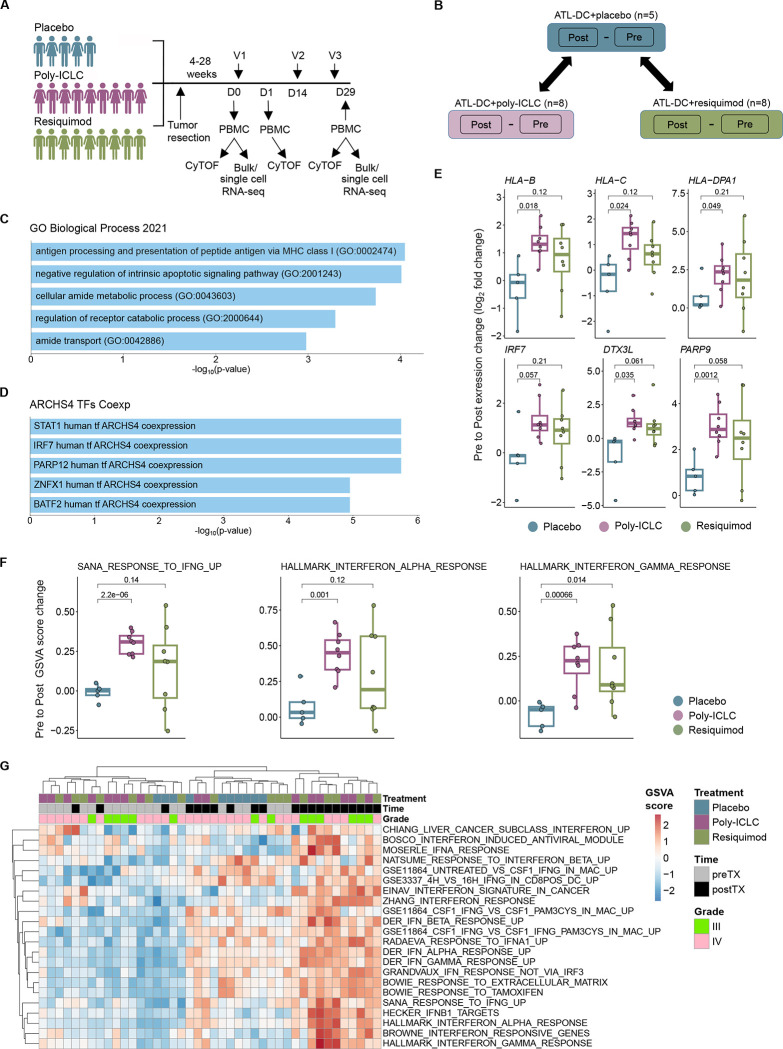
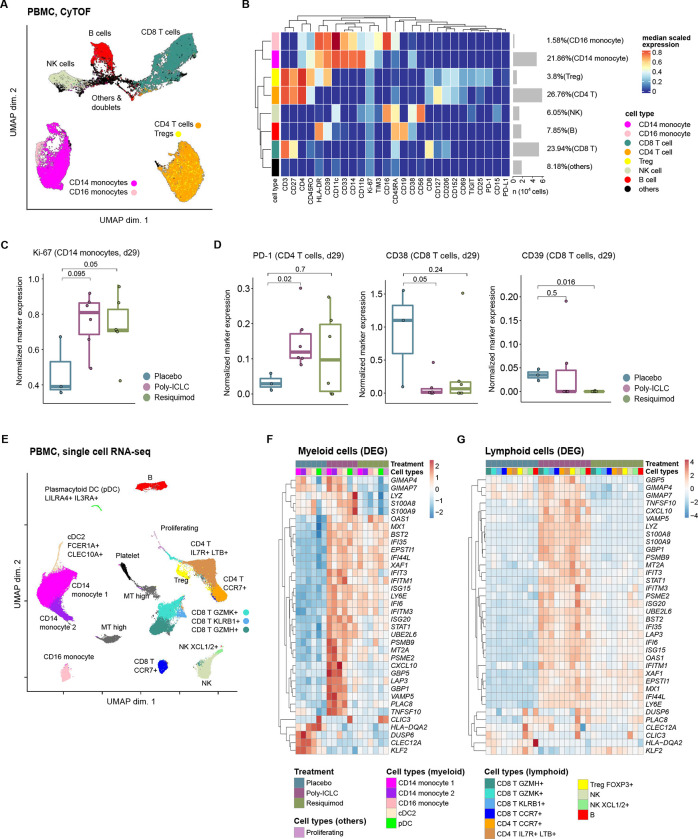
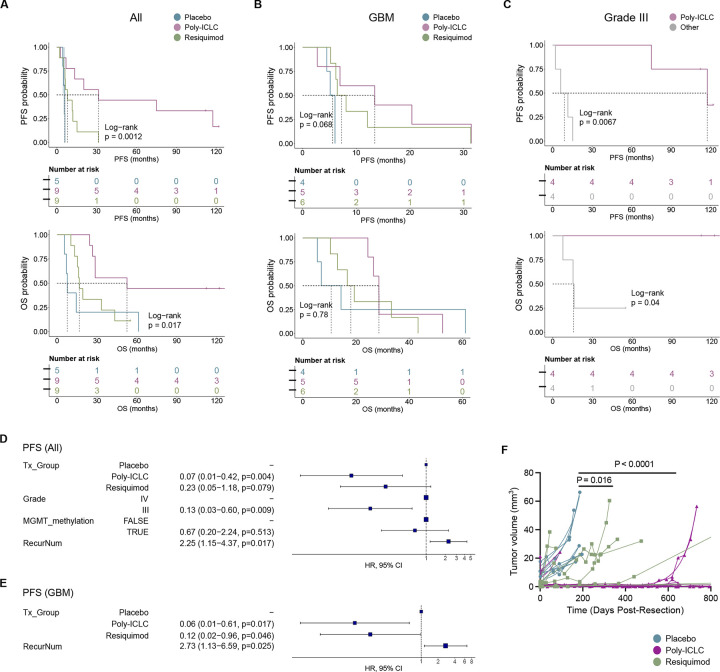
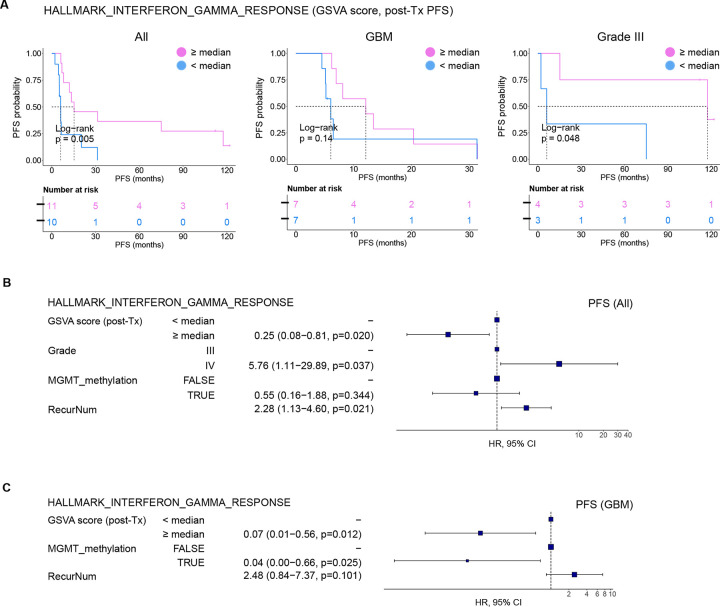
Autologous tumor lysate-pulsed dendritic cell (ATL-DC) vaccination is a promising immunotherapy for patients with high grade gliomas, but responses have not been demonstrated in all patients. To determine the most effective combination of autologous tumor lysate-pulsed DC vaccination, with or without the adjuvant toll-like receptor (TLR) agonists poly-ICLC or resiquimod, we conducted a Phase 2 clinical trial in 23 patients with newly diagnosed or recurrent WHO Grade III-IV malignant gliomas. We then performed deep, high-dimensional immune profiling of these patients to better understand how TLR agonists may influence the systemic immune responses induced by ATL-DC vaccination. Bulk RNAseq data demonstrated highly significant upregulation of type 1 and type 2 interferon gene expression selectively in patients who received adjuvant a TLR agonist together with ATL-DC. CyTOF analysis of patient peripheral blood mononuclear cells (PBMCs) showed increased expression of PD-1 on CD4+ T-cells, decreases in CD38 and CD39 on CD8+ T cells and elevated proportion of monocytes after ATL-DC + TLR agonist administration. In addition, scRNA-seq demonstrated a higher expression fold change of IFN-induced genes with poly-ICLC treatment in both peripheral blood monocytes and T lymphocytes. Patients who had higher expression of interferon response genes lived significantly longer and had longer time to progression compared to those with lower expression. The results suggest that ATL-DC in conjunction with adjuvant poly-ICLC induces a polarized interferon response in circulating monocytes and specific activation of a CD8+ T cell population, which may represent an important blood biomarker for immunotherapy in this patient population.
Trial registration: ClinicalTrials.gov Identifier: NCT01204684.
Keywords: TLR agonist; brain cancer; glioma; immunotherapy.
Conflict of interest statement
Additional Declarations: Yes there is potential Competing Interest. Dr. Salazar is an employee of Oncovir, Inc., which makes poly ICLC (Hiltonol).
Figures
References
-
- Roger Stupp M.E.H., Mason Warren P, van den Bent Martin J, Taphoorn Martin J B, Janzer Robert C, Ludwin Samuel K, Allgeier Anouk, Fisher Barbara, Belanger Karl, Hau Peter, Brandes Alba A, Gijtenbeek Johanna, Marosi Christine, Vecht Charles J, Mokhtari Karima, Wesseling Pieter, Villa Salvador, Eisenhauer Elizabeth, Gorlia Thierry, Weller Michael, Lacombe Denis, Gregory Cairncross J, Mirimanoff René-Olivier. Effects of radiotherapy with concomitant and adjuvant temozolomide versus radiotherapy alone on survival in glioblastoma in a randomised phase III study: 5-year analysis of the EORTC-NCIC trial. Lancet Oncol 10, 459–466 (2009). - PubMed
-
- Linda M. Liau R.M.P., Kiertscher Sylvia M., Odesa Sylvia K, Kremen Thomas J, Giovannone Adrian J., Lin Jia-Wei, Chute Dennis J., Mischel Paul S., Cloughesy Timothy F., and Roth Michael D. Dendritic Cell Vaccination in Glioblastoma Patients Induces Systemic and Intracranial T-cell Responses Modulated by the Local Central Nervous System Tumor Microenvironment. Clin Cancer Res 11, 5515–5525 (2005). - PubMed
-
- Okada H., et al. Induction of CD8+ T-cell responses against novel glioma-associated antigen peptides and clinical activity by vaccinations with {alpha}-type 1 polarized dendritic cells and polyinosinic-polycytidylic acid stabilized by lysine and carboxymethylcellulose in patients with recurrent malignant glioma. J Clin Oncol 29, 330–336 (2011). - PMC - PubMed
Publication types
Associated data
Grants and funding
LinkOut - more resources
Full Text Sources
Medical
Molecular Biology Databases
Research Materials