Analysis of cerebral Interleukin-6 and tumor necrosis factor alpha patterns following different ventilation strategies during cardiac arrest in pigs
- PMID: 37790622
- PMCID: PMC10544304
- DOI: 10.7717/peerj.16062
Analysis of cerebral Interleukin-6 and tumor necrosis factor alpha patterns following different ventilation strategies during cardiac arrest in pigs
Abstract
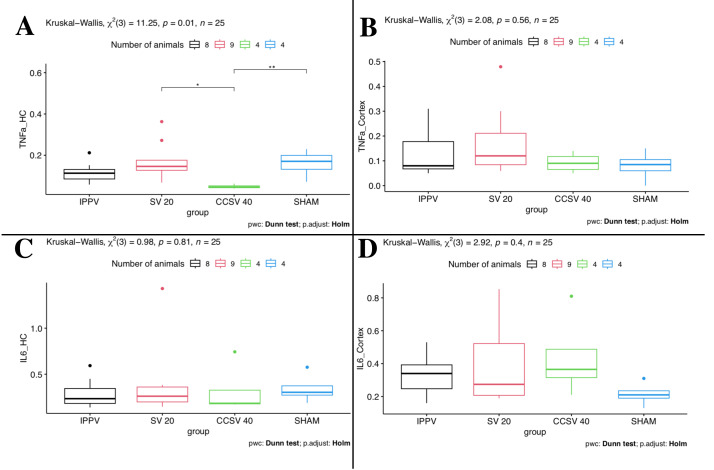
Hypoxia-induced neuroinflammation after cardiac arrest has been shown to be mitigated by different ventilation methods. In this prospective randomized animal trial, 35 landrace pigs were randomly divided into four groups: intermittent positive pressure ventilation (IPPV), synchronized ventilation 20 mbar (SV 20 mbar), chest compression synchronized ventilation 40 mbar (CCSV 40 mbar) and a control group (Sham). After inducing ventricular fibrillation, basic life support (BLS) and advanced life support (ALS) were performed, followed by post-resuscitation monitoring. After 6 hours, the animals were euthanized, and direct postmortem brain tissue samples were taken from the hippocampus (HC) and cortex (Cor) for molecular biological investigation of cytokine mRNA levels of Interleukin-6 (IL-6) and tumor necrosis factor alpha (TNFα). The data analysis showed that CCSV 40 mbar displayed low TNFα mRNA-levels, especially in the HC, while the highest TNFα mRNA-levels were detected in SV 20 mbar. The results indicate that chest compression synchronized ventilation may have a potential positive impact on the cytokine expression levels post-resuscitation. Further studies are needed to derive potential therapeutic algorithms from these findings.
Keywords: Chest-compressions; Interleukines; Neuroinflammation; Porcine; Resuscitation; Synchronized-ventilation.
©2023 Renz et al.
Conflict of interest statement
The synchronized ventilation devices were provided by Weinmann Medical unconditionally and for research purposes only. The authors declare there are no competing interests.
Figures
References
-
- Armstead WM, Hekierski H, Pastor P, Yarovoi S, Higazi AA, Cines DB. Release of IL-6 after stroke contributes to impaired cerebral autoregulation and hippocampal neuronal necrosis through NMDA receptor activation and upregulation of ET-1 and JNK. Translational Stroke Research. 2019;10(1):104–111. doi: 10.1007/s12975-018-0617-z. - DOI - PubMed
-
- Björklund E, Lindberg E, Rundgren M, Cronberg T, Friberg H, Englund E. Ischaemic brain damage after cardiac arrest and induced hypothermia–a systematic description of selective eosinophilic neuronal death. A neuropathologic study of 23 patients. Resuscitation. 2014;85(4):527–532. doi: 10.1016/j.resuscitation.2013.11.022. - DOI - PubMed
-
- Bro-Jeppesen JKJ, Wanscher M, Nielsen N, Friberg H, Bjerre M, Hassager C. Systemic inflammatory response and potential prognostic implications after out-of-hospital cardiac arrest: a substudy of the target temperature management trial. Critical Care Medicine. 2015;43(6):1223–1232. doi: 10.1097/CCM.0000000000000937. - DOI - PubMed
-
- Brower RG, Lanken PN, MacIntyre N, Matthay MA, Morris A, Ancukiewicz M, Schoenfeld D, Thompson BT. National Heart, Lung, and Blood Institute ARDS Clinical Trials Network Higher versus lower positive end-expiratory pressures in patients with the acute respiratory distress syndrome. The New England Journal of Medicine. 2004;351(4):327–336. doi: 10.1056/NEJMoa032193. - DOI - PubMed
-
- Brower RG, Matthay MA, Morris A, Schoenfeld D, Thompson BT, Wheeler A. Ventilation with lower tidal volumes as compared with traditional tidal volumes for acute lung injury and the acute respiratory distress syndrome. The New England Journal of Medicine. 2000;342(18):1301–1308. doi: 10.1056/NEJM200005043421801. - DOI - PubMed
Publication types
MeSH terms
Substances
LinkOut - more resources
Full Text Sources
Medical
Miscellaneous