. 2023 Oct;43(10):e230034.
doi: 10.1148/rg.230034.

Triple-Negative Breast Cancer: Histopathologic Features, Genomics, and Treatment

Affiliations

Triple-Negative Breast Cancer: Histopathologic Features, Genomics, and Treatment

Beatriz E Adrada et al. Radiographics. 2023 Oct.

Abstract

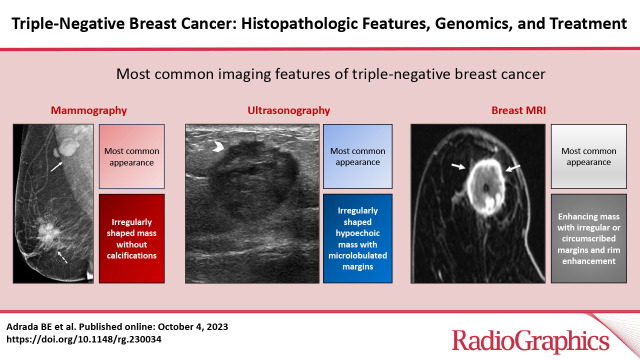
Triple-negative breast cancer (TNBC) is a heterogeneous and aggressive group of tumors that are defined by the absence of estrogen and progesterone receptors and lack of ERBB2 (formerly HER2 or HER2/neu) overexpression. TNBC accounts for 8%-13% of breast cancers. In addition, it accounts for a higher proportion of breast cancers in younger women compared with those in older women, and it disproportionately affects non-Hispanic Black women. TNBC has high metastatic potential, and the risk of recurrence is highest during the 5 years after it is diagnosed. TNBC exhibits benign morphologic imaging features more frequently than do other breast cancer subtypes. Mammography can be suboptimal for early detection of TNBC owing to factors that include the fast growth of this cancer, increased mammographic density in young women, and lack of the typical features of malignancy at imaging. US is superior to mammography for TNBC detection, but benign-appearing features can lead to misdiagnosis. Breast MRI is the most sensitive modality for TNBC detection. Most cases of TNBC are treated with neoadjuvant chemotherapy, followed by surgery and radiation. MRI is the modality of choice for evaluating the response to neoadjuvant chemotherapy. Survival rates for individuals with TNBC are lower than those for persons with hormone receptor-positive and human epidermal growth factor receptor 2-positive cancers. The 5-year survival rates for patients with localized, regional, and distant disease at diagnosis are 91.3%, 65.8%, and 12.0%, respectively. The early success of immunotherapy has raised hope regarding the development of personalized strategies to treat TNBC. Imaging and tumor biomarkers are likely to play a crucial role in the prediction of TNBC treatment response and TNBC patient survival in the future. ©RSNA, 2023 Quiz questions for this article are available in the supplemental material.


Conflict of interest statement

Disclosures of conflicts of interest.—: T.W.M. Consulting fees from Hologic, Siemens Healthineers, and Merit Medical. All other authors, the editor, and the reviewers have disclosed no relevant relationships.

Figures

None
Graphical abstract
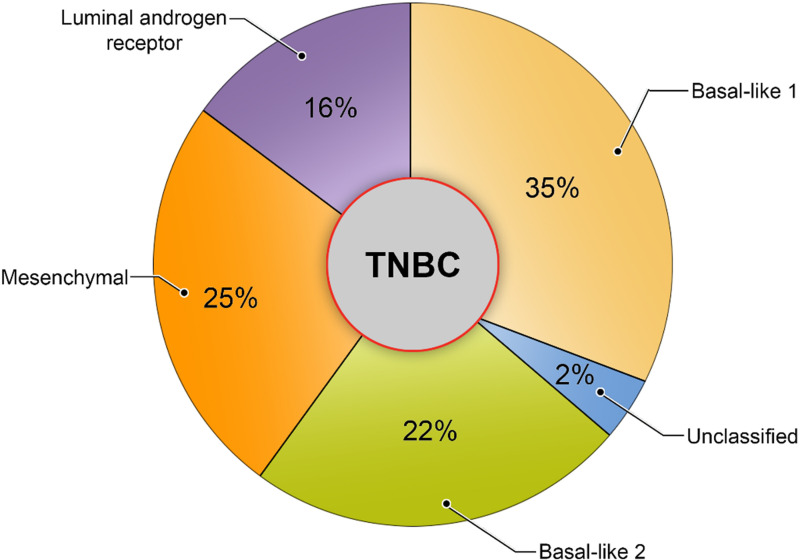
Lehmann subtype classification of TNBC (2016 version), with the
proportions of TNBC tumors in each of the four subgroups cited (22).
Figure 1.
Lehmann subtype classification of TNBC (2016 version), with the proportions of TNBC tumors in each of the four subgroups cited (22).
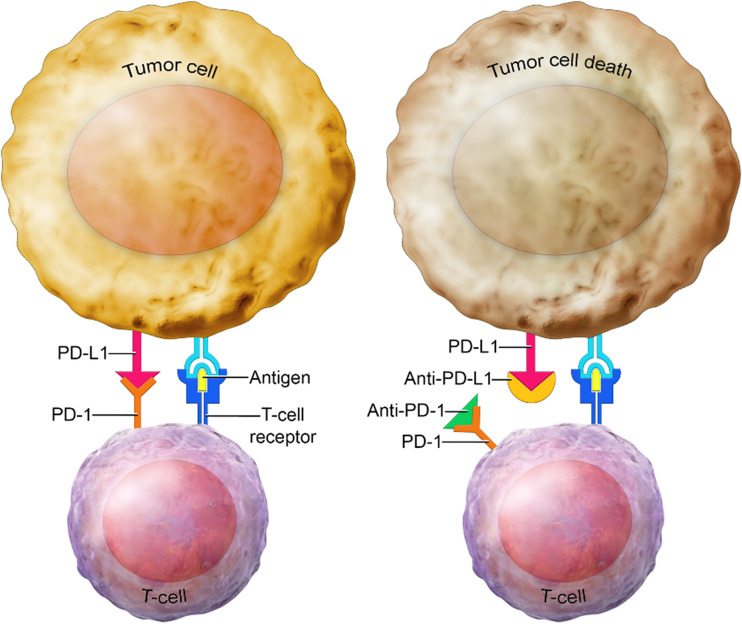
Immune checkpoint inhibitors in TNBC. T cells normally attack the
tumor, but the presence of PD-L1 proteins on tumor cells prevents T cells
from causing death to tumor cells. PD-1 is a checkpoint protein on T cells
that can bind to PD-L1, a protein on some cancer cells. When PD-1 (on the
immune cell) binds to PD-L1 (on the tumor cell), the T cell does not attack
the tumor. This is the basis of immunotherapy, whereby monoclonal antibodies
block PD-1 or PD-L1 proteins. Pembrolizumab is a PD-1–targeted
antibody, and combined with chemotherapy, it has been approved as the
standard of care for patients with TNBC.
Figure 2.
Immune checkpoint inhibitors in TNBC. T cells normally attack the tumor, but the presence of PD-L1 proteins on tumor cells prevents T cells from causing death to tumor cells. PD-1 is a checkpoint protein on T cells that can bind to PD-L1, a protein on some cancer cells. When PD-1 (on the immune cell) binds to PD-L1 (on the tumor cell), the T cell does not attack the tumor. This is the basis of immunotherapy, whereby monoclonal antibodies block PD-1 or PD-L1 proteins. Pembrolizumab is a PD-1–targeted antibody, and combined with chemotherapy, it has been approved as the standard of care for patients with TNBC.
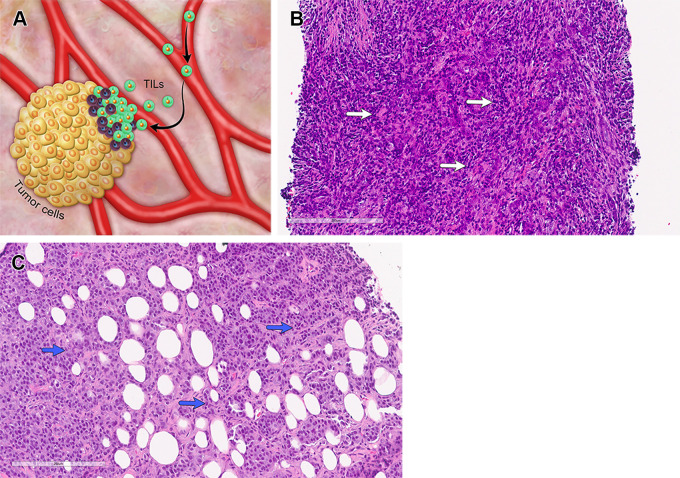
TILs in TNBC. Normal breast tissue does not contain large aggregates
of immune cells. (A) As cancer grows, lymphocytes recognize the cancer cells
as abnormal and infiltrate the tumor. TILs are mononucleated lymphoid cells
that infiltrate the tumor and its stroma and reflect the host immune
response against the tumor cells. Quantification of TILs is performed on
hematoxylin-eosin (H-E)–stained tissue sections from biopsy specimens
obtained at the time of diagnosis and in the residual disease after NAC.
Only those TILs located in the stromal portions between cancer cells are
considered when counting. (B, C) Photomicrographs show two cases of TNBC,
one with high (B) and one with low (C) levels of TILs. Arrows point to
lymphocytes in the stroma associated with the invasive carcinoma. (H-E
stain; original magnification, ×400.)
Figure 3.
TILs in TNBC. Normal breast tissue does not contain large aggregates of immune cells. (A) As cancer grows, lymphocytes recognize the cancer cells as abnormal and infiltrate the tumor. TILs are mononucleated lymphoid cells that infiltrate the tumor and its stroma and reflect the host immune response against the tumor cells. Quantification of TILs is performed on hematoxylin-eosin (H-E)–stained tissue sections from biopsy specimens obtained at the time of diagnosis and in the residual disease after NAC. Only those TILs located in the stromal portions between cancer cells are considered when counting. (B, C) Photomicrographs show two cases of TNBC, one with high (B) and one with low (C) levels of TILs. Arrows point to lymphocytes in the stroma associated with the invasive carcinoma. (H-E stain; original magnification, ×400.)
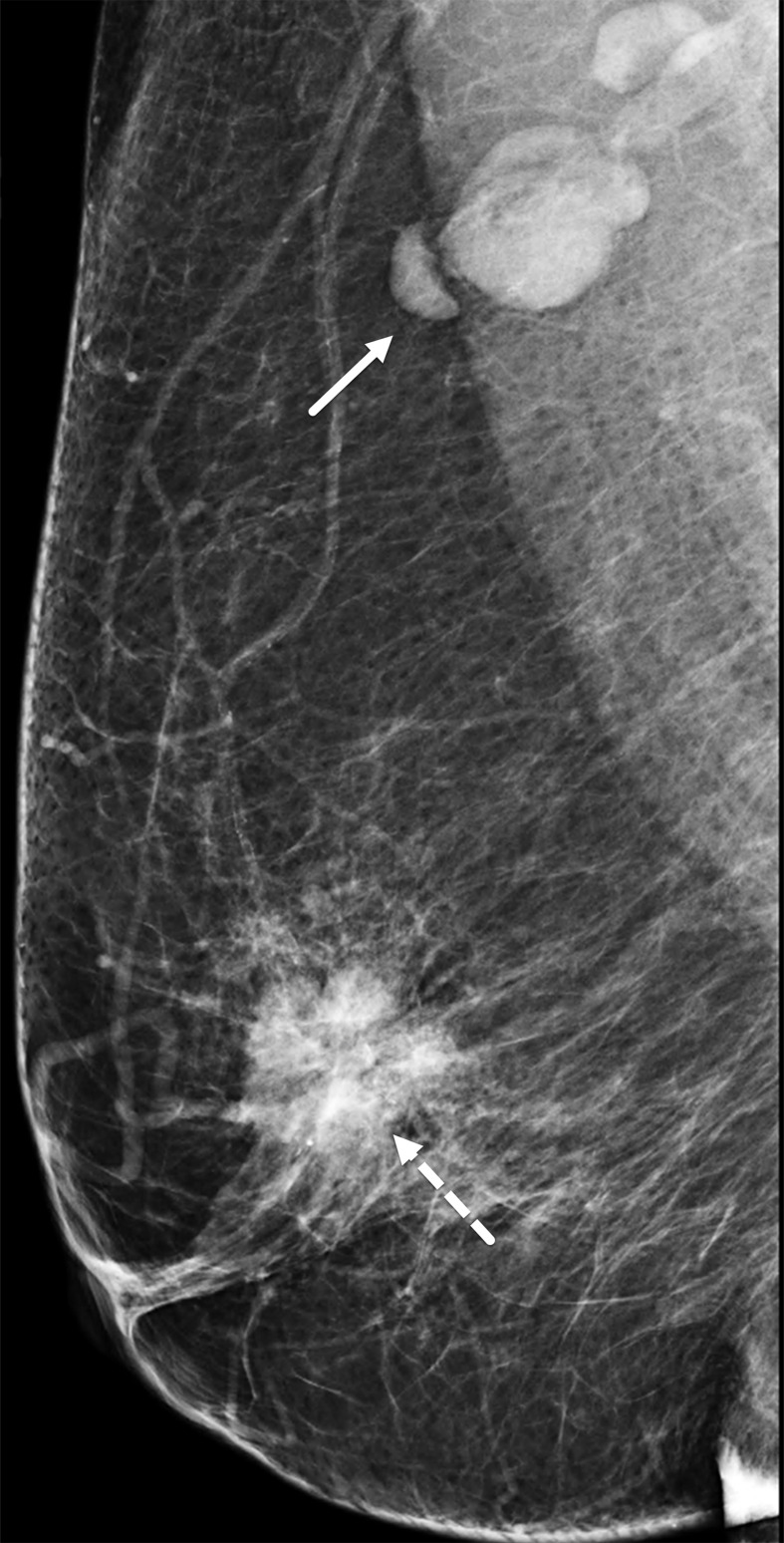
TNBC of the right breast in a 74-year-old woman. Right mediolateral
oblique mammogram shows a 3-cm irregular noncalcified mass (dashed arrow)
with spiculated margins and a 2.5-cm enlarged axillary lymph node (solid
arrow).
Figure 4.
TNBC of the right breast in a 74-year-old woman. Right mediolateral oblique mammogram shows a 3-cm irregular noncalcified mass (dashed arrow) with spiculated margins and a 2.5-cm enlarged axillary lymph node (solid arrow).
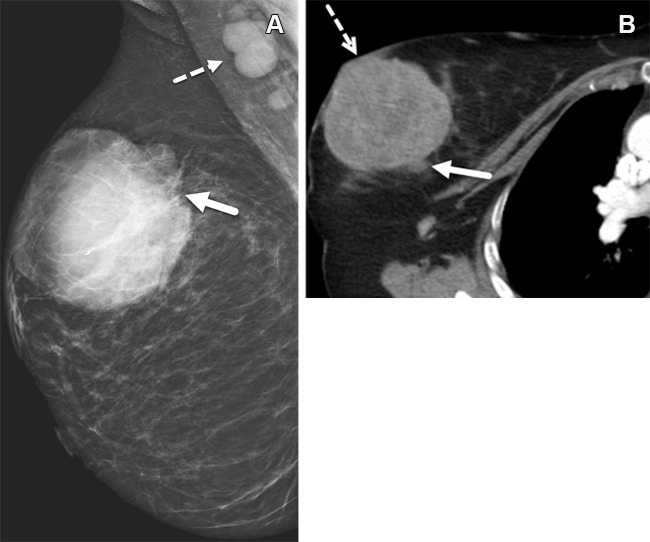
Right breast TNBC in a 44-year-old woman who is a BRCA1 mutation
carrier and has a Ki-67 index (proportion of Ki-67-expressing cells divided
by the proportion of tumor cells) of 91%. (A) Right mediolateral oblique
mammogram shows an 8-cm, high-density, noncalcified round mass (solid arrow)
in the upper outer quadrant and associated axillary adenopathy (dashed
arrow). (B) Axial chest CT image shows the mass (solid arrow) with
microlobulated and indistinct margins invading the overlying skin (dashed
arrow).
Figure 5.
Right breast TNBC in a 44-year-old woman who is a BRCA1 mutation carrier and has a Ki-67 index (proportion of Ki-67-expressing cells divided by the proportion of tumor cells) of 91%. (A) Right mediolateral oblique mammogram shows an 8-cm, high-density, noncalcified round mass (solid arrow) in the upper outer quadrant and associated axillary adenopathy (dashed arrow). (B) Axial chest CT image shows the mass (solid arrow) with microlobulated and indistinct margins invading the overlying skin (dashed arrow).
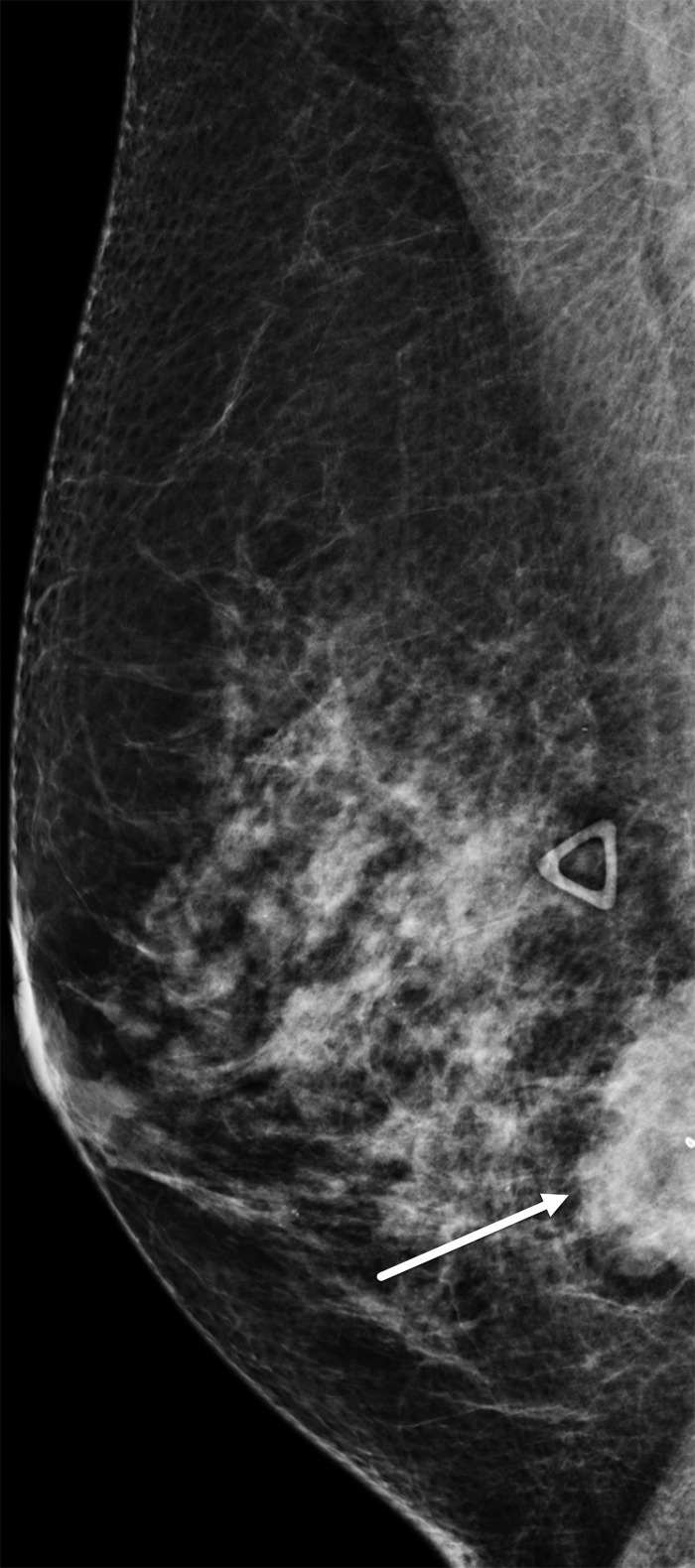
Right breast TNBC in a 54-year-old woman. Right breast mediolateral
oblique mammogram shows a 3.5-cm, high-density, irregularly shaped mass
(arrow) in the lower inner breast, correlating with the palpable abnormality
(triangular marker). Note the posterior location of the tumor.
Figure 6.
Right breast TNBC in a 54-year-old woman. Right breast mediolateral oblique mammogram shows a 3.5-cm, high-density, irregularly shaped mass (arrow) in the lower inner breast, correlating with the palpable abnormality (triangular marker). Note the posterior location of the tumor.
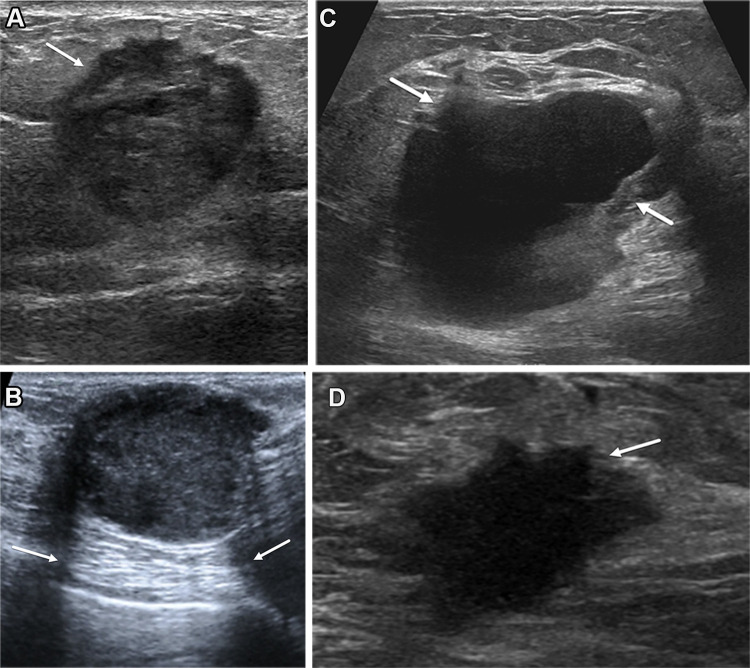
US features of TNBC in four patients. (A) Longitudinal image in a
50-year-old woman shows TNBC as a 3-cm round mass with microlobulated and
angular margins (arrow). (B) Longitudinal image in a 40-year-old woman shows
TNBC as a 3-cm oval mass that is parallel in orientation with posterior
acoustic enhancement (arrows). Note that this mass has a microlobulated
superficial margin. (C) Transverse image in a 30-year-old woman shows TNBC
as a 5-cm oval complex cystic and solid mass (arrows). (D) Transverse image
in a 64-year-old woman shows TNBC as a 2-cm irregularly shaped mass with
angular margins (arrow).
Figure 7.
US features of TNBC in four patients. (A) Longitudinal image in a 50-year-old woman shows TNBC as a 3-cm round mass with microlobulated and angular margins (arrow). (B) Longitudinal image in a 40-year-old woman shows TNBC as a 3-cm oval mass that is parallel in orientation with posterior acoustic enhancement (arrows). Note that this mass has a microlobulated superficial margin. (C) Transverse image in a 30-year-old woman shows TNBC as a 5-cm oval complex cystic and solid mass (arrows). (D) Transverse image in a 64-year-old woman shows TNBC as a 2-cm irregularly shaped mass with angular margins (arrow).
Left breast palpable abnormality in a 39-year-old woman. (A) Left
craniocaudal mammogram shows a 0.9-cm oval mass (dashed arrow) in the upper
outer breast correlating with the palpable area of concern (triangular
marker [*] ). This lesion was shown to represent an intramammary
lymph node at subsequent US. A 1-cm oval mass (solid arrow) at the posterior
depth was incidentally noted. (B) On a transverse US image, the 1-cm mass
appears to have an oval shape and circumscribed margins (arrow). (C)
Six-month follow-up US image shows a 1.4-cm irregularly shaped mass with
microlobulated margins (arrow). US-guided biopsy revealed TNBC.
Figure 8.
Left breast palpable abnormality in a 39-year-old woman. (A) Left craniocaudal mammogram shows a 0.9-cm oval mass (dashed arrow) in the upper outer breast correlating with the palpable area of concern (triangular marker [*] ). This lesion was shown to represent an intramammary lymph node at subsequent US. A 1-cm oval mass (solid arrow) at the posterior depth was incidentally noted. (B) On a transverse US image, the 1-cm mass appears to have an oval shape and circumscribed margins (arrow). (C) Six-month follow-up US image shows a 1.4-cm irregularly shaped mass with microlobulated margins (arrow). US-guided biopsy revealed TNBC.
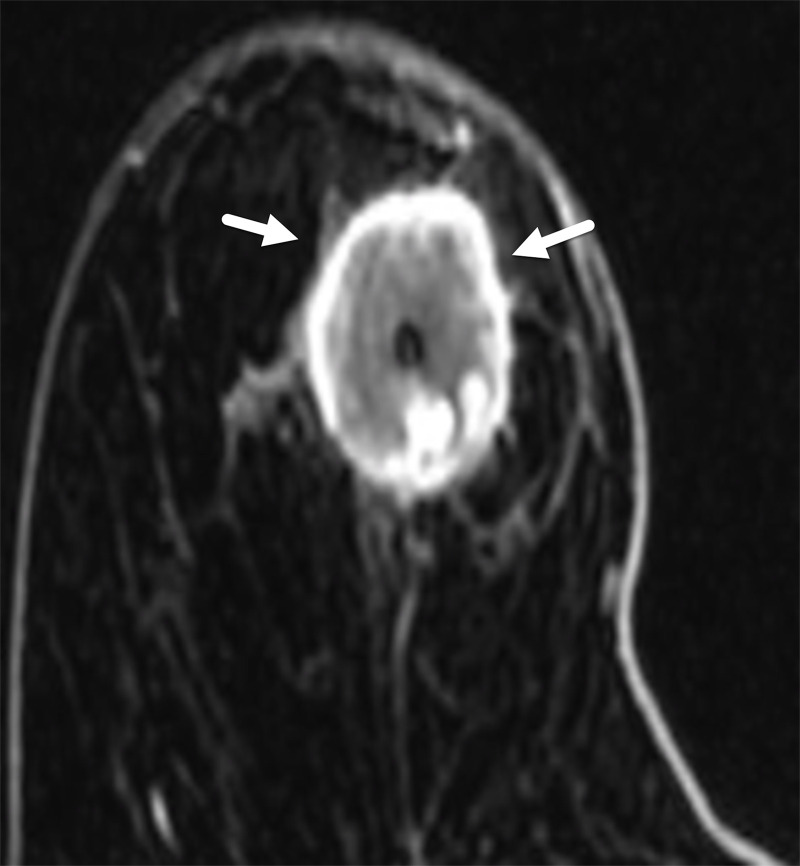
MRI features of TNBC in a 66-year-old woman. Axial postcontrast
T1-weighted subtraction MR image shows TNBC as a 3-cm round mass with thick
and irregular rim enhancement (arrows).
Figure 9.
MRI features of TNBC in a 66-year-old woman. Axial postcontrast T1-weighted subtraction MR image shows TNBC as a 3-cm round mass with thick and irregular rim enhancement (arrows).
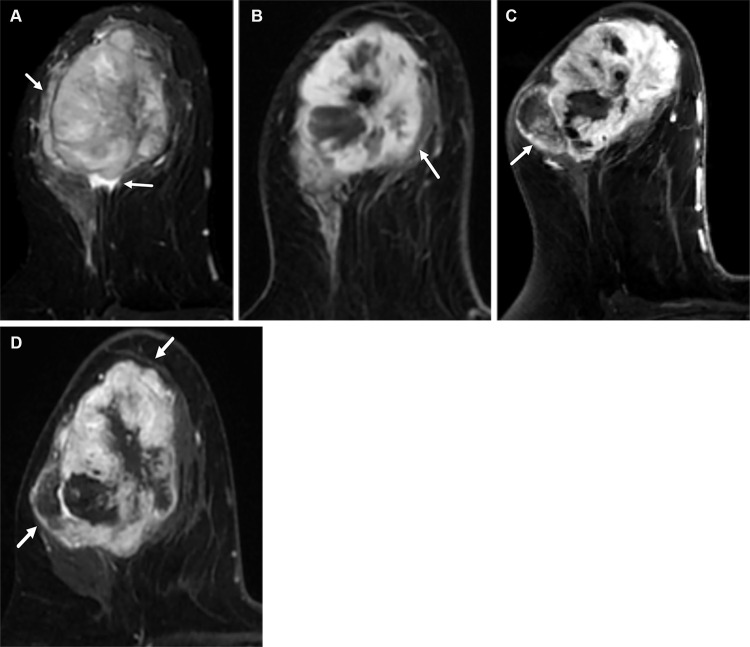
Metaplastic (spindle cell) TNBC of the right breast in a 57-year-old
woman. (A) Axial T2-weighted MR image shows a 6-cm round mass with areas of
very high T2 signal intensity (arrows) consistent with areas of intratumoral
necrosis and surrounding peritumoral edema. The patient was started on NAC.
(B–D) Serial postcontrast MR images show increased tumor size,
indicating progression of disease and resistance to chemotherapy. Axial
postcontrast T1-weighted pretreatment MR image (B) shows a 6-cm
heterogeneously enhancing mass (arrow in B). Axial postcontrast T1-weighted
midtreatment MR image (C) shows that the mass (arrow in C) has increased in
size and now measures 7 cm. Axial postcontrast T1-weighted posttreatment MR
image (D) shows that the mass (arrows in D) is continuously growing and now
measures 8 cm. The surgical-pathologic specimen (not shown) revealed a
residual mass measuring 8 cm in largest diameter.
Figure 10.
Metaplastic (spindle cell) TNBC of the right breast in a 57-year-old woman. (A) Axial T2-weighted MR image shows a 6-cm round mass with areas of very high T2 signal intensity (arrows) consistent with areas of intratumoral necrosis and surrounding peritumoral edema. The patient was started on NAC. (B–D) Serial postcontrast MR images show increased tumor size, indicating progression of disease and resistance to chemotherapy. Axial postcontrast T1-weighted pretreatment MR image (B) shows a 6-cm heterogeneously enhancing mass (arrow in B). Axial postcontrast T1-weighted midtreatment MR image (C) shows that the mass (arrow in C) has increased in size and now measures 7 cm. Axial postcontrast T1-weighted posttreatment MR image (D) shows that the mass (arrows in D) is continuously growing and now measures 8 cm. The surgical-pathologic specimen (not shown) revealed a residual mass measuring 8 cm in largest diameter.
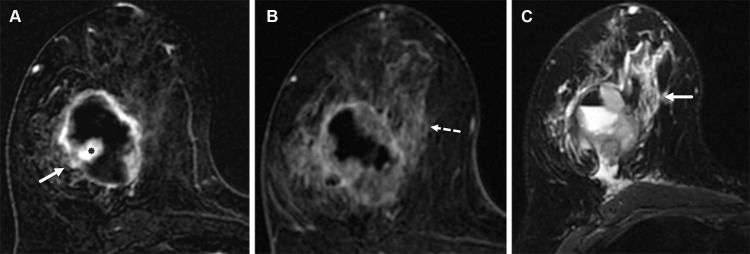
TNBC of the right breast in a 63-year-old woman. (A) Axial
postcontrast T1-weighted subtraction MR image shows a 5-cm complex cystic
and solid enhancing mass (*) with thick irregular rim enhancement
(arrow). (B) Axial late phase postcontrast T1-weighted subtraction MR image
shows associated nonmass enhancement (arrow). (C) Axial T2-weighted MR image
shows peritumoral edema (arrow). MRI-guided biopsy of the area of nonmass
enhancement (not shown) showed reactive changes and lymphocytic
perilobulitis, indicating that the nonmass enhancement represented
peritumoral edema.
Figure 11.
TNBC of the right breast in a 63-year-old woman. (A) Axial postcontrast T1-weighted subtraction MR image shows a 5-cm complex cystic and solid enhancing mass (*) with thick irregular rim enhancement (arrow). (B) Axial late phase postcontrast T1-weighted subtraction MR image shows associated nonmass enhancement (arrow). (C) Axial T2-weighted MR image shows peritumoral edema (arrow). MRI-guided biopsy of the area of nonmass enhancement (not shown) showed reactive changes and lymphocytic perilobulitis, indicating that the nonmass enhancement represented peritumoral edema.
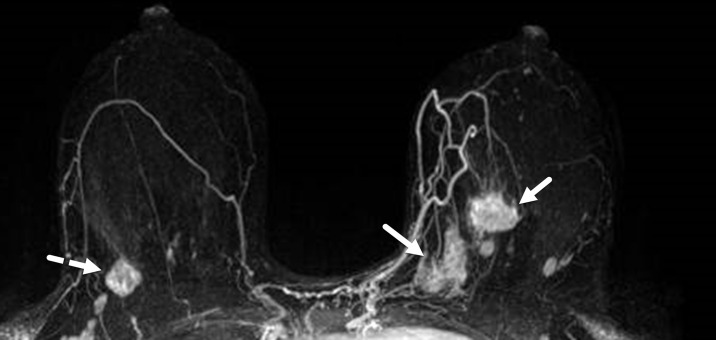
TNBC in both breasts in a 32-year-old woman. Maximum intensity
projection breast MR image shows a unifocal 2-cm mass (dashed arrow) in the
right breast upper outer quadrant. Also demonstrated are multiple masses
(solid arrows) of varying sizes in the left breast, consistent with
multicentric disease.
Figure 12.
TNBC in both breasts in a 32-year-old woman. Maximum intensity projection breast MR image shows a unifocal 2-cm mass (dashed arrow) in the right breast upper outer quadrant. Also demonstrated are multiple masses (solid arrows) of varying sizes in the left breast, consistent with multicentric disease.
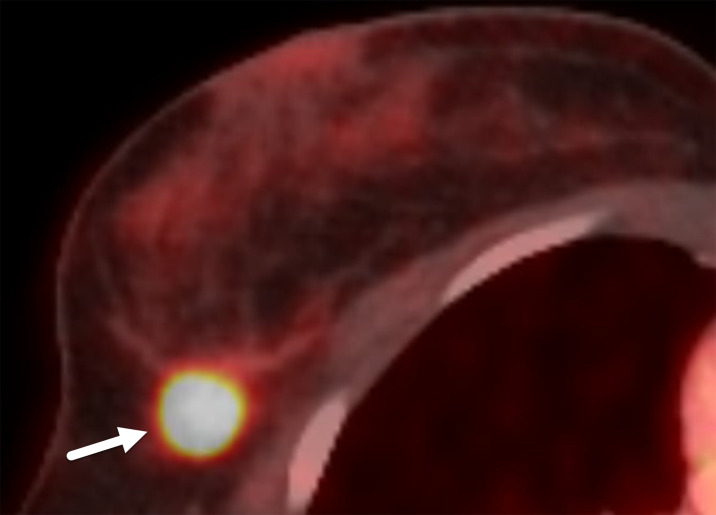
Triple-negative invasive ductal carcinoma in a 33-year-old woman.
Axial PET/CT image shows focal FDG uptake in the mass (arrow). PET/CT has
high sensitivity for TNBC. Higher FDG uptake is related to enhanced
glycolysis and a higher proliferation rate, which are characteristic of
TNBC.
Figure 13.
Triple-negative invasive ductal carcinoma in a 33-year-old woman. Axial PET/CT image shows focal FDG uptake in the mass (arrow). PET/CT has high sensitivity for TNBC. Higher FDG uptake is related to enhanced glycolysis and a higher proliferation rate, which are characteristic of TNBC.
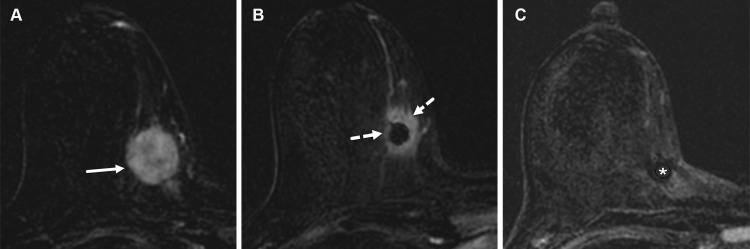
Triple-negative invasive ductal carcinoma of the right breast in a
40-year-old woman. (A) Axial postcontrast T1-weighted subtraction
pretreatment MR image shows a 3-cm round mass (arrow) with homogeneous
enhancement in the upper inner quadrant. (B) Axial postcontrast T1-weighted
subtraction midtreatment MR image shows a 1-cm mass (arrows) with a pattern
of concentric shrinkage. The central area with a signal void is related to
susceptibility artifact from a biopsy clip. (C) Axial postcontrast
T1-weighted subtraction posttreatment MR image shows a biopsy clip
susceptibility artifact (*) but no evidence of enhancement,
indicating complete resolution of the mass. The imaging findings are
consistent with a complete imaging response. Final pathologic analysis
revealed no residual carcinoma in the breast.
Figure 14.
Triple-negative invasive ductal carcinoma of the right breast in a 40-year-old woman. (A) Axial postcontrast T1-weighted subtraction pretreatment MR image shows a 3-cm round mass (arrow) with homogeneous enhancement in the upper inner quadrant. (B) Axial postcontrast T1-weighted subtraction midtreatment MR image shows a 1-cm mass (arrows) with a pattern of concentric shrinkage. The central area with a signal void is related to susceptibility artifact from a biopsy clip. (C) Axial postcontrast T1-weighted subtraction posttreatment MR image shows a biopsy clip susceptibility artifact (*) but no evidence of enhancement, indicating complete resolution of the mass. The imaging findings are consistent with a complete imaging response. Final pathologic analysis revealed no residual carcinoma in the breast.
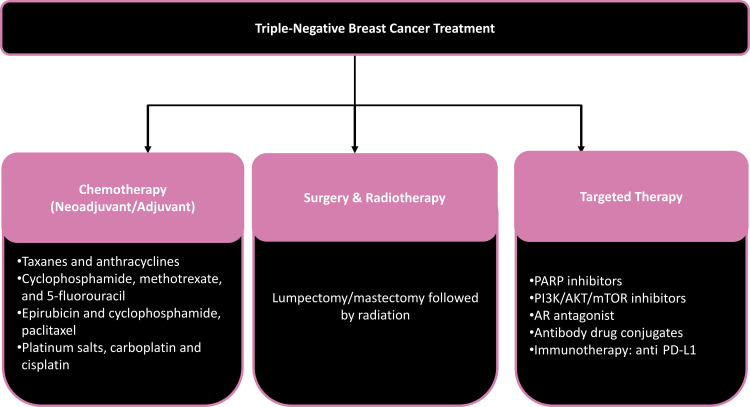
Options for treatment of TNBCs. AR = androgen receptor, PARP = poly
(ADP-ribose), PI3K/AKT/mTOR = phosphoinositide 3–kinase/protein
kinase B/mammalian target of rapamycin.
Figure 15.
Options for treatment of TNBCs. AR = androgen receptor, PARP = poly (ADP-ribose), PI3K/AKT/mTOR = phosphoinositide 3–kinase/protein kinase B/mammalian target of rapamycin.
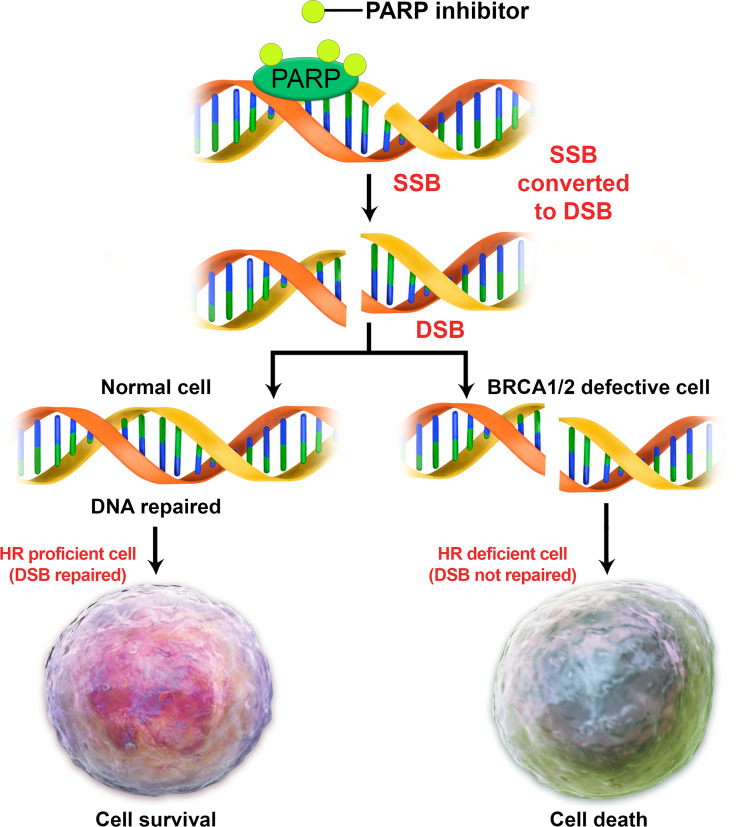
Diagram illustrates how normal cells use several mechanisms to repair
DNA. One of these mechanisms involves the use of BRCA1 and BRCA2 proteins to
help repair DNA double-strand breaks (DSBs) by means of homologous
recombination (HR). Another mechanism used to repair DNA is the poly
(adenosine diphosphate–ribose) polymerase (PARP) system, which helps
to repair DNA single-strand breaks (SSBs). Efficient SSB repair is essential
for cell survival. Unrepaired SSBs can be converted to DSBs, which are toxic
to cells. HR is the major pathway to repairing such DSBs during cell
replication. HR-proficient cells can repair DSBs to ensure genome stability
and cell survival, while HR-deficient cells (in BRCA mutation carriers)
cannot repair DSBs and undergo apoptosis and eventually cell
death.
Figure 16.
Diagram illustrates how normal cells use several mechanisms to repair DNA. One of these mechanisms involves the use of BRCA1 and BRCA2 proteins to help repair DNA double-strand breaks (DSBs) by means of homologous recombination (HR). Another mechanism used to repair DNA is the poly (adenosine diphosphate–ribose) polymerase (PARP) system, which helps to repair DNA single-strand breaks (SSBs). Efficient SSB repair is essential for cell survival. Unrepaired SSBs can be converted to DSBs, which are toxic to cells. HR is the major pathway to repairing such DSBs during cell replication. HR-proficient cells can repair DSBs to ensure genome stability and cell survival, while HR-deficient cells (in BRCA mutation carriers) cannot repair DSBs and undergo apoptosis and eventually cell death.
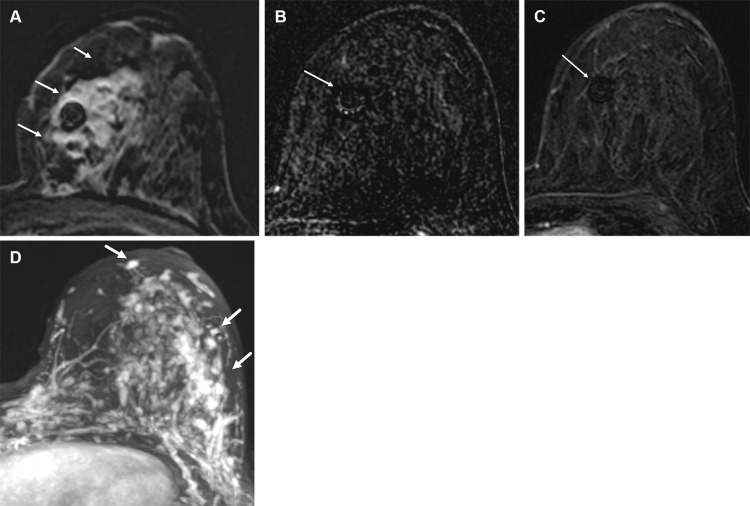
Triple-negative metaplastic carcinoma of the left breast in a
38-year-old woman. (A) Axial postcontrast T1-weighted MR image shows the
malignancy as an 8-cm area of nonmass enhancement with regional distribution
(arrows). (B) Axial postcontrast T1-weighted subtraction MR image in the
early phase after NAC shows no residual enhancement. A biopsy
clip–related susceptibility artifact (arrow) is noted. (C) Axial
postcontrast T1-weighted subtraction MR image in the late phase after NAC
shows no residual enhancement, with the biopsy clip–related
susceptibility artifact (arrow) still seen. The patient underwent surgery,
which revealed a 1-mm focus of residual carcinoma. (D) Maximum intensity
projection breast MR image 1 year after the completion of segmental
mastectomy and radiation therapy shows numerous areas of nonmass enhancement
and multiple foci suggestive of recurrence involving four quadrants
(arrows). US-guided biopsy confirmed the recurrence.
Figure 17.
Triple-negative metaplastic carcinoma of the left breast in a 38-year-old woman. (A) Axial postcontrast T1-weighted MR image shows the malignancy as an 8-cm area of nonmass enhancement with regional distribution (arrows). (B) Axial postcontrast T1-weighted subtraction MR image in the early phase after NAC shows no residual enhancement. A biopsy clip–related susceptibility artifact (arrow) is noted. (C) Axial postcontrast T1-weighted subtraction MR image in the late phase after NAC shows no residual enhancement, with the biopsy clip–related susceptibility artifact (arrow) still seen. The patient underwent surgery, which revealed a 1-mm focus of residual carcinoma. (D) Maximum intensity projection breast MR image 1 year after the completion of segmental mastectomy and radiation therapy shows numerous areas of nonmass enhancement and multiple foci suggestive of recurrence involving four quadrants (arrows). US-guided biopsy confirmed the recurrence.

References

    1. Centers for Disease Control and Prevention . Breast Cancer Statistics . Centers for Disease Control and Prevention website https://www.cdc.gov/cancer/breast/statistics/index.htm. Updated June 6, 2022. Accessed February 1, 2023 .
    1. Trop I , LeBlanc SM , David J , et al. . Molecular classification of infiltrating breast cancer: toward personalized therapy . RadioGraphics 2014. ; 34 ( 5 ): 1178 – 1195 . - PubMed
    1. National Cancer Institute . Cancer Stat Facts: Female Breast Cancer Subtypes . National Institutes of Health, National Cancer Institute website https://seer.cancer.gov/statfacts/html/breast-subtypes.html. Accessed March 28, 2023 .
    1. Howard FM , Olopade OI . Epidemiology of triple-negative breast cancer: a review . Cancer J 2021. ; 27 ( 1 ): 8 – 16 . - PubMed
    1. Liedtke C , Mazouni C , Hess KR , et al. . Response to neoadjuvant therapy and long-term survival in patients with triple-negative breast cancer . J Clin Oncol 2008. ; 26 ( 8 ): 1275 – 1281 . [Published correction appears in J Clin Oncol 2023;41(10):1809-1815.] - PubMed

Substances