


Long-term responses of Icelandic Arctic foxes to changes in marine and terrestrial ecosystems
- PMID: 37792685
- PMCID: PMC10550166
- DOI: 10.1371/journal.pone.0282128
Long-term responses of Icelandic Arctic foxes to changes in marine and terrestrial ecosystems
Abstract
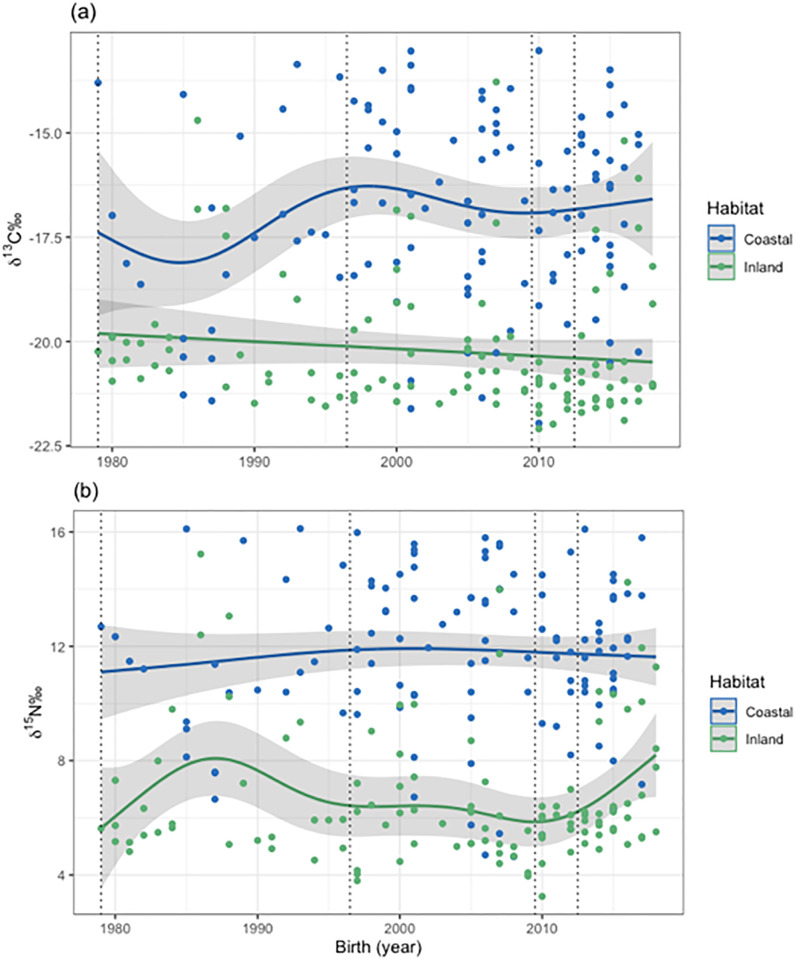
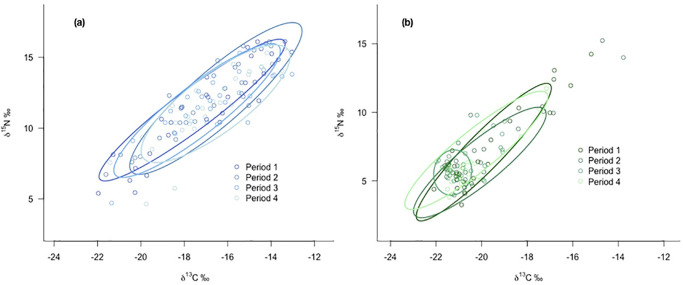
The long-term dynamics of predator populations may be driven by fluctuations in resource availability and reflect ecosystem changes such as those induced by climate change. The Icelandic Arctic fox (Vulpes lagopus) population has known major fluctuations in size since the 1950s. Using stable isotopes analysis of bone collagen over a long-time series (1979-2018), we aimed at identifying the main resources used by Icelandic Arctic foxes during periods of growth and decline to assess if the variations in their population size are linked to fluctuations in the availability of resources. We hypothesized that (1) the decline in Seabird abundance was responsible for the decrease in the fox population; and (2) that the growth in the fox population combined to fluctuations in main resources would lead to an increase in intra-specific competition, ultimately leading to variations in their isotopic niches at the population scale. The isotopic composition of Arctic fox bones differed clearly between inland and coast. Stable isotopes mixing models suggested that marine resources and rock ptarmigans were the most important food source and highlighted a rather stable diet in coastal habitats compared to inland habitats where more fluctuations in dietary composition were observed. Coastal foxes had a broader niche than inland foxes, and there was more variation in niche size in the inland habitat. Our results tend to confirm that a general decline in seabird populations drove the decline in Arctic foxes, especially in coastal habitats. For the inland foxes, our results suggest that the lack of marine resources might have led to an increased use of ptarmigans especially during the most recent period.
Copyright: © 2023 Berthelot et al. This is an open access article distributed under the terms of the Creative Commons Attribution License, which permits unrestricted use, distribution, and reproduction in any medium, provided the original author and source are credited.
Conflict of interest statement
The authors have declared that no competing interests exist.
Figures



References
-
- Ims RA & Ehrich D. Terrestrial ecosystems. In Meltofte H. (Ed.), Arctic biodiversity assessment: Status and trends in Arctic biodiversity. 2013. pp. 384–440). Akureyri: CAFF.
-
- Gauthier G, Berteaux D, Bety J, Tarroux A, Therrien JF, Mc- Kinnon L, et al. The tundra food web of Bylot Island in a changing climate and the role of exchanges between ecosystems. Ecoscience. 2011. 18:223–35.
-
- Chylek P, Folland C, Klett JD, Wang M, Hengartner N, Lesins G, et al. Annual mean Arctic Amplification 1970–2020: Observed and simulated by CMIP6 climate models. Geophysical Research Letters. 2022. 49.
-
- Constable AJ, Harper S, Dawson J, Holsman K, Mustonen T, Piepenburg D, et al. Cross-Chapter Paper 6: Polar Regions. In: Climate Change 2022: Impacts, Adaptation and Vulnerability. Contribution of Working Group II to the Sixth Assessment Report of the Intergovernmental Panel on Climate Change [Pörtner HO, Roberts DC, Tignor M, Poloczanska ES, Mintenbeck K, Alegría A, Craig M, Langsdorf S, Löschke S, Möller V, Okem A, Rama B (eds.)]. Cambridge University Press, Cambridge, UK and New York, NY, USA. 2022. pp. 2319–2368
Publication types
MeSH terms
Substances
LinkOut - more resources
Full Text Sources
