


Posttransplantation late complications increase over time for patients with SCID: A Primary Immune Deficiency Treatment Consortium (PIDTC) landmark study
- PMID: 37793572
- PMCID: PMC11294800
- DOI: 10.1016/j.jaci.2023.09.027
Posttransplantation late complications increase over time for patients with SCID: A Primary Immune Deficiency Treatment Consortium (PIDTC) landmark study
Abstract
Background: The Primary Immune Deficiency Treatment Consortium (PIDTC) enrolled children in the United States and Canada onto a retrospective multicenter natural history study of hematopoietic cell transplantation (HCT).
Objective: We investigated outcomes of HCT for severe combined immunodeficiency (SCID).
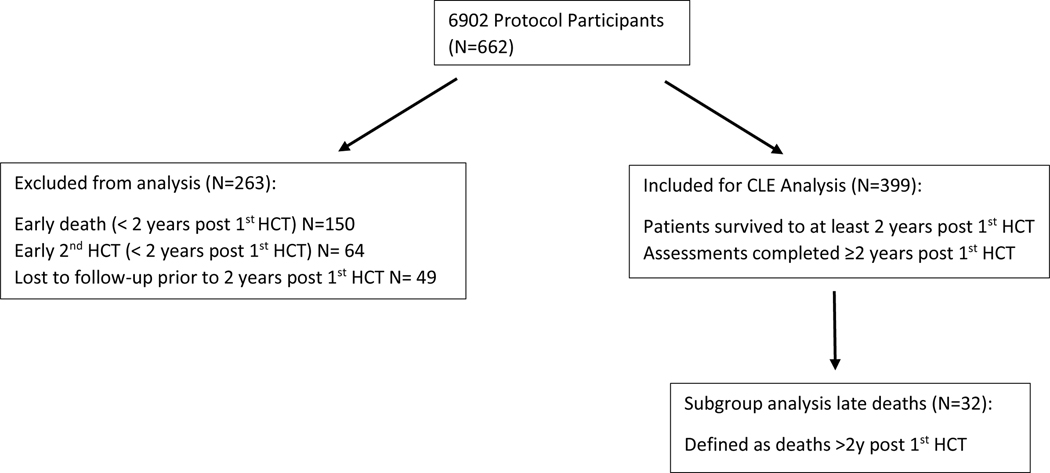
Methods: We evaluated the chronic and late effects (CLE) after HCT for SCID in 399 patients transplanted from 1982 to 2012 at 32 PIDTC centers. Eligibility criteria included survival to at least 2 years after HCT without need for subsequent cellular therapy. CLE were defined as either conditions present at any time before 2 years from HCT that remained unresolved (chronic), or new conditions that developed beyond 2 years after HCT (late).
Results: The cumulative incidence of CLE was 25% in those alive at 2 years, increasing to 41% at 15 years after HCT. CLE were most prevalent in the neurologic (9%), neurodevelopmental (8%), and dental (8%) categories. Chemotherapy-based conditioning was associated with decreased-height z score at 2 to 5 years after HCT (P < .001), and with endocrine (P < .001) and dental (P = .05) CLE. CD4 count of ≤500 cells/μL and/or continued need for immunoglobulin replacement therapy >2 years after transplantation were associated with lower-height z scores. Continued survival from 2 to 15 years after HCT was 90%. The presence of any CLE was associated with increased risk of late death (hazard ratio, 7.21; 95% confidence interval, 2.71-19.18; P < .001).
Conclusion: Late morbidity after HCT for SCID was substantial, with an adverse impact on overall survival. This study provides evidence for development of survivorship guidelines based on disease characteristics and treatment exposure for patients after HCT for SCID.
Keywords: HCT; SCID; bone marrow transplantation; late effects; survivorship.
Copyright © 2023. Published by Elsevier Inc.
Conflict of interest statement
JJB - Advisory Board for Sobi; Advisory Board for Prime Medicine; Advisory Board for Horizon Therapeutics. BJDS - Consultancy for Sobi. JRH - Author Royalties from UpToDate; Grant/Research Support from CSL Behring, Regeneron, Enzyvant, ADMA; DSMB Jasper Therapeutics. JMP – Royalties from UpToDate. MT- Advisory Board for Proteios Technology, Inc; Advisory Board for ImmunoVec, Inc. MJC – Royalties from UpToDate; DSMB for bluebird bio, Rocket Pharma, and Chiesi, Inc; SAB for Homology Medicines, Inc.
Figures


References
-
- Thakar M, Logan BR, Puck JM, Dunn EA, Buckley RH Cowan MJ et al. Measuring the impact of newborn screening on survival after hematopoietic cell transplantation for severe combined immunodeficiency: a 36-year longitudinal study from the Primary Immune Deficiency Treatment Consortium. Lancet 2023, In Press. - PMC - PubMed
-
- Hardin O, Lokhnygina Y, Buckley RH. Long-Term Clinical Outcomes of Severe Combined Immunodeficiency Patients Given Nonablative Marrow Transplants. J Allergy Clin Immunol Pract. 2022;10(4):1077–83. - PubMed
Publication types
MeSH terms
Grants and funding
LinkOut - more resources
Full Text Sources
Research Materials
