. 2023 Oct 4;13(1):16704.
doi: 10.1038/s41598-023-43621-w.

Superconductivity in a breathing kagome metals ROs2 (R = Sc, Y, Lu)

Affiliations

Superconductivity in a breathing kagome metals ROs2 (R = Sc, Y, Lu)

Karolina Górnicka et al. Sci Rep. .

Abstract

We have successfully synthesized three osmium-based hexagonal Laves compounds ROs2 (R = Sc, Y, Lu), and discussed their physical properties. LeBail refinement of pXRD data confirms that all compounds crystallize in the hexagonal centrosymmetric MgZn2-type structure (P63/mmc, No. 194). The refined lattice parameters are a = b = 5.1791(1) Å and c = 8.4841(2) Å for ScOs2, a = b = 5.2571(3) Å and c = 8.6613(2) Å for LuOs2 and a = b = 5.3067(6) Å and c = 8.7904(1) Å for YOs2. ROs2 Laves phases can be viewed as a stacking of kagome nets interleaved with triangular layers. Temperature-dependent magnetic susceptibility, resistivity and heat capacity measurements confirm bulk superconductivity at critical temperatures, Tc, of 5.36, 4.55, and 3.47 K for ScOs2, YOs2, and LuOs2, respectively. We have shown that all investigated Laves compounds are weakly-coupled type-II superconductors. DFT calculations revealed that the band structure of ROs2 is intricate due to multiple interacting d orbitals of Os and R. Nonetheless, the kagome-derived bands maintain their overall shape, and the Fermi level crosses a number of bands that originate from the kagome flat bands, broadened by interlayer interaction. As a result, ROs2 can be classified as (breathing) kagome metal superconductors.


Conflict of interest statement

The authors declare no competing interests.

Figures

Figure 1
Figure 1
(a) 3-orbital tight-binding band structure of a kagome network with nearest-neighbor interactions only, showing a pair of Dirac bands crossing (DP) at the K point of the Brillouin zone. Locations of BZ points are shown schematically in (b). Crystal structure of ROs2 (c,d) shown as a stacking of Os1 breathing kagome layers separated by triangular planes of R and Os2. Note that purple and gray triangles highlighted in panel (c) are not equal in size, thus the symmetry of the 2D kagome network is reduced from p6m to p3m1.
Figure 2
Figure 2
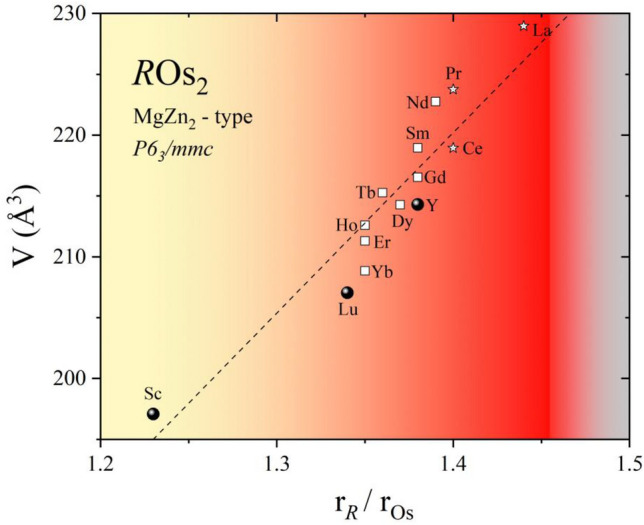
The unit cell volume vs the atomic radius ratio of the rare earth metal to osmium metal, rR/rOs. LaOs2, CeOs2, and PrOs2 form in the hexagonal phase under high pressure.
Figure 3
Figure 3
Zero-field-cooled (open circles) and field-cooled (full circles) temperature-dependent magnetic susceptibility data (H = 10 Oe) for ScOs2 (a), YOs2 (b), and LuOs2 (c). Temperature variation of the lower critical field for ScOs2 (d), YOs2 (e), and LuOs2 (f).
Figure 4
Figure 4
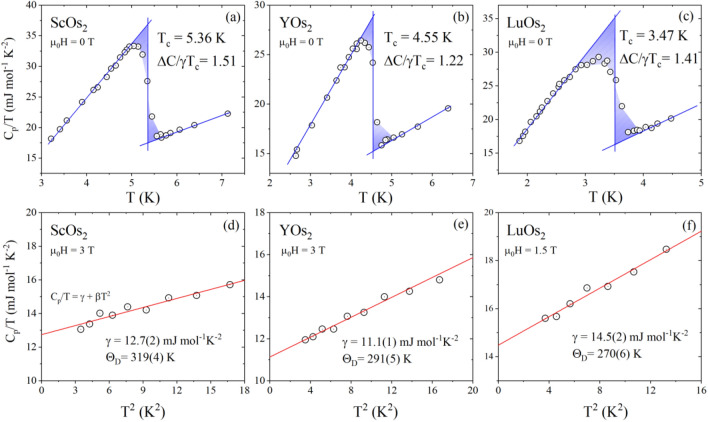
Temperature dependence of the zero-field specific heat in the vicinity of the superconducting phase transition for ScOs2 (a), YOs2 (b), and LuOs2 (c). Cp/T vs T2 measured in a magnetic field: ScOs2 (d), YOs2 (e), and LuOs2 (f).
Figure 5
Figure 5
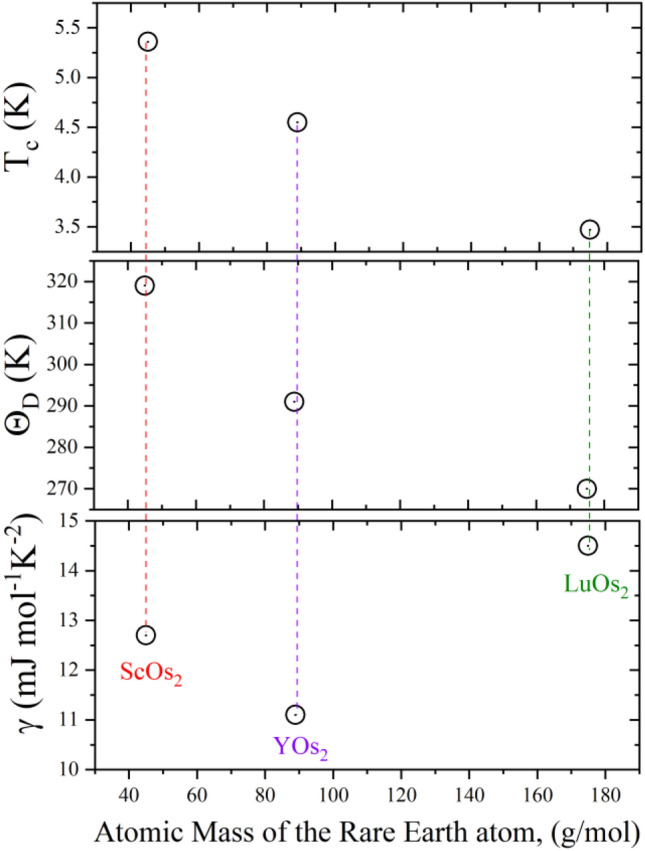
The critical temperature, the Debye temperature, and the Sommerfeld coefficient versus atomic mass of the rare earth atom in ROs2 compounds (R = Sc, Y and Lu).
Figure 6
Figure 6
The electrical resistivity versus temperature measured in zero applied magnetic field for ScOs2 (a), YOs2 (b), and LuOs2 (c). Insets show the superconducting transition under various magnetic fields. (d) The temperature dependence of the upper critical field of all compounds, determined from electrical resistivity measurements.
Figure 7
Figure 7
Band structure and electronic density of states for ScOs2 (a,b), YOs2 (c,d), and LuOs2 (e,f). In all three compounds the DOS(EF) is dominated by the contribution of Os 5d states. Besides the splitting of the completely occupied 4f band in LuOs2 (peak ca. − 4 to − 6 eV below the EF), the difference between fully- (FR; blue line in panels b,d,f) and scalar-relativistic (SR; gray line) is rather small.
Figure 8
Figure 8
Band structure of ScOs2 with Os1 d (a) and Os2 d (b) contribution highlighted (proportional to the color intensity). Os1 dominates the kagome-like bands between 0 and − 6 eV, while Os2 contributed mostly to a number of weakly dispersive bands between − 2 and − 3 eV. Panel (d) shows the tight binding band structure of a kagome system within 3 approximations: in the simplest case (thick gray lines) only nearest-neighbor interactions are considered and all the nearest neighbor tight binding hopping integrals are set to be equal (t1, t2 = − 1), resulting in a perfect p6m kagome. When the hexagonal symmetry is broken in breathing kagome (brown line; t1 = − 1, t2 = 0.9), the Dirac point at K is gapped, but the flat band remains intact. Inclusion of next-nearest neighbor interaction (orange line, t1 = − 1, t2 = 0.9, t3 = 0.1) results in the flat band attaining some dispersion. The three tight-binding models are schematically drawn in panel (c).

References

    1. Yan S, Huse DA, White SR. Spin-liquid ground state of the S = 1/2 Kagome Heisenberg antiferromagnet. Science. 2011;332:1173. - PubMed
    1. Han T-H, Helton JS, Chu S, Nocera DG, Rodriguez-Rivera JA, Broholm C, Lee YS. Fractionalized excitations in the spin-liquid state of a Kagome-lattice antiferromagnet. Nature. 2012;492:406. - PubMed
    1. Iqbal Y, Becca F, Sorella S, Poilblanc D. Gapless spin-liquid phase in the Kagome spin-1 2 Heisenberg antiferromagnet. Phys. Rev. B. 2013;87:060405.
    1. Balents L. Spin liquids in frustrated magnets. Nature. 2010;464:199. - PubMed
    1. Chamorro JR, McQueen TM, Tran TT. Chemistry of quantum spin liquids. Chem. Rev. 2021;121:2898. - PubMed