. 2023 Oct 4;13(1):16709.
doi: 10.1038/s41598-023-43145-3.

Human scent as a first-line defense against disease

Affiliations

Human scent as a first-line defense against disease

Amy R Gordon et al. Sci Rep. .

Abstract

Individuals may have a different body odor, when they are sick compared to healthy. In the non-human animal literature, olfactory cues have been shown to predict avoidance of sick individuals. We tested whether the mere experimental activation of the innate immune system in healthy human individuals can make an individuals' body odor be perceived as more aversive (intense, unpleasant, and disgusting). Following an endotoxin injection (lipopolysaccharide; 0.6 ng/kg) that creates a transient systemic inflammation, individuals smelled more unpleasant compared to a placebo group (saline injection). Behavioral and chemical analyses of the body odor samples suggest that the volatile components of samples from "sick" individuals changed qualitatively rather than quantitatively. Our findings support the hypothesis that odor cues of inflammation in axillary sweat are detectable just a few hours after experimental activation of the innate immune system. As such, they may trigger behavioral avoidance, hence constituting a first line of defense against pathogens of infected conspecifics.


Conflict of interest statement

The authors declare no competing interests.

Figures
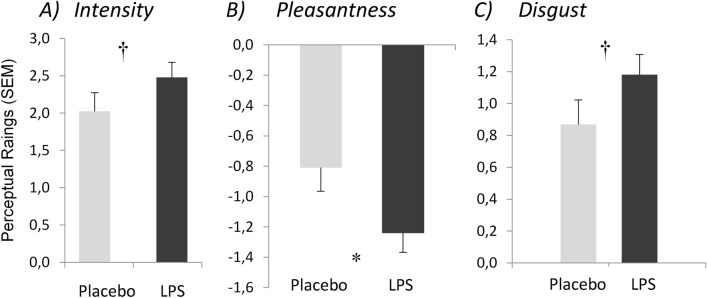
Figure 1
Figure 1
Perceptual ratings of body odor samples. Mean ratings of the perceived (A) intensity, (B) pleasantness, and (C) disgust of T-shirts worn by individuals exposed to lipopolysaccharide (LPS) and a Placebo (saline injection). Error bars show standard errors. An asterisk (*) indicate a significant difference between conditions (p < 0.05) whereas † reflects a p-value between (0.5 and 0.10).
Figure 2
Figure 2
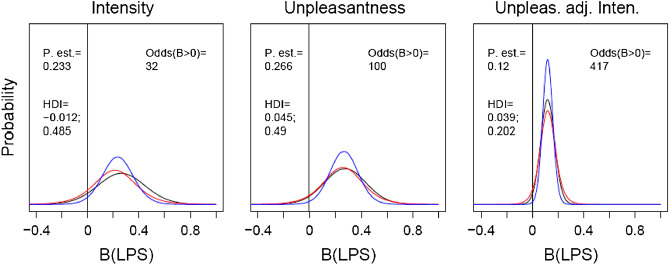
Posterior probability analyses of treatment effects. Likelihood estimates for various effects of LPS treatment in Olsson et al. (red lines) are used as prior probabilities and multiplied with likelihood estimates in the present study (black lines), which results in a distribution of estimated posterior probabilities (blue lines). Point estimates (P.est; with the highest probability) with Highest Density Interval (HDI; corresponding to confidence interval) for the distribution of posterior probabilities, as well as the estimated odds for an effect-size differing from zero, are included in the plots. Note that the pleasantness scale has been reversed to harmonize the x-axes.

References

    1. Curtis VA. Infection-avoidance behaviour in humans and other animals. Trends Immunol. 2014;35:457–464. doi: 10.1016/j.it.2014.08.006. - DOI - PubMed
    1. Schaller M. The behavioural immune system and the psychology of human sociality. Philos. Trans. R. Soc. Lond. B Biol. Sci. 2011;366:3418–3426. doi: 10.1098/rstb.2011.0029. - DOI - PMC - PubMed
    1. Arakawa H, Cruz S, Deak T. Attractiveness of illness-associated odorant cues in female rats is modulated by ovarian hormones, but not associated with pro-inflammatory cytokine levels. Brain Behav. Immun. 2012;26:40–49. doi: 10.1016/j.bbi.2011.07.231. - DOI - PubMed
    1. Ehman KD, Scott ME. Female mice mate preferentially with non-parasitized males. Parasitology. 2002;125:461–466. doi: 10.1017/S003118200200224X. - DOI - PubMed
    1. Kavaliers M, Colwell DD. Discrimination by female mice between the odours of parasitized and non-parasitized males. Proc. Biol. Sci. 1995;261:31–35. doi: 10.1098/rspb.1995.0113. - DOI - PubMed

Publication types