


Heart age gap estimated by explainable advanced electrocardiography is associated with cardiovascular risk factors and survival
- PMID: 37794867
- PMCID: PMC10545529
- DOI: 10.1093/ehjdh/ztad045
Heart age gap estimated by explainable advanced electrocardiography is associated with cardiovascular risk factors and survival
Abstract
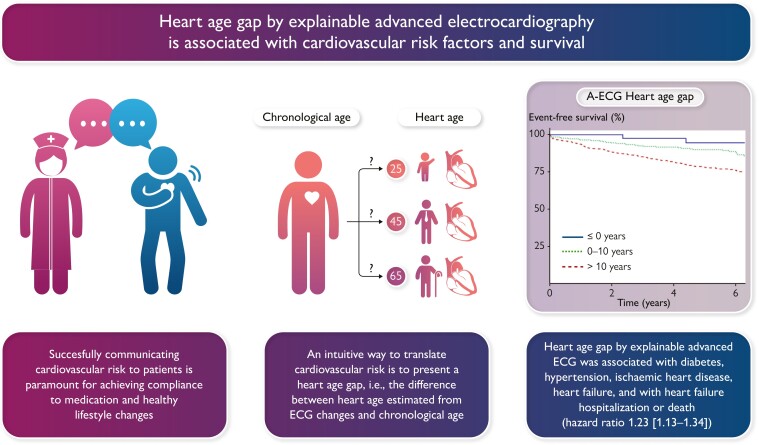
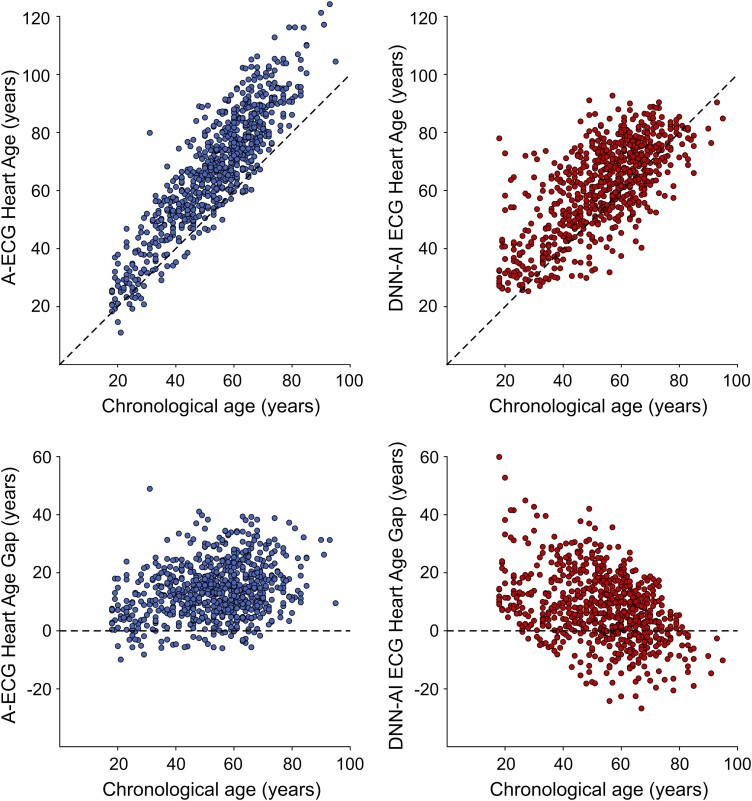
Aims: Deep neural network artificial intelligence (DNN-AI)-based Heart Age estimations have been presented and used to show that the difference between an electrocardiogram (ECG)-estimated Heart Age and chronological age is associated with prognosis. An accurate ECG Heart Age, without DNNs, has been developed using explainable advanced ECG (A-ECG) methods. We aimed to evaluate the prognostic value of the explainable A-ECG Heart Age and compare its performance to a DNN-AI Heart Age.
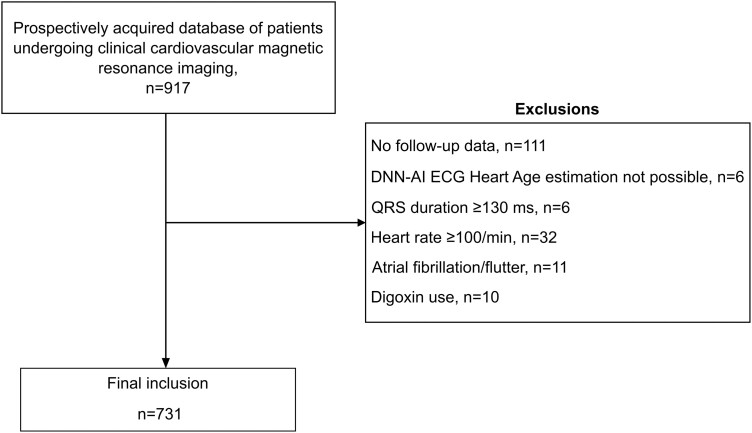
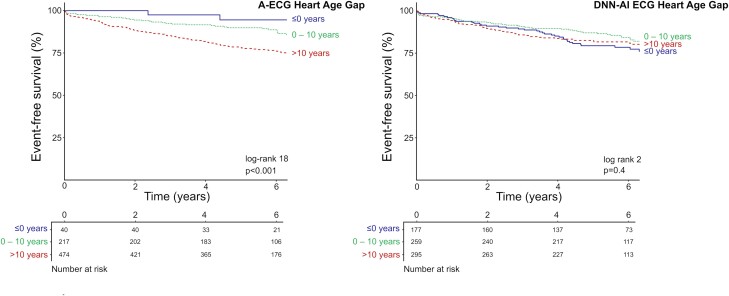
Methods and results: Both A-ECG and DNN-AI Heart Age were applied to patients who had undergone clinical cardiovascular magnetic resonance imaging. The association between A-ECG or DNN-AI Heart Age Gap and cardiovascular risk factors was evaluated using logistic regression. The association between Heart Age Gaps and death or heart failure (HF) hospitalization was evaluated using Cox regression adjusted for clinical covariates/comorbidities. Among patients [n = 731, 103 (14.1%) deaths, 52 (7.1%) HF hospitalizations, median (interquartile range) follow-up 5.7 (4.7-6.7) years], A-ECG Heart Age Gap was associated with risk factors and outcomes [unadjusted hazard ratio (HR) (95% confidence interval) (5 year increments): 1.23 (1.13-1.34) and adjusted HR 1.11 (1.01-1.22)]. DNN-AI Heart Age Gap was associated with risk factors and outcomes after adjustments [HR (5 year increments): 1.11 (1.01-1.21)], but not in unadjusted analyses [HR 1.00 (0.93-1.08)], making it less easily applicable in clinical practice.
Conclusion: A-ECG Heart Age Gap is associated with cardiovascular risk factors and HF hospitalization or death. Explainable A-ECG Heart Age Gap has the potential for improving clinical adoption and prognostic performance compared with existing DNN-AI-type methods.
Keywords: Cardiovascular disease; Heart age; Risk prediction; Vascular age.
© The Author(s) 2023. Published by Oxford University Press on behalf of the European Society of Cardiology.
Conflict of interest statement
Conflict of interest: T.T.S. is owner and founder of Nicollier-Schlegel SARL, which performs ECG interpretation consultancy using software that can quantify the advanced ECG measures used in the current study. T.T.S. and M.U. are owners and founders of Advanced ECG Systems, a company that is developing commercial applications of advanced ECG technology used in the current study.
Figures
References
-
- Hamczyk MR, Nevado RM, Barettino A, Fuster V, Andrés V. Biological versus chronological aging: JACC focus seminar. J Am Coll Cardiol 2020;75:919–930. - PubMed
-
- Groenewegen KA, den Ruijter HM, Pasterkamp G, Polak JF, Bots ML, Peters SA. Vascular age to determine cardiovascular disease risk: a systematic review of its concepts, definitions, and clinical applications. Eur J Prev Cardiol 2016;23:264–274. - PubMed
-
- Lopez-Gonzalez AA, Aguilo A, Frontera M, Bennasar-Veny M, Campos I, Vicente-Herrero T, et al. . Effectiveness of the heart age tool for improving modifiable cardiovascular risk factors in a Southern European population: a randomized trial. Eur J Prev Cardiol 2015;22:389–396. - PubMed
LinkOut - more resources
Full Text Sources
Research Materials
Miscellaneous