


Erinaceus coronavirus persistence in hedgehogs (Erinaceus europaeus) in a non-invasive, in vivo, experimental setting
- PMID: 37795019
- PMCID: PMC10545950
- DOI: 10.3389/fvets.2023.1213990
Erinaceus coronavirus persistence in hedgehogs (Erinaceus europaeus) in a non-invasive, in vivo, experimental setting
Abstract
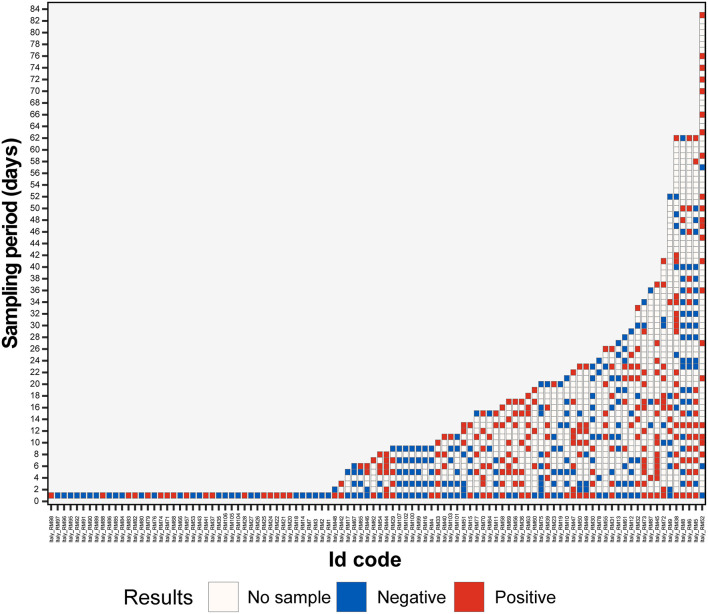
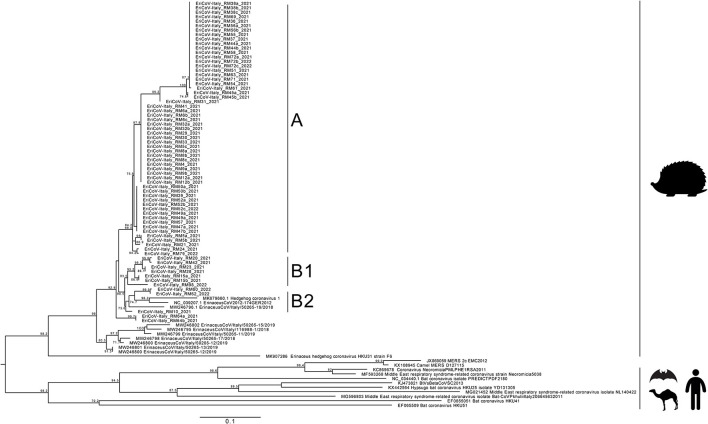
In the last 20 years, new zoonotic CoV strains have emerged (SARS-CoV, MERS-CoV, and SARS-CoV-2), and new species have also been reported in animals. In Europe, the Erinaceus coronavirus (EriCoV) was recently described in Erinaceus europaeus. However, information on the prevalence and duration of viral shedding is unknown. In this study, feces samples were collected from 102 European hedgehogs hosted in the Center for the Recovery of Wild Fauna in Rome and analyzed for the presence of EriCoV RNA by Reverse Transcription-PCR. In total, 45 animals (44.1%) resulted positive for EriCoV at the first sampling and 63 (61.7%) animals were positive at the follow-up, which was performed from the 3rd to the 86th day. The duration of fecal virus shedding showed a mean duration of 22.8 days and lasted up to 62 days. Eighteen hedgehogs showed intermittent viral shedding. Phylogenetic analysis showed a correlation with EriCoV strains reported in Germany, the United Kingdom, and northern Italy. None of the EriCoV sequences showed the CD200 ortholog insertion, previously observed in strains isolated in animals from northern Italy. Interestingly, all but one animal revealed the presence in their feces of the same EriCoV sequences, analyzing the short genomic region at 3' spike gene and 5' ORF3a 500bp fragment (100% nt.id.) in both first and follow-up samples. This result suggests that animals were infected with the same strain during their stay at the center. Our results confirm that EriCoV can persist in hedgehogs for a long period, underlining that hedgehogs are an important commensal reservoir for Merbecovirus. A long duration of viral shedding increases the likelihood that the virus will spread in the environment.
Keywords: Coronavirus; Erinaceus coronavirus (EriCoV); Erinaceus europaeus; European hedgehogs; Merbecovirus.
Copyright © 2023 De Sabato, Ianiro, Manzia, Monini, Chiappini, Di Bartolo and Vaccari.
Conflict of interest statement
The authors declare that the research was conducted in the absence of any commercial or financial relationships that could be construed as a potential conflict of interest.
Figures
References
LinkOut - more resources
Full Text Sources
Research Materials
Miscellaneous
