


"Idiopathic" minimal change nephrotic syndrome: a podocyte mystery nears the end
- PMID: 37795536
- PMCID: PMC10878723
- DOI: 10.1152/ajprenal.00219.2023
"Idiopathic" minimal change nephrotic syndrome: a podocyte mystery nears the end
Abstract
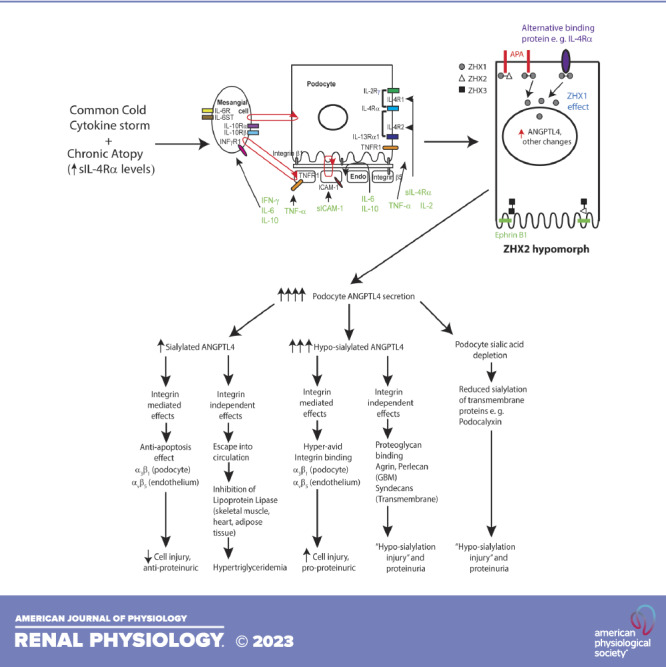
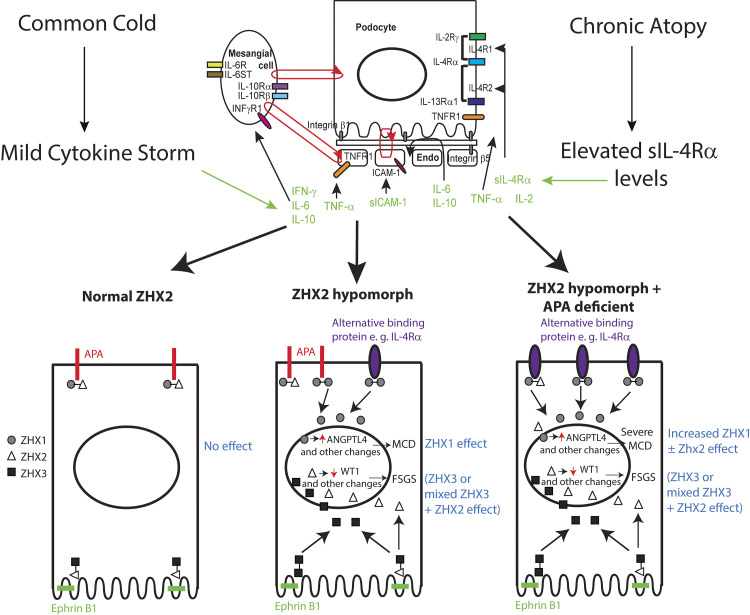
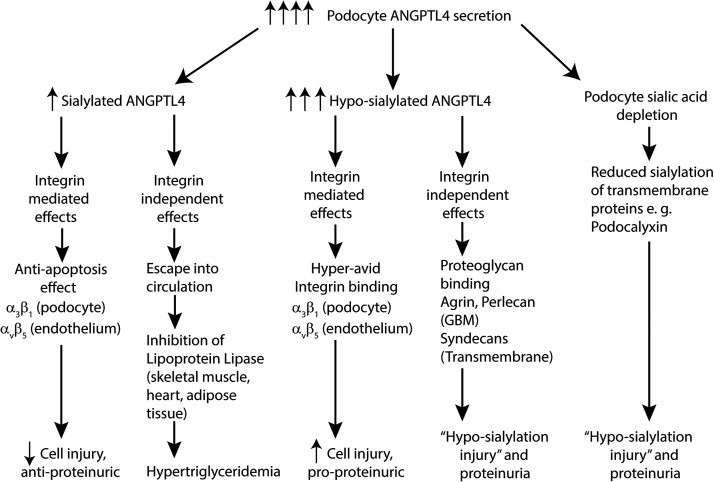
The discovery of zinc fingers and homeoboxes (ZHX) transcriptional factors and the upregulation of hyposialylated angiopoietin-like 4 (ANGPTL4) in podocytes have been crucial in explaining the cardinal manifestations of human minimal change nephrotic syndrome (MCNS). Recently, uncovered genomic defects upstream of ZHX2 induce a ZHX2 hypomorph state that makes podocytes inherently susceptible to mild cytokine storms resulting from a common cold. In ZHX2 hypomorph podocytes, ZHX proteins are redistributed away from normal transmembrane partners like aminopeptidase A (APA) toward alternative binding partners like IL-4Rα. During disease relapse, high plasma soluble IL-4Rα (sIL-4Rα) associated with chronic atopy complements the cytokine milieu of a common cold to displace ZHX1 from podocyte transmembrane IL-4Rα toward the podocyte nucleus. Nuclear ZHX1 induces severe upregulation of ANGPTL4, resulting in incomplete sialylation of part of the ANGPTL4 protein, secretion of hyposialylated ANGPTL4, and hyposialylation-related injury in the glomerulus. This pattern of injury induces many of the classic manifestations of human minimal change disease (MCD), including massive and selective proteinuria, podocyte foot process effacement, and loss of glomerular basement membrane charge. Administration of glucocorticoids reduces ANGPTL4 upregulation, which reduces hyposialylation injury to improve the clinical phenotype. Improving sialylation of podocyte-secreted ANGPTL4 also reduces proteinuria and improves experimental MCD. Neutralizing circulating TNF-α, IL-6, or sIL-4Rα after the induction of the cytokine storm in Zhx2 hypomorph mice reduces albuminuria, suggesting potential new therapeutic targets for clinical trials to prevent MCD relapse. These studies collectively lay to rest prior suggestions of a role of single cytokines or soluble proteins in triggering MCD relapse.
Keywords: atopy; cytokine storm; minimal change disease; nephrotic syndrome; podocyte.
Conflict of interest statement
S.S.C. is founder and president of GDTHERAPY LLC. S.S.C. is inventor on the following patents: United States 14/943,167 and United States 15/803,524 for sialylation-based therapeutics of kidney disease; PCT/US2011/039255 and PCT/US2014/030009 for recombinant-mutated human ANGPTL4-related treatment of proteinuria and chronic kidney disease; PCT/US2019/042748 for therapeutic depletion of specific cytokines to prevent common cold-induced relapse or worsening of human glomerular disease; PCT/US2022/47254 for therapeutic depletion of cytokine combinations to ameliorate systemic manifestations and reduce mortality in severe viral cytokine storms; PCT/US2022/47263 for therapeutic reduction of ZHX2 expression to reduce morbidity and mortality from cytokine storms; and PCT/US2023/062503 to use recombinant-mutated human ANGPTL4 to treat multisystem disease resulting from cytokine storms. None of the other authors has any conflicts of interest, financial or otherwise, to disclose.
Figures
References
-
- International Study of Kidney Disease in Children. Nephrotic syndrome in children: prediction of histopathology from clinical and laboratory characteristics at time of diagnosis: a report of the International Study of Kidney Disease in Children. Kidney Int 13: 159–165, 1978. doi: 10.1038/ki.1978.23. - DOI - PubMed
-
- Meyrier A, Radhakrishnan J. Minimal change disease: etiology, clinical features, and diagnosis in adults (Online). https://medilib.ir/uptodate/show/3046 [26 July 2023].
Publication types
MeSH terms
Substances
Grants and funding
LinkOut - more resources
Full Text Sources
Medical
