. 2023 Oct;203(1-2):79-93.
doi: 10.1007/s00442-023-05452-4. Epub 2023 Oct 5.

Modeling heterothermic fitness landscapes in a marsupial hibernator using changes in body composition

Affiliations

Modeling heterothermic fitness landscapes in a marsupial hibernator using changes in body composition

Tamara Abarzúa et al. Oecologia. 2023 Oct.

Abstract

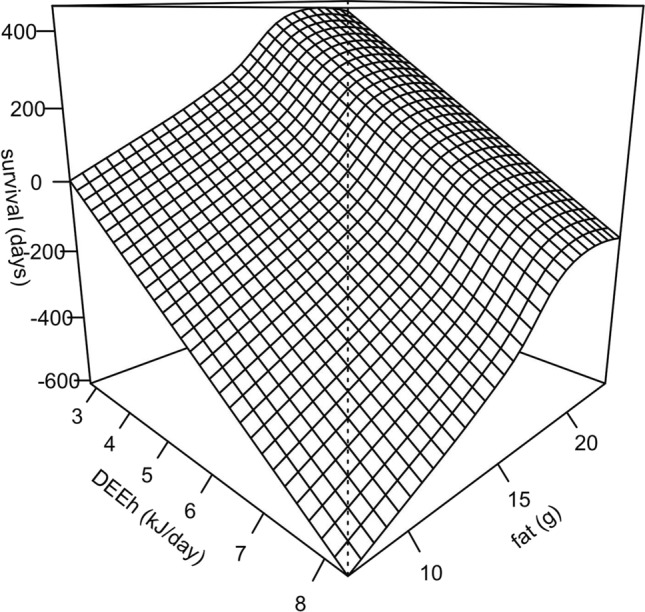
Hibernation is an adaptive strategy that allows animals to enter a hypometabolic state, conserving energy and enhancing their fitness by surviving harsh environmental conditions. However, addressing the adaptive value of hibernation, at the individual level and in natural populations, has been challenging. Here, we applied a non-invasive technique, body composition analysis by quantitative magnetic resonance (qMR), to calculate energy savings by hibernation in a population of hibernating marsupials (Dromiciops gliroides). Using outdoor enclosures installed in a temperate rainforest, and measuring qMR periodically, we determined the amount of fat and lean mass consumed during a whole hibernation cycle. With this information, we estimated the daily energy expenditure of hibernation (DEEH) at the individual level and related to previous fat accumulation. Using model selection approaches and phenotypic selection analysis, we calculated linear (directional, β), quadratic (stabilizing or disruptive, γ) and correlational (ρ) coefficients for DEEH and fat accumulation. We found significant, negative directional selection for DEEHDEEH = - 0.58 ± 0.09), a positive value for fat accumulation (βFAT = 0.34 ± 0.07), and positive correlational selection between both traits (ρDEEH × FAT = 0.24 ± 0.07). Then, individuals maximizing previous fat accumulation and minimizing DEEH were promoted by selection, which is visualized by a bi-variate selection surface estimated by generalized additive models. At the comparative level, results fall within the isometric allometry known for hibernation metabolic rate in mammals. Thus, by a combination of a non-invasive technique for body composition analysis and semi-natural enclosures, we were characterized the heterothermic fitness landscape in a semi-natural population of hibernators.

Keywords: Correlational selection; Dromiciops; Hibernation; Isometric scaling; Quantitative magnetic resonance; Selection surface.


Conflict of interest statement

The authors declare that there are not competing interests.

Figures
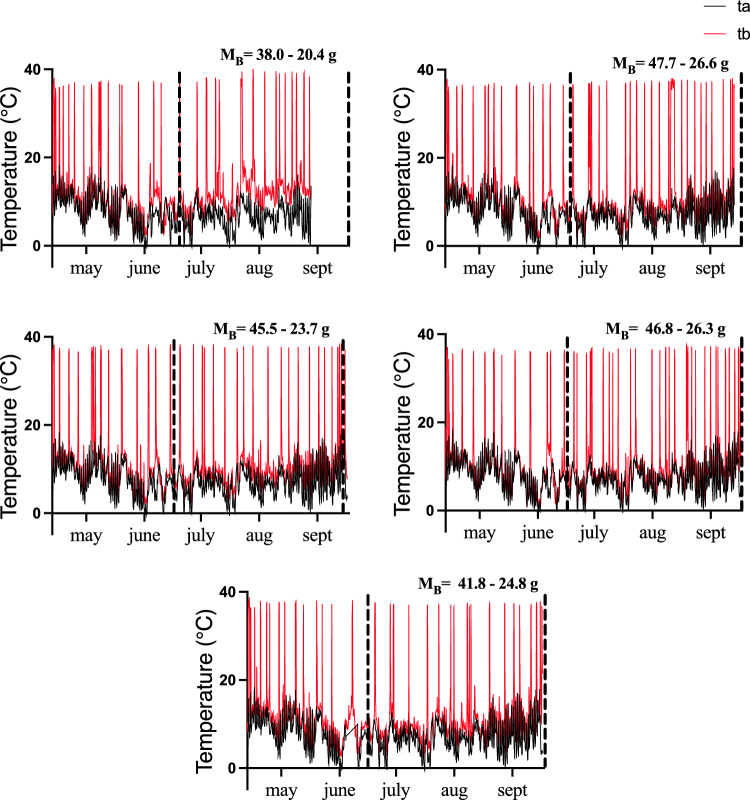
Fig. 1
Fig. 1
Time series of body temperatures (red, from intraperitoneal data-loggers) and ambient temperatures (black, from environmental data-loggers), in five individuals with intraperitoneal data-loggers. The change in body mass during the experiment is shown in each plot. Dotted lines represents the winter period. See text for details and methods
Fig. 2
Fig. 2
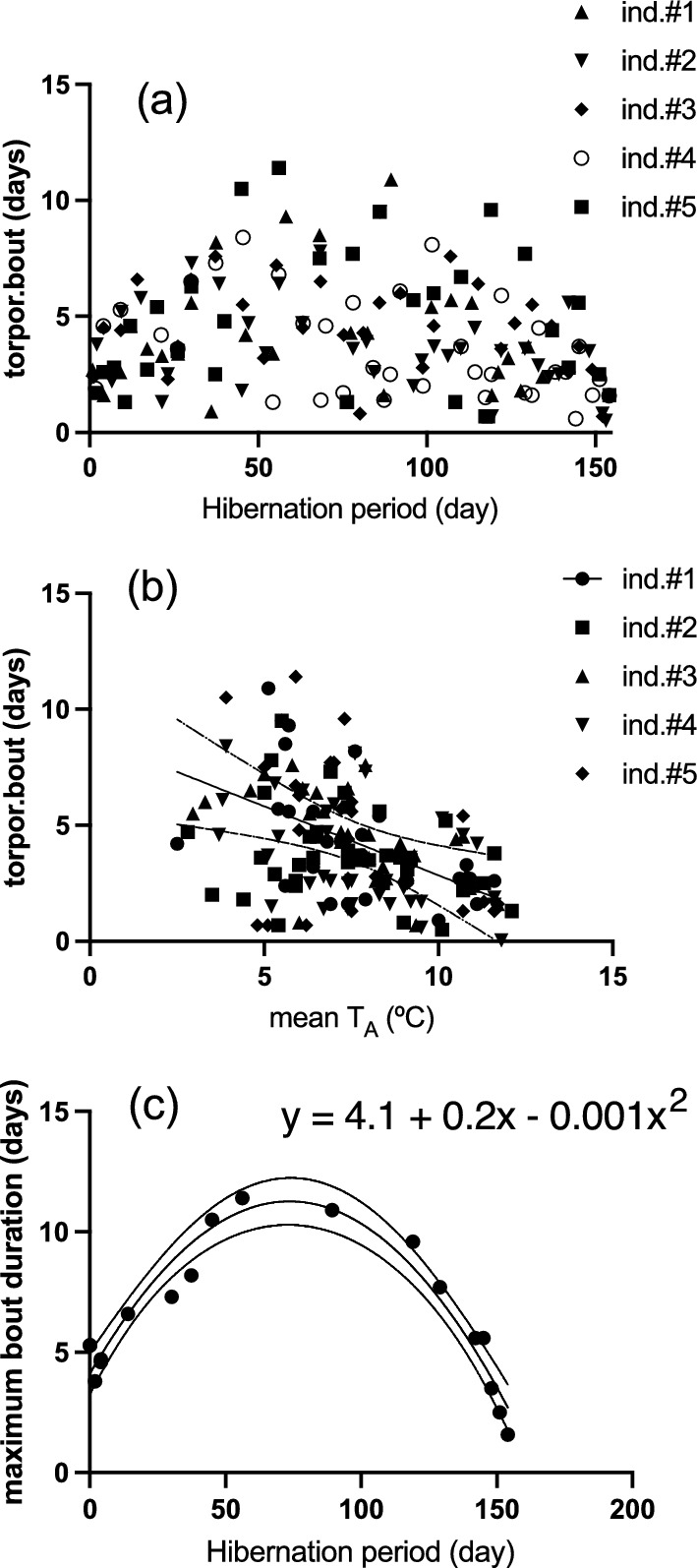
a Relationship between torpor bout duration and the hibernation period of the five individuals with data-loggers presented in Fig. 1. b Relationship between torpor bout duration and ambient temperature for the same individuals. c Maximum torpor bout duration, extracted from the time series of TB (a), associated with the hibernation period. The dataset was adjusted to a parable (adjusted R2 = 0.90, p = 0.0001), for which the equation is indicated in the graph. Confidence interval of 95% was shown
Fig. 3
Fig. 3
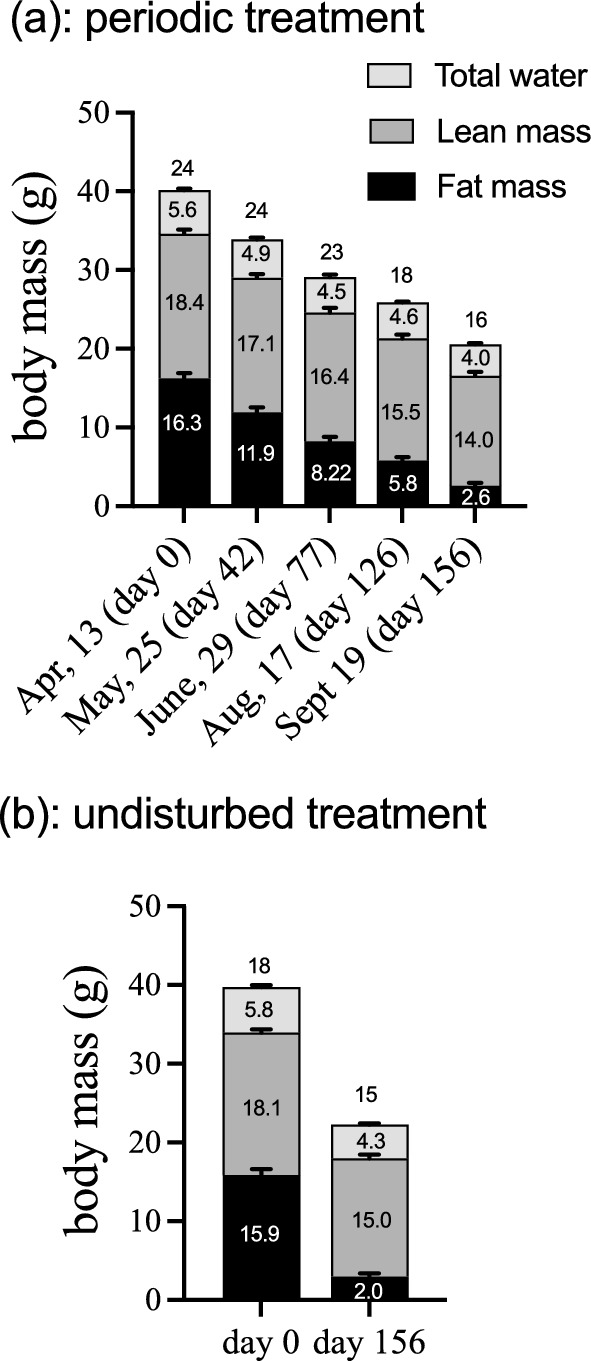
Changes in body mass and composition (total water, lean mass and fat mass, in grams; within bars) during the experimental period (means; error bars represent standard errors). a Represents the “periodic” treatment and b shows the “undisturbed” treatment (= only initial and final qMR measurements). Numbers above bars show sample size, and numbers within bars indicate means in grams
Fig. 4
Fig. 4
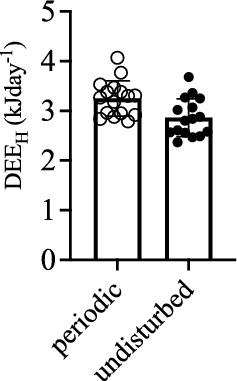
Daily energy expenditure of hibernation (DEEH) determined in individuals that were moved periodically to the laboratory for measurements of qMR and individuals that were measured only at the beginning and end of the experiment, showing a net increase of 0.39 kJ day−1 in periodically disturbed animals. Significant values are shown after an ANCOVA using lean mass as covariate (F1,29 = 6.2; p = 0.019)
Fig. 5
Fig. 5
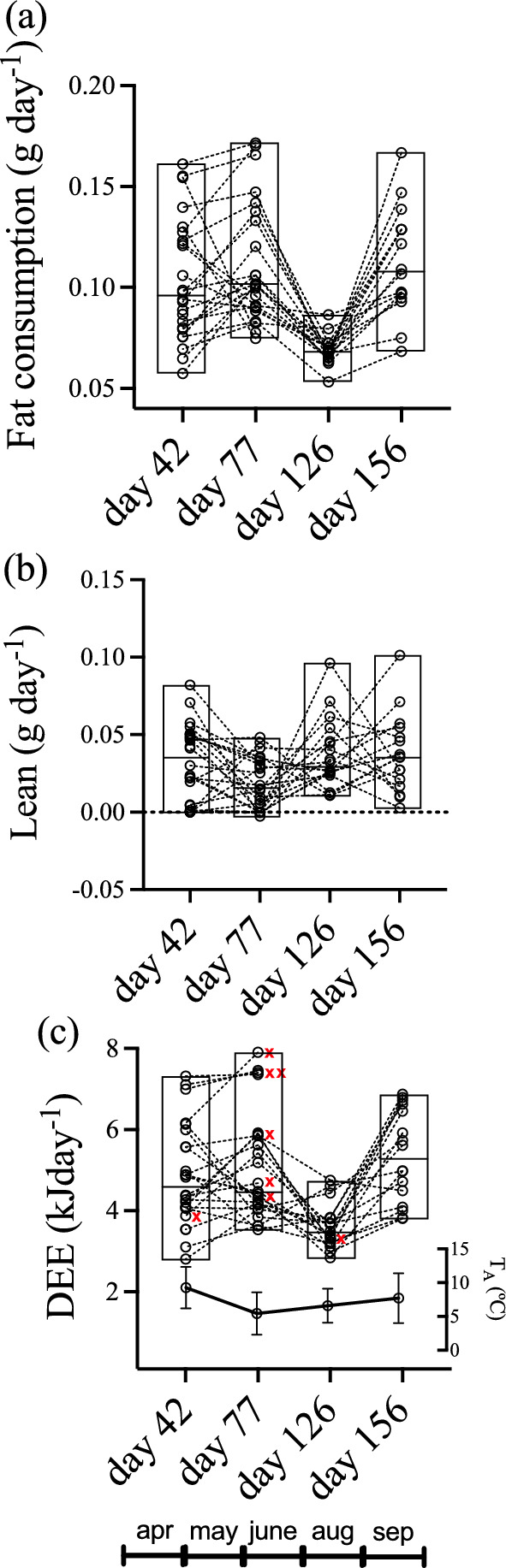
Time progression of fat (a), lean mass (b,) and energy consumption as DEEH (c), expressed as individual reaction norms. Boxes represent medians and range. Red crosses show non-survivor animals. Mean ambient temperature at the experimental site is plotted as reference in b
Fig. 6
Fig. 6
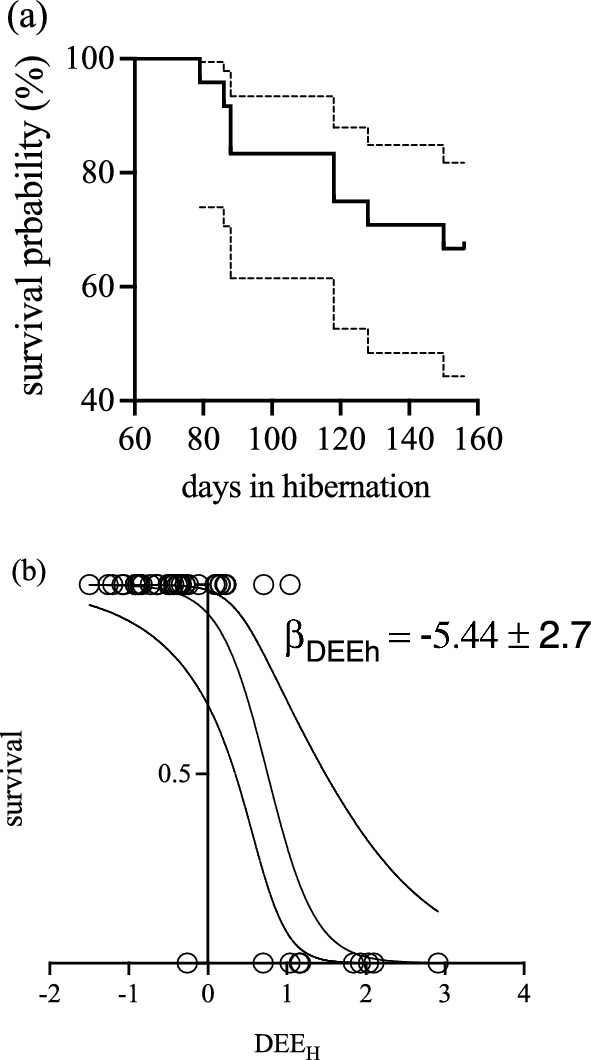
a Survival curve (± 95% confidence intervals, dotted line) of D. gliroides hibernation in our semi-natural enclosures. b Survival as binomial variable, in function of DEEH (standardized traits to mean = 0 and SD = 1). The linear coefficient of selection is shown for DEEH, and was found to be significant (logistic regression with p = 0.045)
Fig. 7
Fig. 7
Correlational selection maximizing low DEEH and high fat accumulation, represented by a fitness surface modeled using generalized additive models (adj-R2 = 0.82; deviance explained = 84%) and integrated smoothing parameters on the dataset using days of survival as fitness proxy. See “Results” and Table 4 for details
Fig. 8
Fig. 8
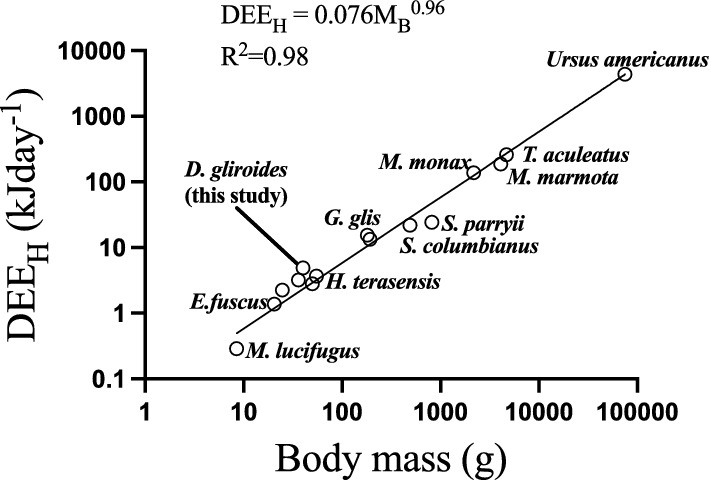
Comparative analysis of daily energy expenditure of hibernation (DEEH) using data from literature and our results for D. gliroides (modified from Nespolo et al. 2022b). Body composition during hibernation was recorded as body mass changes during hibernation for each hibernator

References

    1. Arnold SJ. Morphology, performance, and fitness. Am Zool. 1983;23:347–361. doi: 10.1093/icb/23.2.347. - DOI
    1. Artacho P, Nespolo RF. Intrapopulation variation in the standard metabolism of a terrestrial mollusc: repeatability of the CO2 production in the land snail Helix aspersa. Physiol Biochem Zool. 2009;82:181–189. doi: 10.1086/590222. - DOI - PubMed
    1. Artacho P, Nespolo RF. Natural selection reduces energy metabolism in the garden snail, Helix aspersa (Cornu aspersum) Evolution. 2009;63:1044–1050. doi: 10.1111/j.1558-5646.2008.00603.x. - DOI - PubMed
    1. Barak O, Geiser F, Kronfeld-schor N. Flood-induced multiday torpor in golden spiny mice (Acomys russatus) Aust J Zool. 2018;66:401–405. doi: 10.1071/zo19061. - DOI
    1. Barnes BM. Freeze avoidance in a mammal-body temperatures below 0 degrees C in an arctic hibernator. Science. 1989;244:1593–1595. doi: 10.1126/science.2740905. - DOI - PubMed

LinkOut - more resources