


Comparative risk perceptions of switching to JUUL vs. continued smoking and subsequent switching away from cigarettes: a longitudinal observational study
- PMID: 37798775
- PMCID: PMC10552465
- DOI: 10.1186/s40359-023-01351-8
Comparative risk perceptions of switching to JUUL vs. continued smoking and subsequent switching away from cigarettes: a longitudinal observational study
Abstract
Background: Evidence indicates that electronic nicotine delivery systems (ENDS) pose lower risk than cigarettes; however, many smokers harbor misperceptions that ENDS are equally or more harmful, possibly deterring them from switching. This study examines whether comparative risk perceptions of JUUL vs. smoking are associated with subsequent switching, among smokers who recently purchased JUUL.
Methods: N = 16,996 current established smokers who recently purchased a JUUL Starter Kit were followed 6 times over 12 months. Comparative risk perceptions were assessed using both direct and indirect measures (i.e., contrasting JUUL and smoking directly in questions, and deriving from separate absolute scales). Repeated-measures logistic regression examined switching across follow-up (no smoking in past 30 days) as a function of baseline risk perceptions, adjusting for demographics and baseline smoking behavior.
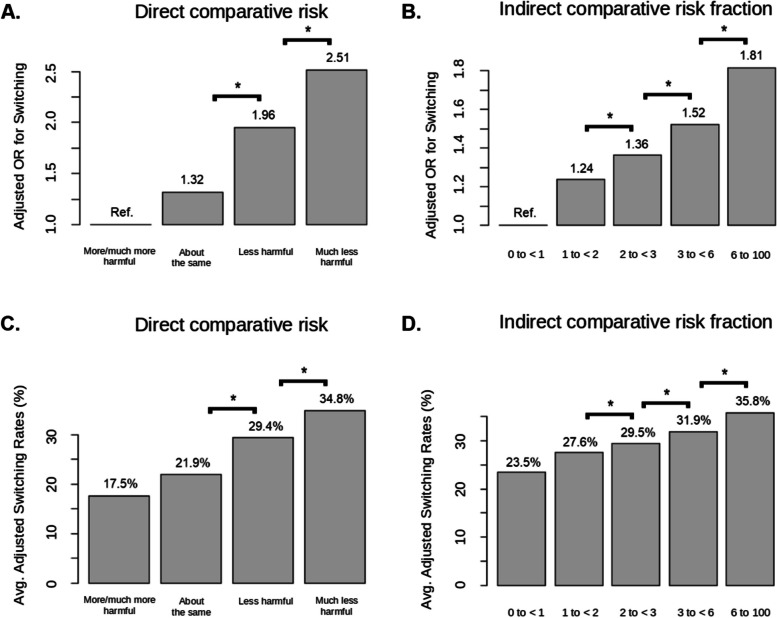
Results: Perceiving JUUL as less harmful than smoking was associated with higher switching rates, using both direct (e.g., adjusted odds ratio [AOR] = 1.48 for "JUUL much less" vs. "more/much more harmful") and indirect (AOR = 1.07, for each 10-unit increase in fraction; AOR = 1.51 for highest (6-100) vs. lowest (0 to < 1) fraction categories) comparative risk measures (all p < 0.0001). Among the subset smoking 10 + cigarettes per day, associations between risk perceptions and switching were more pronounced (AOR = 2.51 for "JUUL much less" vs. "more/much more harmful"; AOR = 1.81 for 6-100 vs. 0 to < 1 fraction, both p < 0.0001).
Conclusions: Smokers who perceive JUUL as less harmful than cigarettes have higher odds of switching. Future research should examine whether messaging which aligns comparative risk perceptions with current evidence can facilitate switching, especially among heavier smokers.
Keywords: Cigarettes; Electronic nicotine Delivery Systems; JUUL; Risk perceptions; Smoking; Switching.
© 2023. BioMed Central Ltd., part of Springer Nature.
Conflict of interest statement
Through PinneyAssociates, Inc., authors AS, and SS provide consulting services on tobacco harm reduction on an exclusive basis to Juul Labs, Inc (JLI). This study was funded by JLI. The preparation of this manuscript was supported by JLI, and JLI reviewed and provided comments on a near-final draft of the manuscript.
Figures

References
-
- Hartmann-Boyce J, Butler AR, Theodoulou A, Onakpoya IJ, Hajek P, Bullen C, et al. Biomarkers of potential harm in people switching from smoking tobacco to exclusive e-cigarette use, dual use or abstinence: secondary analysis of Cochrane systematic review of trials of e-cigarettes for smoking cessation. Addiction. 2023;118(3):539–45. - PMC - PubMed
-
- McNeill A, Simonavičius E, Brose LS, Taylor E, East K, Zuikova E, et al. September 2022. A report commissioned by the Office for Health Improvement and Disparities. London: Office for Health Improvement and Disparities; 2022. Nicotine vaping in England: an evidence update including health risks and perceptions.
-
- Hartmann-Boyce J, Butler AR, Theodoulou A, Onakpoya IJ, Hajek P, Bullen C, et al. Biomarkers of potential harm in people switching from smoking tobacco to exclusive e-cigarette use, dual use or abstinence: secondary analysis of Cochrane systematic review of trials of e-cigarettes for smoking cessation. Addiction. 2022;118(3):539–545. - PMC - PubMed
Publication types
MeSH terms
Grants and funding
LinkOut - more resources
Full Text Sources
Medical
Miscellaneous
