Outcomes of Surgical Treatment for Patients With Mild Scoliosis and Age-Appropriate Sagittal Alignment With Minimum 2-Year Follow-up
- PMID: 37798979
- PMCID: PMC10562222
- DOI: 10.14245/ns.2346454.227
Outcomes of Surgical Treatment for Patients With Mild Scoliosis and Age-Appropriate Sagittal Alignment With Minimum 2-Year Follow-up
Abstract
Objective: The goal of this study was to determine if patients with mild scoliosis and age-appropriate sagittal alignment have favorable outcomes following surgical correction.
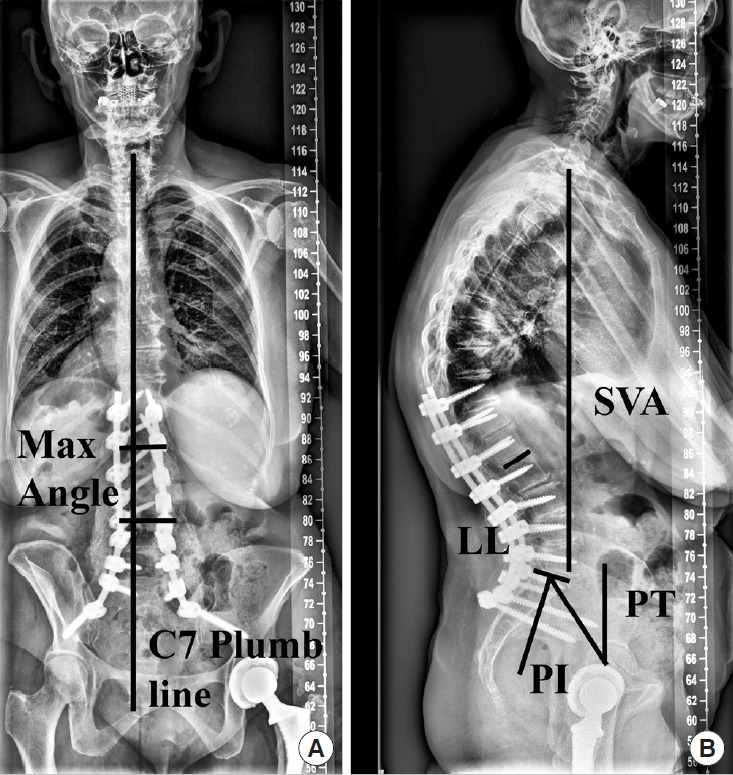
Methods: Retrospective review of a prospective, multicenter adult spinal deformity database. Inclusion criteria: operative patients age ≥18 years, and preoperative pelvic tilt, mismatch between pelvic incidence and lumbar lordosis (PI-LL), and C7 sagittal vertical axis all within established age-adjusted thresholds with minimum 2-year follow-up. Health-related quality of life (HRQoL) scores: Oswestry Disability Index (ODI), 36-item Short Form health survey (SF-36), Scoliosis Research Society-22R (SRS22R), back/leg pain Numerical Rating Scale and minimum clinically important difference (MCID)/substantial clinical benefit (SCB). Two-year and preoperative HRQoL radiographic data were compared. Patients with mild scoliosis (Mild Scoli, Max coronal Cobb 10°-30°) were compared to those with larger curves (Scoli).
Results: One hundred fifty-one patients included from 667 operative patients (82.8% women; average age, 56.4 ± 16.2 years). Forty-two patients (27.8%) included in Mild Scoli group. Mild Scoli group had significantly worse baseline leg pain, ODI, and physical composite scores (p < 0.02). Mean 2-year maximum coronal Cobb angle was significantly improved compared to baseline (p < 0.001). All 2-year HRQoL measures were significantly improved compared to (p < 0.001) except mental composite score, SRS activity and SRS mental for the Mild Scoli group (p > 0.05). From the mild Scoli group, 36%-74% met either MCID or SCB for the HRQoL measures. Sixty-four point three percent had minimum 1 complication, 28.6% had a major complication, 35.7% had reoperation.
Conclusion: Mild scoliosis patients with age-appropriate sagittal alignment benefit from surgical correction, decompression, and stabilization at 2 years postoperative despite having a high complication rate.
Keywords: Adult spinal deformity; Complications; Mild scoliosis; Outcomes; Sagittal alignment.
Conflict of interest statement
The authors have nothing to disclose.
Figures


Comment in
-
Impacts of Adult Spinal Deformity Surgery on Coronal Malalignment: Commentary on "Outcomes of Surgical Treatment for Patients With Mild Scoliosis and Age-Appropriate Sagittal Alignment With Minimum 2-Year Follow-up".Neurospine. 2023 Sep;20(3):849-851. doi: 10.14245/ns.2346926.463. Epub 2023 Sep 30. Neurospine. 2023. PMID: 37798980 Free PMC article. No abstract available.
References
-
- Bess S, Boachie-Adjei O, Burton D, et al. Pain and disability determine treatment modality for older patients with adult scoliosis, while deformity guides treatment for younger patients. Spine (Phila Pa 1976) 2009;34:2186–90. - PubMed
-
- Glassman SD, Schwab FJ, Bridwell KH, et al. The selection of operative versus nonoperative treatment in patients with adult scoliosis. Spine (Phila Pa 1976) 2007;32:93–7. - PubMed
-
- Smith JS, Fu KM, Urban P, et al. Neurological symptoms and deficits in adults with scoliosis who present to a surgical clinic: incidence and association with the choice of operative versus nonoperative management. Journal of neurosurgery. J Neurosurg Spine. 2008;9:326–31. - PubMed
-
- Bridwell KH, Baldus C, Berven S, et al. Changes in radiographic and clinical outcomes with primary treatment adult spinal deformity surgeries from two years to three- to fiveyears follow-up. Spine (Phila Pa 1976) 2010;35:1849–54. - PubMed
LinkOut - more resources
Full Text Sources
Research Materials
Miscellaneous