


Machine Learning for Detecting Virus Infection Hotspots Via Wastewater-Based Epidemiology: The Case of SARS-CoV-2 RNA
- PMID: 37799774
- PMCID: PMC10550031
- DOI: 10.1029/2023GH000866
Machine Learning for Detecting Virus Infection Hotspots Via Wastewater-Based Epidemiology: The Case of SARS-CoV-2 RNA
Abstract
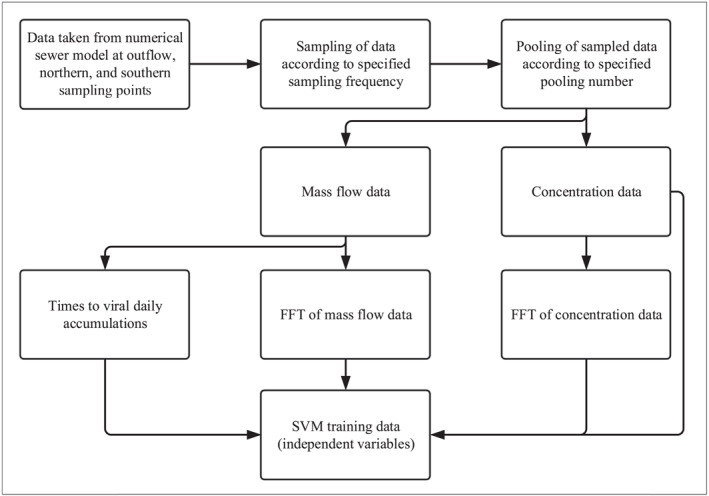
Wastewater-based epidemiology (WBE) has been proven to be a useful tool in monitoring public health-related issues such as drug use, and disease. By sampling wastewater and applying WBE methods, wastewater-detectable pathogens such as viruses can be cheaply and effectively monitored, tracking people who might be missed or under-represented in traditional disease surveillance. There is a gap in current knowledge in combining hydraulic modeling with WBE. Recent literature has also identified a gap in combining machine learning with WBE for the detection of viral outbreaks. In this study, we loosely coupled a physically-based hydraulic model of pathogen introduction and transport with a machine learning model to track and trace the source of a pathogen within a sewer network and to evaluate its usefulness under various conditions. The methodology developed was applied to a hypothetical sewer network for the rapid detection of disease hotspots of the disease caused by the SARS-CoV-2 virus. Results showed that the machine learning model's ability to recognize hotspots is promising, but requires a high time-resolution of monitoring data and is highly sensitive to the sewer system's physical layout and properties such as flow velocity, the pathogen sampling procedure, and the model's boundary conditions. The methodology proposed and developed in this paper opens new possibilities for WBE, suggesting a rapid back-tracing of human-excreted biomarkers based on only sampling at the outlet or other key points, but would require high-frequency, contaminant-specific sensor systems that are not available currently.
Keywords: COVID‐19; SARS‐CoV‐2; machine learning; sewer network modeling; support vector machine; wastewater‐based epidemiology.
© 2023 The Authors. GeoHealth published by Wiley Periodicals LLC on behalf of American Geophysical Union.
Conflict of interest statement
The authors declare no conflicts of interest relevant to this study.
Figures




References
-
- Abdeldayem, O. M. , Dabbish, A. M. , Habashy, M. M. , Mostafa, M. K. , Elhefnawy, M. , Amin, L. , et al. (2022). Viral outbreaks detection and surveillance using wastewater‐based epidemiology, viral air sampling, and machine learning techniques: A comprehensive review and outlook. Science of the Total Environment, 803, 149834. 10.1016/j.scitotenv.2021.149834 - DOI - PMC - PubMed
-
- Ahmed, W. , Angel, N. , Edson, J. , Bibby, K. , Bivins, A. , O'Brien, J. W. , et al. (2020). First confirmed detection of SARS‐CoV‐2 in untreated wastewater in Australia: A proof of concept for the wastewater surveillance of COVID‐19 in the community. Science of the Total Environment, 728, 138764. 10.1016/j.scitotenv.2020.138764 - DOI - PMC - PubMed
-
- Bailey, O. , Arnot, T. C. , Blokker, E. J. M. , Kapelan, Z. , Vreeburg, J. , & Hofman, J. (2019). Developing a stochastic sewer model to support sewer design under water conservation measures. Journal of Hydrology, 573, 908–917. 10.1016/j.jhydrol.2019.04.013 - DOI
-
- Banik, B. K. , Di Cristo, C. , Leopardi, A. , & de Marinis, G. (2017). Illicit intrusion characterization in sewer systems. Urban Water Journal, 14(4), 416–426. 10.1080/1573062X.2016.1176220 - DOI
-
- Bartos, M. , & Kerkez, B. (2021). Observability‐based sensor placement improves contaminant tracing in river networks. Water Resources Research, 57(7), e2020WR029551. 10.1029/2020WR029551 - DOI
LinkOut - more resources
Full Text Sources
Miscellaneous