Review
. 2023 Dec:76:102394.
doi: 10.1016/j.mib.2023.102394. Epub 2023 Oct 4.

Evolution and synthetic biology

Affiliations
Review

Evolution and synthetic biology

Marya Y Ornelas et al. Curr Opin Microbiol. 2023 Dec.

Abstract

Evolutionary observations have often served as an inspiration for biological design. Decoding of the central dogma of life at a molecular level and understanding of the cellular biochemistry have been elegantly used to engineer various synthetic biology applications, including building genetic circuits in vitro and in cells, building synthetic translational systems, and metabolic engineering in cells to biosynthesize and even bioproduce complex high-value molecules. Here, we review three broad areas of synthetic biology that are inspired by evolutionary observations: (i) combinatorial approaches toward cell-based biomolecular evolution, (ii) engineering interdependencies to establish microbial consortia, and (iii) synthetic immunology. In each of the areas, we will highlight the evolutionary premise that was central toward designing these platforms. These are only a subset of the examples where evolution and natural phenomena directly or indirectly serve as a powerful source of inspiration in shaping synthetic biology and biotechnology.


Conflict of interest statement

Declaration of Competing Interest The authors declare that they have no known competing financial interests or personal relationships that could have appeared to influence the work reported in this paper.

Figures

Figure 1:
Figure 1:
Combinatorial approaches for the evolution of biomolecules in bacteria, yeast, and mammalian cells. Methods for diversifying biomolecules highlighted in this review include orthogonal tRNA/tRNA synthetase pairs, base editors, error-prone DNA polymerases, T7 RNA polymerase - cytidine deaminase fusions, DNA polymerase - CRISPR Cas9 fusions, and synthetic genomes. All methods outlined here follow the approach of mutate, screen, and select.
Figure 2:
Figure 2:
Synthetic microbial communities based on natural observation. A) Naturally occurring microbial consortia exist in all habitats and display distinct characteristics from mono-culture organisms. These communities are largely defined by obligate metabolite exchange and demonstrate division of labor in which growth and bioproduction in one species each carry metabolic burden. B) Mating of fungal species is mediated by secretion of peptide hormones, which bind a GPCR and affect downstream processes which allow mating. Peptide/GPCR pairs are not conserved between all fungi. C) Eukaryotic cells contain metabolically essential organelles such as mitochondria and chloroplast. These organelles are thought to have evolved from endosymbiotic bacteria which propagated inside host cells through syntrophy and/or parasitism. D) The principles of naturally occurring microbial communities have been leveraged by synthetic biologists for a number of purposes. Mee et al., have engineered a 14-member consortium defined by amino acid auxotrophs. Synthetic consortia have also been used as the basis of circuits which can be used to control populations of different species in the consortium. Through the principle of division of labor, consortia can be used to more efficiently synthesize natural products and biofuels which place excessive burden on mono-culture microbes. E) Orthogonal peptide-GPCR pairs from many fungal taxa have been expressed in mutant S. cerevisiae to engineer communication networks based on cell survival. F) Model bacteria have been engineered to express genes associated with modern-day endosymbionts and organelles. These mutant bacteria were fused with mutant S. cerevisiae, where they fulfill an essential bioenergetic role from within the yeast cytosol in the manner of an organelle.
Figure 3:
Figure 3:
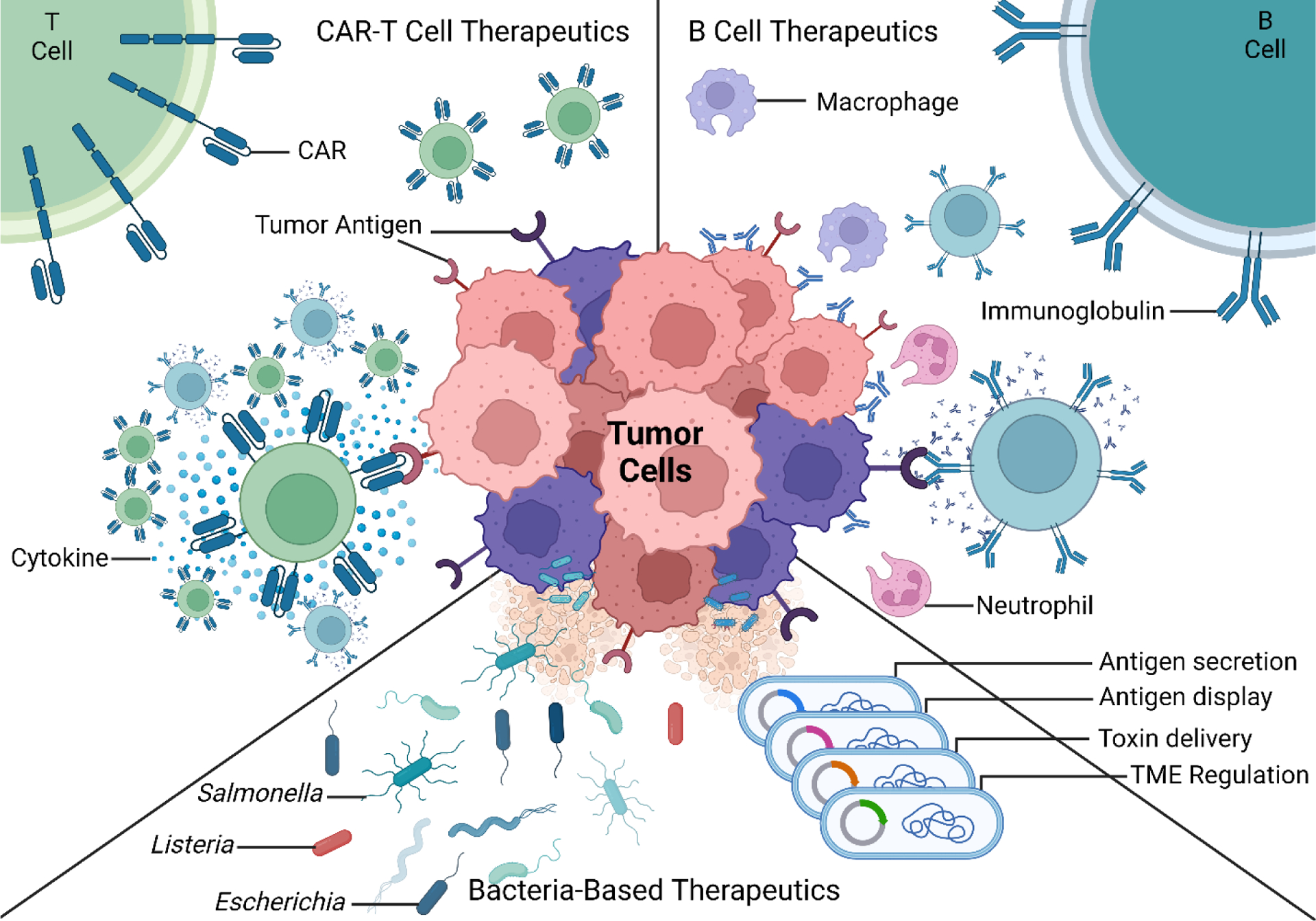
Modalities of tumor elimination by cellular consortia. CAR T cells act as signaling agents in cellular consortia by means of cytokine release, which stimulates proliferation of T and B cells during the adaptive immune response. Engineered B cells are also used in treating tumors by means of their specific antibody secretion tagging of tumor tissue for elimination by neutrophils and macrophages within the cellular consortia of both the innate and adaptive immune responses. Bacteria-based therapeutics are also used as anti-cancer modalities by means of recruiting cellular consortia by antigen secretion, antigen display on their surfaces, metabolite secretion in the TME, as well as direct toxin delivery for tumor elimination. All methods directly benefit from biomolecular evolution of various receptors (i.e., CARs, antibodies).

References

    1. Gardner TS; Cantor CR; Collins JJ Construction of a Genetic Toggle Switch in Escherichia Coli. Nature 2000, 403 (6767), 339–342. 10.1038/35002131. - DOI - PubMed
    1. Hockenberry AJ; Jewett MC Synthetic in Vitro Circuits. Curr. Opin. Chem. Biol 2012, 16 (3), 253–259. 10.1016/j.cbpa.2012.05.179. - DOI - PMC - PubMed
    1. Liu Y; Kim DS; Jewett MC Repurposing Ribosomes for Synthetic Biology. Curr. Opin. Chem. Biol 2017, 40, 87–94. 10.1016/j.cbpa.2017.07.012. - DOI - PMC - PubMed
    1. Wang K; Neumann H; Peak-Chew SY; Chin JW Evolved Orthogonal Ribosomes Enhance the Efficiency of Synthetic Genetic Code Expansion. Nat. Biotechnol 2007, 25 (7), 770–777. 10.1038/nbt1314. - DOI - PubMed
    1. Melo Czekster C; Robertson WE; Walker AS; Söll D; Schepartz A In Vivo Biosynthesis of a β-Amino Acid-Containing Protein. J. Am. Chem. Soc 2016, 138 (16), 5194–5197. 10.1021/jacs.6b01023. - DOI - PMC - PubMed

Publication types

LinkOut - more resources