. 2023 Oct 6;20(1):228.
doi: 10.1186/s12974-023-02915-6.

Nisin a probiotic bacteriocin mitigates brain microbiome dysbiosis and Alzheimer's disease-like neuroinflammation triggered by periodontal disease

Affiliations

Nisin a probiotic bacteriocin mitigates brain microbiome dysbiosis and Alzheimer's disease-like neuroinflammation triggered by periodontal disease

Chuanjiang Zhao et al. J Neuroinflammation. .

Abstract

Introduction: Periodontitis-related oral microbial dysbiosis is thought to contribute to Alzheimer's disease (AD) neuroinflammation and brain amyloid production. Since probiotics can modulate periodontitis/oral dysbiosis, this study examined the effects of a probiotic/lantibiotic, nisin, in modulating brain pathology triggered by periodontitis.

Methods: A polymicrobial mouse model of periodontal disease was used to evaluate the effects of this disease on brain microbiome dysbiosis, neuroinflammation, Alzheimer's-related changes, and nisin's therapeutic potential in this context.

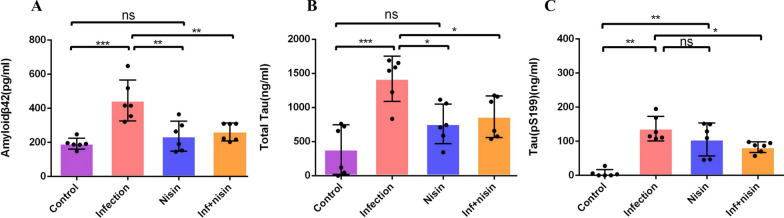
Results: 16S sequencing and real-time PCR data revealed that Nisin treatment mitigated the changes in the brain microbiome composition, diversity, and community structure, and reduced the levels of periodontal pathogen DNA in the brain induced by periodontal disease. Nisin treatment significantly decreased the mRNA expression of pro-inflammatory cytokines (Interleukin-1β/IL-1 β, Interleukin 6/IL-6, and Tumor Necrosis Factor α/TNF-α) in the brain that were elevated by periodontal infection. In addition, the concentrations of amyloid-β 42 (Aβ42), total Tau, and Tau (pS199) (445.69 ± 120.03, 1420.85 ± 331.40, 137.20 ± 36.01) were significantly higher in the infection group compared to the control group (193.01 ± 31.82, 384.27 ± 363.93, 6.09 ± 10.85), respectively. Nisin treatment markedly reduced the Aβ42 (261.80 ± 52.50), total Tau (865.37 ± 304.93), and phosphorylated Tau (82.53 ± 15.77) deposition in the brain of the infection group.

Discussion: Nisin abrogation of brain microbiome dysbiosis induces beneficial effects on AD-like pathogenic changes and neuroinflammation, and thereby may serve as a potential therapeutic for periodontal-dysbiosis-related AD.

Keywords: Antimicrobial therapy; Brain microbiome; Neuroinflammation; Nisin; Oral microbiome; Periodontal disease.


Conflict of interest statement

The authors declare no competing interest with this study.

Figures
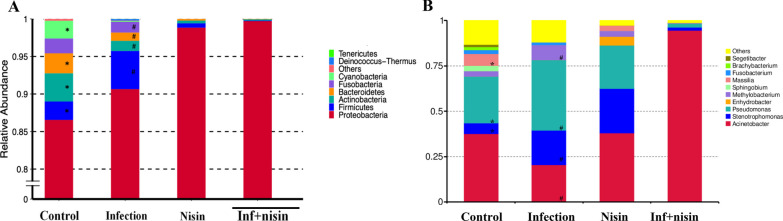
Fig. 1
Fig. 1
Analysis of the microbial abundance by 16s rRNA sequencing shows that nisin reverses the changes in brain microbiome composition induced by oral polymicrobial infection. The groups included Control, Infection, Nisin, Infection + Nisin. Differential abundance analysis for bacteria at phylum (A) and genus level (B). *, the difference between the Control and Infection group was significant (P < 0.05). #, the difference between the Infection and Infection + Nisin group was significant (P < 0.05)
Fig. 2
Fig. 2
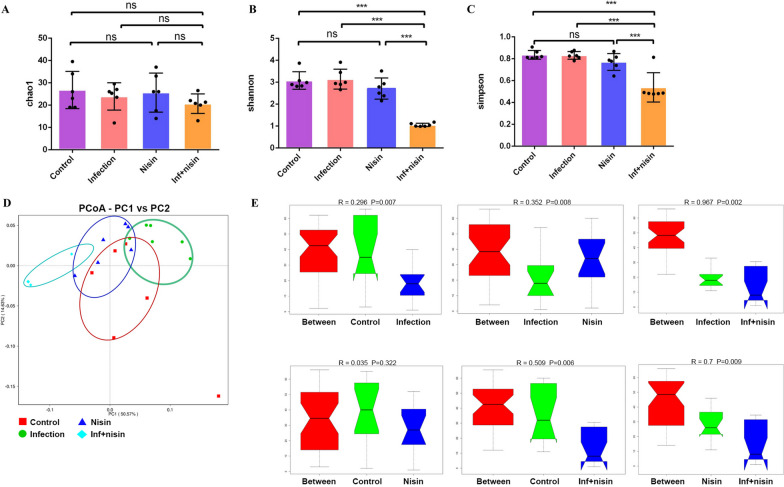
Analysis of microbial community composition and diversity shows that nisin alters microbial diversity and community structure in brain following oral polymicrobial infection. The groups included Control, Infection, Nisin, Infection + Nisin. AC Chao1 estimator, Shannon index and Simpson index are analyzed based on the numbers of OTUs from brain tissues. There is no significant difference in Chao1 among the four groups. As for Shannon index and Simpson index, the bacterial diversity score of the Infection + Nisin group is significantly lower than that of the Control, Infection and Nisin group. D PCoA based on weighted Unifrac distance is shown for different groups. The microbial compositions of Infection and Infection + Nisin group are shifting to different states, while the microbial compositions of Control and Nisin group are in the middle state. E Analysis of Similarity (Anosim) among different groups are shown. The microbiome compositions of the Control, Nisin and Infection + Nisin group are significantly different from that of the Infection group
Fig. 3
Fig. 3
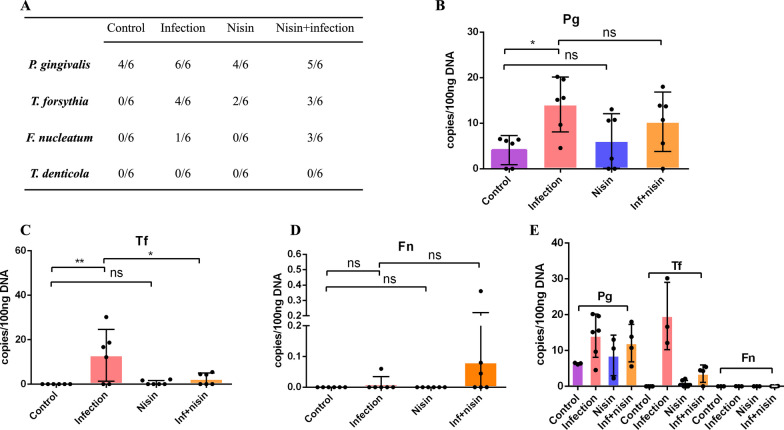
Nisin attenuates the burden of periodontal pathogens in the brain following oral polymicrobial infection. DNA was isolated and purified from the brain samples of four groups (Control, Infection, Nisin and Infection + nisin). The bacteria were quantified by standard real-time PCR using primers corresponding to 16S ribosomal RNA. A The table demonstrates the detection frequency (%) of periodontal pathogens in all collected brain samples. The copy numbers of each pathogen B P. gingivalis, C T.forsythia, and D F. nucleatum) were detected in every 100 ng DNA. *, the difference between the two groups was significant (P < 0.05), ns, the difference between the two groups was non-significant. E The copy number of each pathogen shown in aggregate for comparisons of relative levels
Fig. 4
Fig. 4
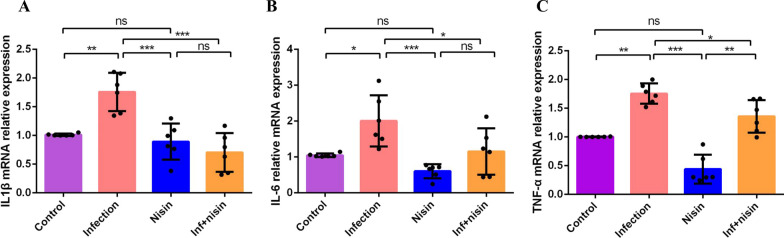
Nisin inhibits the expression of proinflammatory cytokines in the brain following oral polymicrobial infection. To evaluate the immune cytokine profiles in brain tissues, mRNA expression of IL-1β (A), IL-6 (B) and TNF-α (C) were measured by real-time PCR. The amount of mRNA in each reaction was normalized to GAPDH. Data are shown as means ± standard deviation from 6 mice per group. *, the difference between the two groups was significant (P < 0.05). **, the difference between the two groups was significant (P < 0.01). ***, the difference between the two groups was significant (P < 0.001), ns, the difference between the two groups was non-significant
Fig. 5
Fig. 5
Nisin abrogates the deposition of Aβ42, Tau, and phosphorylated Tau in the brain following oral polymicrobial infection. To evaluate the effect of nisin on modulating brain pathological changes, ELISA analysis was conducted to determine the levels of Aβ42 (A), total Tau (B) and phosphorylated Tau (C) in brain homogenates. Data are shown as means ± standard deviation from 6 mice per group. *, the difference between the two groups was significant (P < 0.05). **, the difference between the two groups was significant (P < 0.01). ***, the difference between the two groups was significant (P < 0.001), ns, the difference between the two groups was non-significant

References

    1. Eke PI, Dye BA, Wei L, Slade GD, Thornton-Evans GO, Borgnakke WS, Taylor GW, Page RC, Beck JD, Genco RJ. Update on prevalence of periodontitis in adults in the USA: NHANES 2009 to 2012. J Periodontol. 2015;86(5):611–622. doi: 10.1902/jop.2015.140520. - DOI - PMC - PubMed
    1. Di Benedetto A, Gigante I, Colucci S, Grano M. Periodontal disease: linking the primary inflammation to bone loss. Clin Dev Immunol. 2013;2013:5037554. doi: 10.1155/2013/503754. - DOI - PMC - PubMed
    1. Whitmore SE, Lamont RJ. Oral bacteria and cancer. PLoS Pathog. 2014;10(3):e1003933. doi: 10.1371/journal.ppat.1003933. - DOI - PMC - PubMed
    1. Kim J, Amar S. Periodontal disease and systemic conditions: a bidirectional relationship. Odontology. 2006;94(1):10–21. doi: 10.1007/s10266-006-0060-6. - DOI - PMC - PubMed
    1. Kapila YL. Oral health's inextricable connection to systemic health: special populations bring to bear multimodal relationships and factors connecting periodontal disease to systemic diseases and conditions. Periodontol 2000. 2021;87(1):11–16. doi: 10.1111/prd.12398. - DOI - PMC - PubMed