[Preprint]. 2023 Sep 26:2023.09.25.559370.
doi: 10.1101/2023.09.25.559370.

Tenofovir Activation is Diminished in the Brain and Liver of Creatine Kinase Brain-Type Knockout Mice

Affiliations

Tenofovir Activation is Diminished in the Brain and Liver of Creatine Kinase Brain-Type Knockout Mice

Colten D Eberhard et al. bioRxiv. .

Update in

Abstract

Tenofovir (TFV) is a nucleotide reverse transcriptase inhibitor prescribed for the treatment and prevention of human immunodeficiency virus infection, and the treatment of chronic hepatitis B virus infection. Here, we demonstrate that creatine kinase brain-type (CKB) can form tenofovir-diphosphate (TFV-DP), the pharmacologically active metabolite, in vitro, and identify nine missense mutations (C74S, R96P, S128R, R132H, R172P, R236Q, C283S, R292Q, and H296R) that diminish this activity. Additional characterization of these mutations reveal that five (R96P, R132H, R236Q, C283S, and R292Q) have ATP dephosphorylation catalytic efficiencies less than 20% of wild-type (WT), and seven (C74S, R96P, R132H, R172P, R236Q, C283S, and H296P) induce thermal instabilities. To determine the extent CKB contributes to TFV activation in vivo, we generated a CKB knockout mouse strain, Ckbtm1Nnb. Using an in vitro assay, we show that brain lysates of Ckbtm1Nnb male and female mice form 70.5% and 77.4% less TFV-DP than wild-type brain lysates of the same sex, respectively. Additionally, we observe that Ckbtm1Nnb male mice treated with tenofovir disoproxil fumarate for 14 days exhibit a 22.8% reduction in TFV activation in liver compared to wild-type male mice. Lastly, we utilize mass spectrometry-based proteomics to elucidate the impact of the knockout on the abundance of nucleotide and small molecule kinases in the brain and liver, adding to our understanding of how loss of CKB may be impacting tenofovir activation in these tissues. Together, our data suggest that disruptions in CKB may lower levels of active drug in brain and liver.

Keywords: creatine kinase brain-type; drug metabolism; knockout; mouse model; proteomics; tenofovir.


Figures
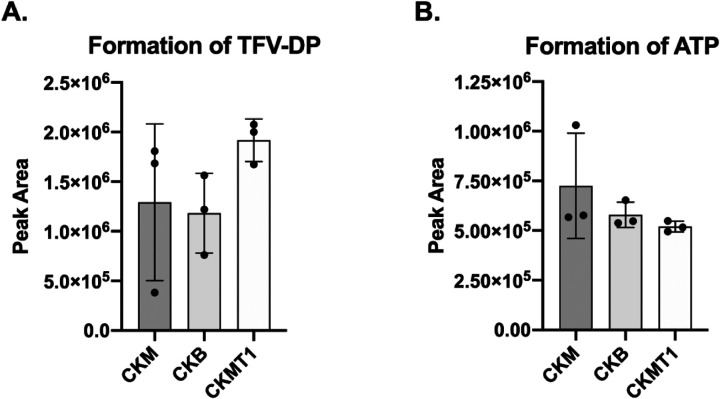
Figure 1.
Figure 1.
Cytosolic (CKM and CKB) and mitochondrial (CKMT1) creatine kinases show similar activities in the formation of (A) TFV-DP and (B) ATP. Recombinantly expressed and purified enzymes were incubated with phosphocreatine and TFV-MP or ADP. Metabolites were detected using uHPLC-MS and area under the peak curve was used to measure metabolite levels, (n=3). Error bars represent standard deviation. Statistical analyses were performed using a one-way Brown-Forsythe and Welch ANOVA with Dunnett’s multiple comparisons test. Despite trends, no comparisons were found to be significantly different.
Figure 2.
Figure 2.
In vitro activity of sixteen recombinantly expressed mutant CKB enzymes in the formation of (A) ATP and (B) TFV-DP. Phosphocreatine and reaction substrate (ADP or TFV-MP) were incubated with purified enzyme, and ATP or TFV-DP was detected using uHPLC-MS. Metabolite formation is shown normalized to the average wild-type area under the peak curve. Assays were conducted in triplicate and error bars represent standard deviation. Statistical analyses were performed using a one-way Brown-Forsythe and Welch ANOVA with Dunnett’s multiple comparisons test; P-values < 0.05*, 0.01**.
Figure 3.
Figure 3.
Differential scanning fluorimetry utilizing SYPRO orange dye reveals double peaks or shouldering of six naturally occurring mutants and the C283S negative control mutant (blue, solid) when compared to WT (black, dotted). Statistical analyses of melting temperatures (peak maxima) were performed using a one-way Brown-Forsythe and Welch ANOVA with Dunnett’s multiple comparisons test; P-values < 0.05*, 0.01**. : mutants that displayed reduced formation of TFV-DP in the in vitro activity assay, : mutants with < 20% the ATP dephosphorylation catalytic activity of WT
Figure 4.
Figure 4.
Ckb knockout mice were generated using CRISPR/Cas9. The most productive male breeder possessed two mutations on the same allele, (A) a 55 bp (base pair) (B) a 28 bp deletion, located at the guide RNA oligonucleotides target sites. mRNA extracted from brains of homozygous mice was reverse transcribed into cDNA and the first 5 exons were amplified by PCR. (C) Sanger sequencing revealed a new 3’ splice site, a new out-of-frame start codon, and the absence of any mutation-induced alternative splicing. If this transcript is translated, a protein of just 5 amino acids would be produced. (D) Genomic DNA (gDNA) was amplified by PCR and run on an agarose gel to genotype subsequent litter. (E) Using quantitative PCR, Ckb expression was determined to be significantly lower in homozygote mice (n = 7). (F) Immunoblotting for CKB shows a total loss of CKB protein in homozygote brain lysates. Statistical analyses of Ckb expression were performed on the Log(Fold Change) using an ordinary one-way ANOVA with Sidak’s multiple comparisons test; P-values < 0.05*. Lad. = ladder.
Figure 5.
Figure 5.
Tissue-specific TFV activation in wild-type (WT) and Ckbtm1Nnb (KO) mice. (A) Full brain lysates were incubated in the presence of TFV-MP, ATP, phosphocreatine, and phosphoenolpyruvate (n = 3 or 4). Formation of TFV-DP was detected using uHPLC-MS. Wild-type and KO mice were dosed orally via drinking water and TFV metabolites were extracted from harvested tissues and detected by uHPLC-MS. (B) TFV is the only metabolite present in serum and shows no change between sexes or genotypes. TFV activation (TFV-DP/TFV) was calculated for liver, colon, and kidney samples. (C) In liver, KO males and WT females have significantly lower TFV activation than WT males. (D,E) No change in TFV activation was observed in colon or kidney. Statistical analyses were performed using an ordinary one-way ANOVA with Sidak’s multiple comparisons test; P-values < 0.05*, 0.01**, 0.001***, 0.0001****.
Figure 6.
Figure 6.
Proteomic analyses of brain lysates reveal significant changes in the abundance of nucleotide and small molecule kinases. (A) Creatine kinases (Ckb, Ckm, and Ckmt1), Nme1, and Pkm are able to phosphorylate TFV-MP to TFV-DP, while Entpd1 is able to dephosphorylate TFV-DP to TFV. (B) Dtymk is a nucleotide kinase that reversibly transfers a phosphate to ATP, Pfkl and Pgk1 transfer a phosphate group from ATP to small molecules. Statistical analysis is completed using SimpliFi. P-values < 0.05*, < 0.01**, < 0.001***, < 0.0001****.
Figure 7.
Figure 7.
Proteomic analyses of liver lysates reveal significant changes in the abundance of nucleotide and small molecule kinases. (A) Adenylate kinases (Ak3 and Ak4) and pyruvate kinases (Pklr and Pkm) are able to phosphorylate TFV to TFV-MP and TFV-MP to TFV-DP, respectively. (B) Adk and Cmpk1 are nucleotide kinases that reversibly transfer a phosphate to/from ATP, while Enpp3 and Entpd5 are nucleotide phosphatases. (C) Idnk, Mvk, Pgk1, and Tkfc transfer a phosphate group from ATP to small molecules. Statistical analysis is completed using SimpliFi. P-values < 0.05*, < 0.01**, < 0.001***, < 0.0001****.

References

    1. Viread (tenofovir disoproxil fumarate) [packet insert]. Foster City, CA: Gilead Sciences, Inc; 2021.
    1. Delaney WEt Ray AS, et al. Intracellular metabolism and in vitro activity of tenofovir against hepatitis B virus. Antimicrob Agents Chemother. 2006;50(7):2471–7. - PMC - PubMed
    1. Truvada (emtricitabine/tenofovir disoproxil fumarate) [package insert]; Foster City, CA; Gilead Sciences, Inc; 2022.
    1. Descovy (emtricitabine/tenofovir alafenamide) [package insert]; Foster City, CA; Gilead Sciences, Inc; 2022.
    1. Birkus G, Wang R, et al. Cathepsin A is the major hydrolase catalyzing the intracellular hydrolysis of the antiretroviral nucleotide phosphonoamidate prodrugs GS-7340 and GS-9131. Antimicrob Agents Chemother. 2007;51(2):543–50. - PMC - PubMed

Publication types
